
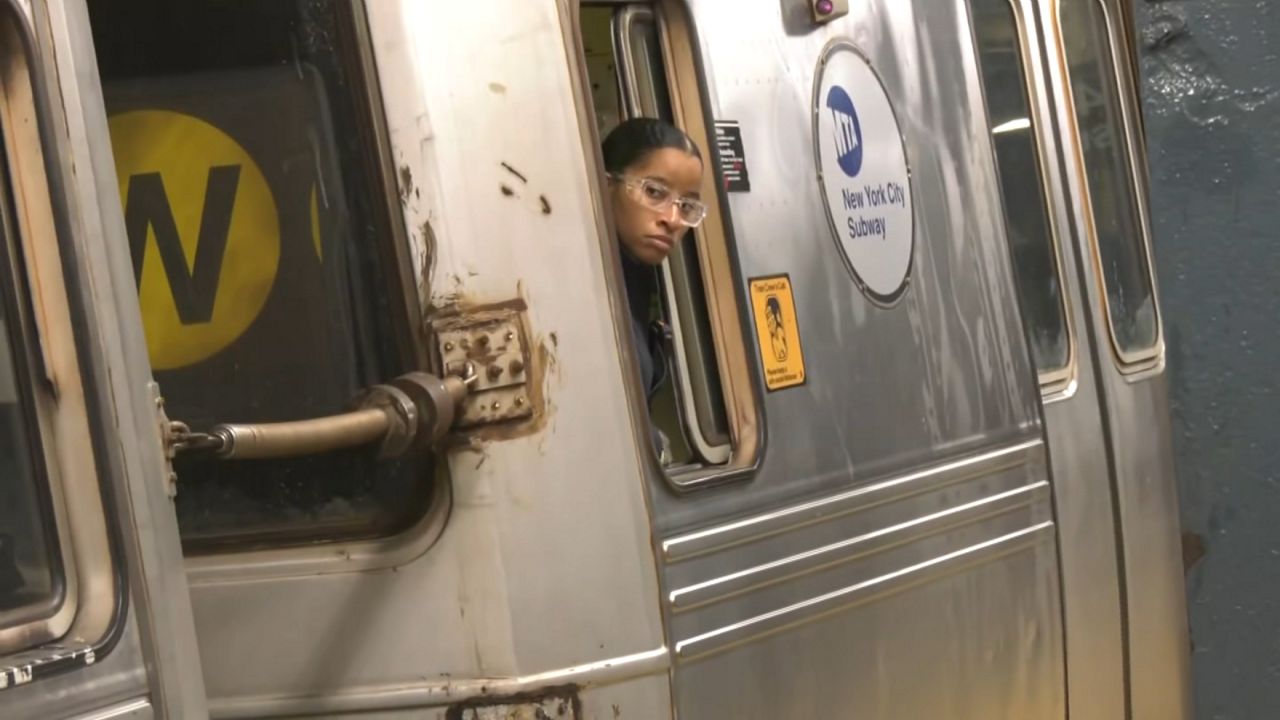
Ten-car subway trains currently have a conductor in the middle and an operator at the front, but there are five-car trains, like the Times Square Shuttle and the G at times, that only have an operator.
A bill on the governor’s desk would mandate all trains have two-person crews.
What You Need To Know
Ten-car subway trains currently have a conductor in the middle and an operator at the front, but there are five-car trains, like the Times Square Shuttle and the G at times, that only have an operator
A bill the governor must sign by the end of the year would mandate two people on every train with two cars or more, despite a report that looked at 400 train lines around the world and found 94% operated safely with one or no operator
The Citizens Budget Commission says it would cost the MTA $10 million right now, and over $400 million in the future, but the Transport Workers Union says it’s about safety
“All over the world where they run subways, the direction everyone is going in is either one operator or zero operators,” said Eric Goldwyn, an associate professor at NYU’s Marron Institute of Urban Management. “And here in New York, we’re looking at a law that would sort of enshrine two operators on any train with two cars or more.”
Goldwyn co-authored a report that looked at more than 400 individual subway and commuter rail lines in 36 cities and found about 94% use one-person train operation or OPTO, or zero-person.
Andrew Rein, president of the good government group Citizens Budget Commission, says moving to OPTO would save money the MTA could use to improve service.
“They could save $450 million a year once it’s all phased in. That would address their structural budget gap as well as provide better service,” Rein said.
He says the bill instead would cost the MTA $10 million.
The Transport Workers Union (TWU) says it is about safety. Local 100 President John Chiarello says conductors have an important job.
“They have to look and see what’s going on,” Chiarello said. “And they have to make sure when they close the doors that somebody doesn’t stick a bag in the door, someone that doesn’t stick, you know, their arm in the door or any way of them being dragged. So, from 800 feet away now, how could a train operator make that distinction?”
The MTA says operators at the front have cameras that let them see everything — but Chiarello says it’s also about emergencies where passengers must evacuate, as well as security.
“How are you possibly going to get hundreds of people out of a train safely with one person leading the way?” Chiarello said. “They’re the eyes and ears of the station as well. When they pull in, they see all types of things that could be happening. It could be a crime in progress they could radio in.”
MTA Chair and CEO Janno Lieber said on the Brian Lehrer show Tuesday that operators are not law enforcement and the bill ties the authority’s hands on better service at a lower cost.
“This is, sort of an oddball, you know, move by the legislature,” Lieber said.
In a statement to NY1, state Sen. Monica Martinez, a co-sponsor of the bill, said “A trained conductor provides on the ground coordination which no automated system can match.”
A spokesperson for the governor says Hochul is reviewing the bill.
It is a tough decision for the governor: If she does veto the bill, she could lose support from the TWU and possibly face attack ads the union is known for as she runs for reelection. However, the governor has been instrumental in fully funding the MTA.