
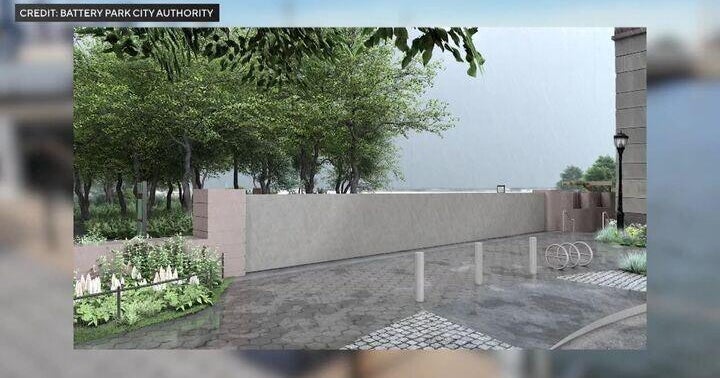
Phase 2 of the Battery Park Resiliency Project is underway, and it means a piece of public art called “Upper Room” has been eliminated in order to install flood protection.
Phase 1 of the project, which is about 95% complete, includes an overhaul of Wagner Park. Currently underway, the second phase includes three main elements: A flood wall, a pump station, and tide gates. It’s necessary because the neighborhood is built on landfill, officials say.
“We’re doing some demolition work right now on this beloved piece of public art that was here for 30 years, and what’s going to replace it is a piece of our flood protection project,” said Raju Mann, president and CEO of the Battery Park City Authority. “[The landfill] is uniquely at risk from sea level rise and storm surge and significant rain storms that we’re seeing in New York every year.”
What to know about the new flood wall
The flood wall will protect the southern end of Battery Park City to Tribeca. Along the wall, operational flood gates will keep an open flow from community to waterfront. In some cases, the gates will slide horizontally, while in others, they’ll lift out of the ground.

Currently underway, the second phase includes three main elements: A flood wall, a pump station, and tide gates.
Battery Park Resiliency Project
“We have worked really closely with the buildings and with the community to design a flood wall system and flood protection system that keeps what is so special about this neighborhood, which is access to the water and views of the water,” Mann said.
What to know about the new pump station
When rainfall overburdens the sewer system, the new pump station will reduce the strain. In addition, at least two tide gate chambers will replace what was the Upper Room, the decades-old art installation that was demolished in recent weeks to make the road to the project possible. The tide gate chambers will be invisible to New Yorkers.
“It’s the most important part that needs to work,” said Heather Fuhrman, the Battery Party City Authority’s senior vice president of design and construction.
Fuhrman said a tide gate chamber is essentially a big metal flap below the surface.
“It’s a massive piece of infrastructure that lets tide in underground, but essentially the flap allows water to flow out,” Fuhrman said.
However, it doesn’t allow water to flow from the river into the neighborhood.
Mann said efforts were made to design around Upper Room, but the authority just couldn’t figure out a way. What will ultimately take its place will be a critical piece of infrastructure in Battery Park City.
Looking forward to a “really fabulous new waterfront”
According to Mann, construction will be broken up over the next five years to ensure the neighborhood has access to open space.
“Once the project is complete, [there will be a] really fabulous new waterfront with more landscaping, more seating, more shade,” Mann said.
“I know that change is difficult and can be challenging, but the outcome of change can be really rewarding,” Fuhrman added.
And in this case, that change will protect Battery Park City and Lower Manhattan from a 100-year flood.
The resiliency project is slated for completion in 2031. The Brookfield Marina and walkways immediately surrounding it will be closed for the duration of the project.