
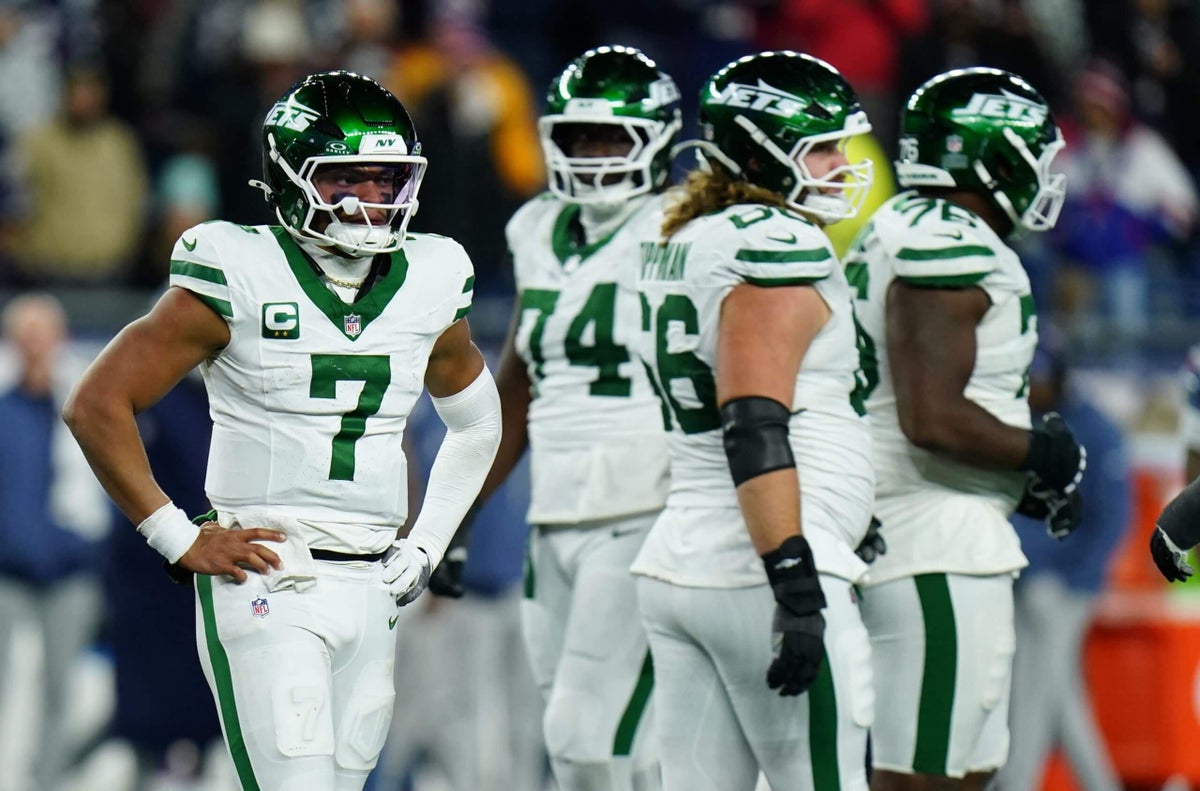
Justin Fields was on the verge of getting benched four weeks ago, but those plans were thwarted when Tyrod Taylor suffered an injury during practice. Now, it’s really happening: Fields has been benched in favor of Taylor ahead of Sunday’s game against the Ravens in Baltimore.
It was the prudent move for a Jets coaching staff in evaluation mode. Coach Aaron Glenn and general manager Darren Mougey need to figure out what players on the roster currently can be counted on to play key roles next year, particularly on offense. Fields — who has thrown for fewer than 100 yards four times in nine starts — was working counter to that goal.
Taylor is flawed, too, but he can be trusted to take more shots downfield and distribute the ball better to the Jets’ young pass catchers: wide receivers Adonai Mitchell, John Metchie, Arian Smith, Isaiah Williams and tight end Mason Taylor.
It was easy to understand why the Jets wanted to resurrect Fields. Ultimately, Fields is who he always was: an athletically gifted quarterback who struggles with processing and accuracy. The Jets might have overpaid him ($40 million over two years, $30 million guaranteed), but he still only ranks 20th in APY and his contract won’t hamstring the Jets in future years. It won’t be a long-lasting mistake.
Now the question becomes how to handle Fields going forward — for the rest of this season and next offseason, when the Jets are still on the hook to pay him the remaining $10 million guaranteed.
What to do in the final 7 weeksOption A: Fields backs up Taylor.
In 2022, the Jets benched Zach Wilson after a terrible game against the Patriots (sound familiar?) and demoted him to third string, elevating Mike White to starter and putting Joe Flacco at No. 2. The idea was to let Wilson develop in the background without the threat of playing. (Of course, both White and Flacco suffered injuries, forcing Wilson back into the lineup anyway.)
This situation is a little different. Fields doesn’t have a future with the Jets, and — unlike Wilson — is not a young quarterback they recently drafted second overall. Fields is in his fifth season and, if anything, has regressed from the start of his career — some work off to the side won’t accomplish much for the Jets’ long-term. It also doesn’t make much sense to leave the door open for Fields to play again this season.
Option B: Fields is QB3, with rookie Brady Cook elevated to No. 2.
Taylor, of course, also isn’t a long-term option at quarterback and isn’t even under contract for 2026. At this point the Jets would be smart to see what they have in undrafted rookie Brady Cook, who is on the practice squad. Elevating Cook to No. 2 would create the possibility that the rookie plays if Taylor gets hurt again.
Another option would be adding somebody not currently in the building — they worked out Desmond Ridder and Dorian Thompson-Robinson earlier this season — but Cook showed intriguing flashes in training camp, and it’s worth seeing if he can be developed into a usable backup.
It’s unclear if the Jets intend to simply demote Fields to No. 2 or 3; Glenn isn’t scheduled to speak to the media again until Wednesday.
What to do in the offseasonOption A: Release Fields.
There are a few different paths the Jets can take, and answer to what they should do depends on how Mougey and Glenn plan to approach the NFL Draft when it comes to quarterback. It’s hard to project since, as of now, it seems only two quarterbacks with high first-round grades — Indiana’s Fernando Mendoza and Alabama’s Ty Simpson — are expected to declare for the draft, and nobody yet knows what the Jets think of them or any other prospects.
Releasing Fields feels like the most likely outcome, even with the financial issues attached to that. If the Jets release him, they could prioritize eating his dead money in one fell swoop ($22 million dead cap, $1 million savings if he’s released before June 1). Or they can designate him a post-June 1 release, which would spread the dead cap hit out over multiple years and provide more cap savings ($13 million dead cap in 2026, $10 million savings).
The Jets are not short on cap space in 2026 (Over the Cap currently estimates them with $99 million in 2026 cap space), so eating it all at once might be the way to go. Though the Jets weren’t starved for cap space this past offseason and opted to spread out Aaron Rodgers’ dead cap post-June 1 when he was released — that might be standard operating procedure for Mougey.
Something that will be mentioned a lot this offseason: If the Jets release Fields pre-June 1 this offseason, that will mean they will be paying Fields and Rodgers a combined $57 million in 2026 to not play for them. That’s not nothing, but I don’t think it will ultimately be a deterrent from moving on if the Jets do decide to go that route.
Option B: Trade Fields.
This seems unlikely since there presumably won’t be much interest, though he could be an intriguing No. 2 for teams with a mobile starting quarterback (Ravens, Eagles, Commanders). If the Jets did convince someone to take him, they’d save $11 million and incur $12 million in dead cap.
Option C: Keep Fields as a bridge for a rookie.
The previous Jets regime admitted they made a mistake by drafting Wilson and handed him the starting job without competition. (An argument can be made that the Jets made a similar mistake when they handed Fields the starting job this year.) It’s imperative they don’t make the same mistake again — even if they believe the guy they’re drafting can step in on Day 1.
The question is whether Fields is the right man to be that bridge. He is, by all accounts, a quality person and teammate, but he’s not someone who should be tasked with mentoring a rookie. He is in his fifth year and, in a lot of ways, still plays like a rookie. The processing issues that plagued him in Chicago are still present and he’s thrown the ball worse in 2025 than at any other point in his career.
If Fields is going to be a backup for the Jets, it should not be behind a rookie. The Jets need someone more proven as a passer in that role.
Option D: Keep Fields as training-camp competition.
As mentioned, there is a feeling that there could be just two high-level quarterback prospects in the draft. That can obviously change (Jaxson Dart wasn’t viewed as a first-round pick at this point last year). The Jets would have to land a top-five pick to get one of those two top-end prospects. As of now, Tankathon projects the Jets for the No. 5 pick — ahead of them, the Browns and Saints need quarterbacks. Immediately behind them, the Raiders could be looking for one too.
There’s also the possibility that the Jets don’t fall in love with any of the 2026 quarterback prospects.
If one or both of those outcomes — the Jets fall too far down the draft order or don’t like these prospects — play out, the Jets will turn their attention to the 2027 draft. It’s a risky proposition for any regime to keep kicking the bucket down the road at quarterback, but if they do that, it means they’ll need someone to play quarterback for them in 2026. If they don’t want to break the bank, options would include the likes of Gardner Minshew, Flacco, Malik Willis, Mitchell Trubisky, Kenny Pickett and Carson Wentz, —none of whom should be anyone’s full-time starter at this point. Same goes for if the Jets decided to try for another lottery ticket by trading for someone like Anthony Richardson (Colts) or Will Levis (Titans).
In the draft, even if the Jets don’t pick a QB with their first pick, it’s conceivable they’d take a flier on a Dart-type prospect later in the first round (the Colts pick the own will likely fall in the 20’s) or after Day 1.
In those scenarios, Fields could be part of a wholly uninspiring quarterback competition.
Option E: Keep Fields as the No. 2 for a veteran QB.
This falls into the bucket where the Jets either kick the can down the road by playing a serviceable quarterback in 2026 and targeting one in the draft in 2027 — or going all-in now on trading for a notable veteran quarterback, though it’s too early to speculate just yet on who that might be (check back in the coming weeks).
On the lower end — quarterbacks who can play well enough in 2026 and belong ahead of Fields on any depth chart — that would include options like Marcus Mariota and Jimmy Garoppolo in free agency. On the trade market: Mac Jones — having a renaissance of sorts in San Francisco — would be an intriguing option, as would young Eagles quarterback Tanner McKee and Texans quarterback Davis Mills. On the mid-tier veteran side: Arizona’s Jacoby Brissett and the Giants’ Jameis Winston.
Cardinals quarterback Kyler Murray is a name that will be floated this offseason but that doesn’t seem like a great fit unless he’s released and is willing to sign a prove-it deal in free agency.
Fields would be perfectly adequate as a No. 2 option behind any of those players for one more season if the Jets decided they didn’t want to move on from him. Ultimately, though, the Jets should be thinking about moving on from Fields and revamping their quarterback room entirely.