
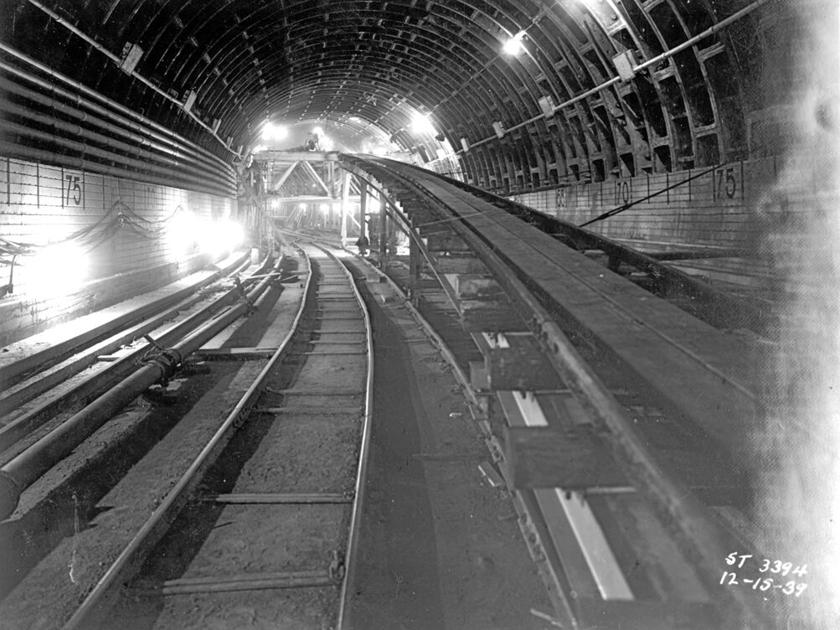
Most people in the borough had not been born when the Queens-Midtown Tunnel opened to drivers on Nov. 15, 1940.
And now the Metropolitan Transportation Authority has decided to throw a sort of anniversary party.
Nellie Hankins, manager of the MTA’s bridges and tunnels historical archives, said the route all take for granted today was a massive — and popular — undertaking.
“It was first proposed by the Manhattan borough president in the 1920s,” Hankins told the Chronicle. The Holland tunnel was under construction but hadn’t been completed The idea was to build a tunnel from Midtown Manhattan into Queens.”
Hankins said there also was talk of other projects, such as a tunnel beneath Manhattan directly to New Jersey.
“That didn’t come to fruition,” she said.
The Queens-Midtown’s groundbreaking in 1936 was a huge deal, Hankins said.
“FDR was there,” she said of the president. “People were really excited about the scope of it. And New Jersey was getting all their infrastructure. People thought Long Island should as well.”
It took some doing. New York City began the project but then ran out of money. The state came in and took over. President Roosevelt came through with some New Deal money, securing not only an important project, but work for thousands of people who needed it in the throes of the Great Depression.
Hankins said there were an estimated 18 million work hours put into the actual construction, and twice that number in related jobs for manufacturing, shipping and even secretarial work.
It was designed by Ole Singstad, who also worked on the Holland, Lincoln and Brooklyn-Battery tunnels among others.
While not an eye-popping engineering marvel like say, the Brooklyn Bridge, Hankins said it still was a massive undertaking.
“It wasn’t groundbreaking engineering — pun intended — but he knew what he was doing and he did it well,” Hankins said.
As to the opposition that would spring up against any such project today, Hankins said it was a different time.
“People were excited about it,” she said. “Newspapers were excited about it.” So too, of course, were the New York City Chamber of Commerce and other business and civic groups.
The Long Island Rail Road had a few gripes — Hankins said the massive rail yards presently adjacent to the Queens end are exactly where they were in 1936.
She said the Queens side had been light industrial and manufacturing, with low-rise housing and the accompanying stores, taverns and barbershops.
“They were really careful about what they disrupted,” Hankins said. “Moving people and businesses is expensive.” Hankins said the MTA still has the building-by-building photographs employees took of surrounding neighborhoods in preparation.
And almost as soon as it opened with four million cars the first year, came World War II with gas rationing, rubber shortages and Detroit switching to making tanks.
There also were worries about sabotage.
“When World War II stopped, it picked up again,” Hankins said.
She said the tunnel would prove to increase population, business and even access to Long Island’s recreational facilities.
“The contributions were over time, I think a little more gradual than people realize.”