
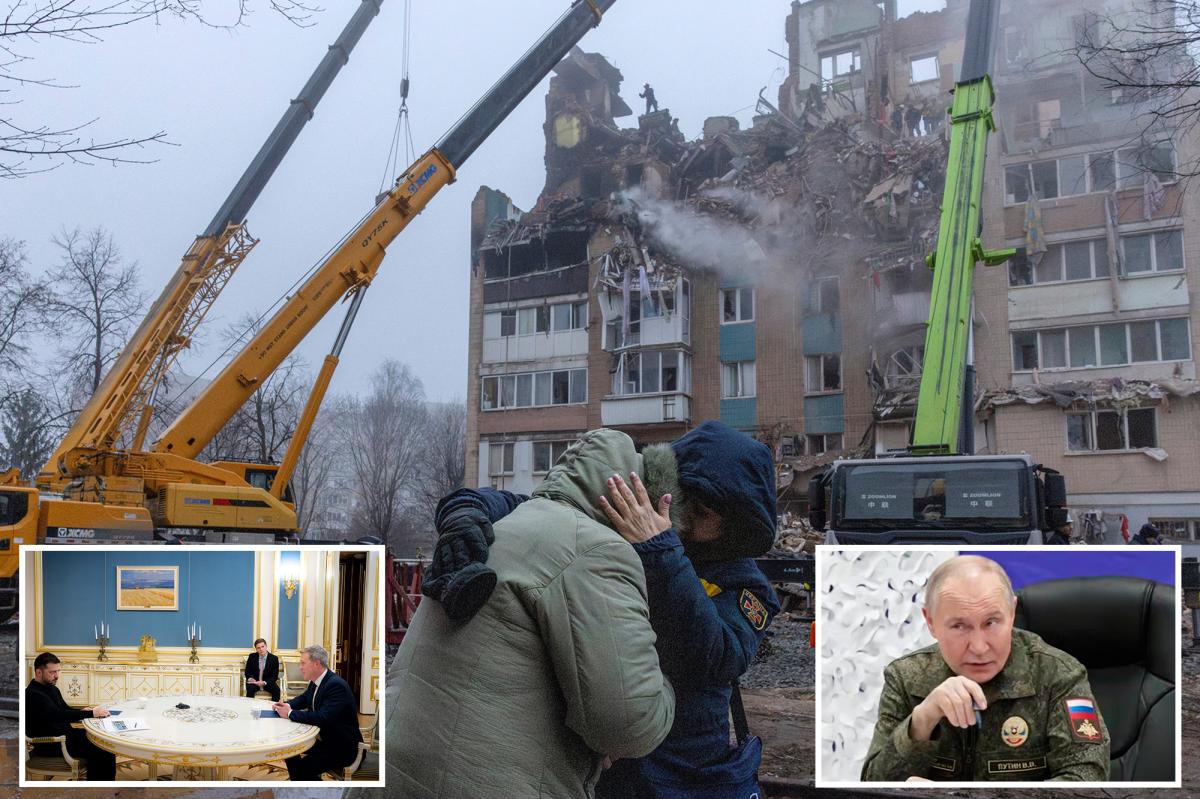
WASHINGTON — The US’ sweeping 28-point blueprint to end the nearly four-year war between Russia and Ukraine proposes territorial freezes, troop caps, economic reintegration for Moscow, and a future “Peace Council” chaired by President Donald Trump, senior US officials confirmed exclusively to The Post.
The plan, which Kyiv and Moscow have not publicly accepted, outlines the most detailed picture yet of what Washington foresees as a way to end the war — and was built on weeks of US Special Envoy Steve Witkoff’s consultations with both the Russians and Ukrainians, the officials said.
The officials said they received “positive feedback” from Ukraine’s Secretary of the National Security and Defense Council Rustem Umerov during discussions with Witkoff in Miami in recent weeks, but stopped short of saying Kyiv signed off on the deal.
US officials have received positive feedback from Ukraine’s leaders. AP
“The plan was drawn up immediately following discussions with one of the most senior members of Zelensky’s administration, Umerov,” one of the officials said. “So Umerov agreed to the majority of this plan, and he made several modifications to it, which we included and presented it to President Zelensky.”
“I don’t want to say that [Kyiv] full-heartedly … agreed to it and they’re ready to sign off. They agreed to the majority of the plan,” the person added.
Zelensky acknowledged the American “vision” to end the war in a social media post on Thursday and said work is ahead.
“We agreed that our teams will work on the points to ensure it’s all genuine,” Zelensky said. “We’re geared up for clear and honest work—Ukraine, the U.S., our European and global partners.”
Millions have been displaced, injured, and killed in the war. REUTERS
At its core, the proposal affirms Ukraine’s right to remain a separate nation from Russia — but also cements major concessions.
Under the plan, the US would recognize the entire Donbas — including areas Moscow has been unable to capture in more than 11 years of war — as Russian. Regions of Kherson and Zaporizhzhia would remain frozen along battle lines, effectively turning front-line trenches into internationally acknowledged borders.
Ukrainian forces would also withdraw from territory they still hold in Donetsk, carving out a neutral, demilitarized buffer zone that Russia would be barred from entering.
A plan has been put into place to end the war though neither side has publicly accepted the agreement.
In exchange, the US would orchestrate a web of security guarantees designed to deter further Russian aggression — but with strict conditions. Washington would respond decisively if Russia reinvaded Ukraine, reinstating global sanctions and voiding any benefits Moscow receives under the agreement.
But the guarantees evaporate if Ukraine fires missiles at Moscow or St. Petersburg “without cause” or if it attacks Russian territory.
The plan also commits Ukraine to limit its armed forces to 600,000 troops, enshrine permanent neutrality by pledging never to join NATO and codifying that ban in its own charter. NATO, in turn, would have to promise not to station troops in Ukraine — though European fighter jets would be based in neighboring Poland.
The document also proposed a US-mediated Russia-NATO dialogue, massive reconstruction programs for Ukraine, and even a path for Moscow’s return to global respectability — including rejoining the G8 and entering long-term economic cooperation agreements with Washington in sectors ranging from energy and rare-earth mining to AI and data centers.
If approved, Ukraine will still be a separate nation from Russia. AP
The plan also addresses frozen Russian assets, calling for $100 billion in seized Russian funds to be pumped into US-led Ukraine reconstruction projects — with Washington pocketing 50% of the profits. Europe would match the investment with its own $100 billion while unfreezing remaining Russian funds for joint US-Russian ventures aimed at “strengthening relations.”
Ukraine would also secure early access to EU markets while Brussels considers its membership bid.
On the humanitarian front, the plan mandates an “all-for-all” exchange of prisoners and civilian hostages — including abducted Ukrainian children — along with family reunifications and victim-support efforts.
Part of the concessions made include the US recognizing Donbas, while Kherson and Zaporizhzhia would remain frozen along the battle lines. AP
One of the most politically explosive provisions calls for full amnesty for all parties involved in wartime actions, eliminating any future legal claims over battlefield conduct.
That item, one of the senior White House officials said, was proposed by Kyiv.
It had previously stated that “Ukraine will conduct a full audit of all aid received and create a legal mechanism to recover any errors found and punish those who illegally profiteered from the war,” the person said.
Ukraine would be also required to hold elections within 100 days of the agreement taking effect, as elections have been barred by the Ukrainian constitution due to the declaration of martial law for wartime.
Ukraine also called for full amnesty for all parties involved in wartime actions. AFP via Getty Images
The entire plan would be enforced by a new peace council headed by Trump, whose role would include imposing sanctions for violations and ensuring both sides retreat to agreed lines before the ceasefire begins.
Russia, for its part, would have to codify a legal policy of non-aggression against both Ukraine and Europe and recommit to nuclear non-proliferation treaties. Ukraine would reaffirm its status as a non-nuclear state.
In a rare gesture of shared control, the Zaporizhzhia nuclear plant — Europe’s largest — would be restarted under IAEA oversight, with electricity split 50-50 between Russia and Ukraine.
Start your day with all you need to know
Morning Report delivers the latest news, videos, photos and more.
Thanks for signing up!
Both governments would also pledge sweeping cultural-tolerance programs aimed at reducing ethnic tensions and eliminating discrimination — including bans on Nazi ideology and protections for linguistic minorities and media. The plan’s authors claim that once all parties sign on, the ceasefire would take effect immediately.
Kyiv has not publicly endorsed the proposal — and the Kremlin has similarly kept quiet — but the document represents the most ambitious US attempt to date to map out an endgame for the war that has redrawn Europe’s borders and triggered the largest land conflict since World War II.
On Wednesday night, Secretary of State Marco Rubio appeared to deny that the US had decided to push the peace plan on Ukraine, becoming the first Trump administration official to publicly temper expectations on a reported deal that would gut Kyiv’s defense force and give up land to Russia.
“Ending a complex and deadly war such as the one in Ukraine requires an extensive exchange of serious and realistic ideas. And achieving a durable peace will require both sides to agree to difficult but necessary concessions,” he wrote in a cryptic post to X. “That is why we are and will continue to develop a list of potential ideas for ending this war based on input from both sides of this conflict.”
The comment came after Axios on Tuesday reported a deal had been reached, citing Putin henchman Kirill Dmitriev, who claimed he worked on the plan with Witkoff.
Senior US officials believe Dmitriev leaked the plan to Axios as a way to put their “their POV out there first [because] it seemed like they were winning,” one of the officials said. “This is just a tit for tat. Always has been.”
Witkoff appeared to have surmised the same in a quickly deleted post to X in response to the article Tuesday night.
“He must have got this from K,” Witkoff wrote of the Axios author, Barak Ravid — apparently meaning to send it as a DM referring to Dmitriev by his first initial.