
On a late Friday afternoon in September, in the Morrisania section of the Bronx, two boys kicked a flat basketball back and forth over a basement grate on Prospect Avenue. Around the corner on East 163rd Street, a Bx6 bus hissed as it lowered to the curb in front of a three-story brick building with a faded red awning that read, “Johnson Bar-B-Q; Open Since 1954.” The owner of Johnson’s, Dwayne Johnson — son of the late founders, James and Pauline — sat in front of a window filled with spider plants, sporting short grey hair and a grey mustache, and wearing a grey T-shirt over a lean frame.
“Back for more?” he said, and followed me inside.
This was my third visit in as many weeks. After I ordered mac and cheese and fried chicken, I told him I’d been reading about interesting Morrisanians. He quietly walked to the back kitchen without commenting.
Laminated family pictures covered the kitchen door. In one, James, in a white T-shirt, long sideburns, and a short afro, looks forward, smirking, while Pauline stands behind him. She’s pretty, smiling widely, seemingly at something he said.
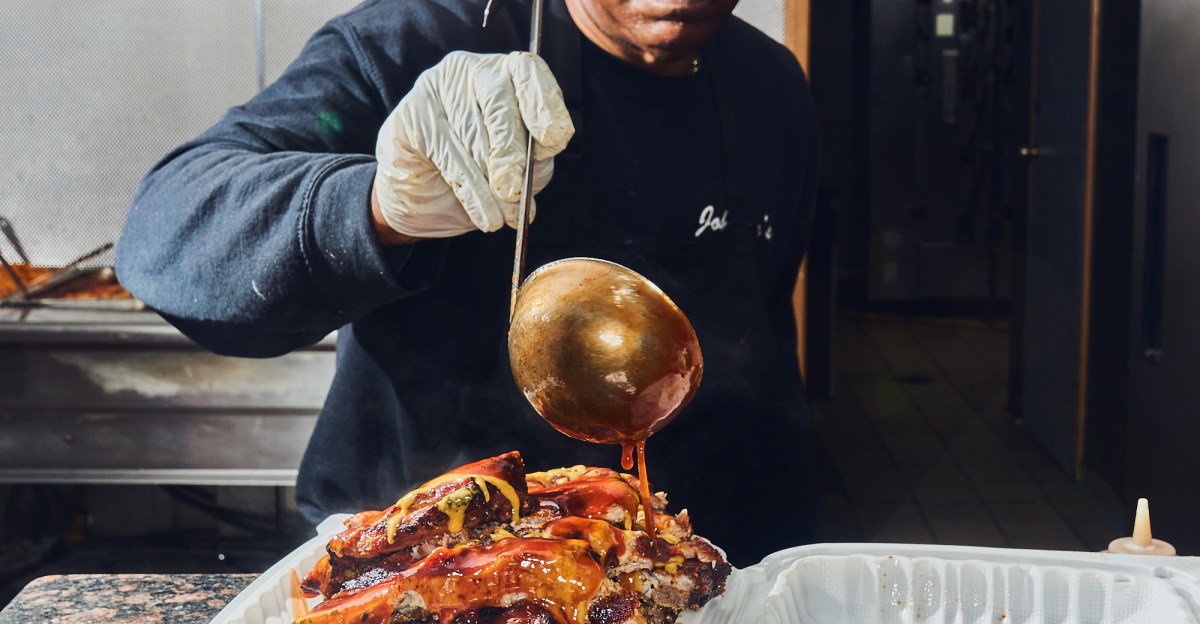
The lobby of the takeout restaurant is small. There are no tables: just a TV and two chairs that aren’t for customers. On an earlier visit, I ate my ribs on a bench at an empty basketball court at the nearby McKinley housing projects. The ribs had a crisp bark, were chewy in spots, tender in others, but not falling off the bone. Johnson had spooned a ladle of red sauce over them, then the tangy mustard sauce — “Carolina Gold” as it’s called in South Carolina — but not in Morrisania. Delicious.
“A lot of great people came from this neighborhood,” Johnson said as he returned from the kitchen. “Watch the chicken!” he yelled to a cook, as he motioned for me to follow him outside. We walked to the edge of the sidewalk.
Johnson said, “My father stood me here when I was eight and asked, ‘What do you see?’ I said, ‘I don’t know, a bunch of alcoholics and dope fiends?’ My dad said, ‘No, stupid! I see 11 Black-owned businesses, and 11 Black-owned properties on one block.’”
Johnson is 68, so that would have happened in 1965. He pointed at another three-story building across the street.

Dwayne Johnson out front of his restaurant. Scott Semler
“That was a bakery, Mr. Hope’s,” he said. He began spinning and pausing with his arm out, like a clock’s second hand. “That was Ms. Mary’s beauty parlor. That was Dr. Rawland’s office. There was a hardware store. That was my uncle’s liquor store. That was a barber shop.” He continued until he landed back at Johnson’s, the only business left from that time.
The Morrisania that Johnson’s parents settled in toward the late ’40s and early ’50s was, according to a 1951 issue of the African American magazine Our World, “a place of hope and unlimited possibilities.” On an evening stroll, you could walk by Colin Powell’s school, Morris High School, and Thelonious Monk’s house. Visitors could slide into clubs like the 845 or Sylvia’s Blue Morocco, where Miles Davis, Charlie Parker, Tito Puente, Mongo Santamaría, and other burgeoning icons played jazz, mambo, pachanga, boogaloo, doo-wop, or calypso.
Outside, groups like the Chantels would sing dreamy harmonies on street corners while dapper numbers-runners hopped out of chrome-framed New Yorkers to take bets from checkers players on the sidewalk. Spaldeen balls bounded off broomsticks during stickball games into the evening, until neighbors told each other’s kids to go inside for their respective dinners: chitlins, curried goat, arroz con pollo, and gefilte fish.
Morrisania, a base for union activity and left-wing activism, was more welcoming and integrated than the rest of the borough, but landlords only selectively accepted Black families. Postal workers and Pullman porters had better shots at a lease. James Johnson was a Pullman porter when he arrived from Sumter, South Carolina. After finding an apartment on East 163rd, he met Pauline. She came from a family of cooks in Virginia, and he came from a Gullah Geechee family, with a deep home-cooking tradition.
Pauline moved in, and soon after, they purchased the current storefront space from their landlord for $3,800. James left his job, and the pair quickly established their food as a staple of the neighborhood: fried chicken, black-eyed peas, macaroni and cheese, collard greens, and, above all, ribs doused in tangy mustard sauce. They frequently traveled to a family farm in Accomac, Virginia, for fresh pecans, yams, watermelons, and more, so they could prepare food that was fresh and familiar for the many Black families arriving in New York from the Southeast, all following a well-established route of the Great Migration.
Dwayne was born near the beginning of Johnson’s barbecue story, but his earliest memories are of the 1960s, when he began seeing those “alcoholics and dope fiends.”
He told me, “The drugs were always here.” Indeed, heroin arrived in the ’40s, and the teen gangs were around even longer. But in the 1960s, the new Cross Bronx Expressway displaced thousands; over 600 factories left the city between 1958 and 1974, and white flight pulled over 400,000 away from the Bronx in a decade. In all, the South Bronx lost more than 60 percent of its population between 1950 and 1980.

A regular customer at Johnson’s. Scott Semler
By the 1970s, building fires — about 40 a day — raged, due to disinvestment, arson, and neglect by landlords and the government; the city closed Bronx firehouses and subway stops right at the peak of the crisis and the Bronx lost 80 percent of residences.
Hetty Fox, an neighborhood activist who contributed to Fordham professor Mark Naisson’s Bronx African American History Project, recalled leaving town and returning as a young adult to find the building where she safely spent idyllic summer nights on the fire escape in her pajamas burnt to the ground. She said, “It was like an angel of death with a sword, moving from Vyse Avenue and slowly creeping up the hill.”
Back in front of Johnson’s, Dwayne continued, “Things were bad, but the Nation of Islam and the Black Panthers were on every street corner, telling people to buy Black, and open businesses. Have you heard of Hilton White? Hilton White was a god. He got dozens of people off drugs through basketball. Even the drug dealers were paying people’s rent. Not just once or twice, but every month for dozens of people.” He said of the fires, “Nobody ever fucked with us. That’s the type of respect my father had.” James Johnson was a fixture in the neighborhood, famous not just for his food, but for his all-night checkers tournaments.
James invested his restaurant earnings in real estate. The family was well-positioned to leave, but they stayed. Johnson said, “My mother told me, ‘Who would we be, if we didn’t support the community that gave to us?’”
As we spoke, a cook brought out a plastic bag with my food and passed it to Johnson. I realized I might have to sacrifice the crispness of the chicken skin for the sake of the interview; he was going to hold the bag until we were done.
In all the literature about Morrisania from those years, Johnson’s Bar-B-Q is the only restaurant that appears frequently. Thanks to it, mustard sauce has become as much a part of Morrisania culture as South Carolina culture. A former neighborhood resident, Quincy Brathwaite, recalled, “I was watching a movie at the RKO Theatre when I was 11, in 1974. Somebody was eating chicken inside and somebody else yelled, ‘Y’all smell that?’ A man called out, ‘That’s Johnson’s,’ and everyone laughed.”
Johnson’s partner needed help inside. He passed me my bag of chicken and told me to walk down to “23,” officially known as Behagen Playground, where hip-hop pioneer Grandmaster Flash used to throw hip-hop jams.
I walked down Tinton Avenue alongside the Forest Houses until I reached “23.” Six boys played basketball on a submerged court in the fading sunlight. Dembow music played from a smart speaker on the concrete amphitheater benches. I sat at picnic tables behind the court next to a baseball field fence.

Dwayne Johnson at the buffet station, packing food.
An adjacent table was occupied by two women in their 30s. They were sharing a traditional joint (not the wax pens of the new generation of marijuana smokers). I acknowledged this, and they laughed. It turned out they were great-granddaughters of the late Eleanor Bumpurs, who was famously killed by a police officer when she was 66 in 1984. Bumpurs was immortalized in an Audre Lorde poem and in the credits of Spike Lee’s Do the Right Thing.
I opened my container of chicken over mac and cheese. Eleanor’s namesake called out, “That’s Johnson’s.”
I nodded as I took my first bite. To my surprise, the chicken, fried as a half bird and cleaved into rough sections, remained crisp. The skin didn’t shatter, however. There was moisture and air pockets, so each bite had delightful crackle, pull, and chew. The meat was hot, moist, and tender. It separated easily from the bone, and the mustard sauce was a perfect tangy complement. The mac and cheese was good, too — little elbows and a crisped cheesy topping — but the chicken was extraordinary.
Dwayne Johnson took over the restaurant from his parents in 1986 and didn’t miss a beat. The community has always centered art and activism. In Morrisania’s worst times, the inheritors of jazz and Latin traditions created a music and art culture as vibrant as their parents’ and grandparents’ doo-wop and bebop. Johnson fed the movement, beginning with hip-hop’s creator, Kool Herc, who still comes regularly. Rapper Fat Joe along with others like Showbiz and Lord Finesse, grew up in the Forest Houses and was raised on Johnson’s.
This summer, Joe told Jadakiss on their shared podcast, “They got the motherfuckin’ mustard sauce from down South… DJ SNS looks like he eats there every day; wherever he DJs, you can see the mustard stain on his shoulder.”
Johnson continues to cook for Old Timers’ Day each year (unrelated to the one at Yankee Stadium), preparing upwards of 140 hotel pans of chicken, ribs, black-eyed peas, and more, still, as always, for free. He told me that as many as 7,000 people come out to celebrate the neighborhood. He also cooks for the Bronx Graffiti and Street Jam yearly on Juneteenth.

Scott Semler
The restaurant, maybe the last Black-owned business on the block, has never been in danger of closing, not during the fires or the COVID-19 pandemic lockdowns, because the family behind it has been an eager participant in every phase and facet of neighborhood life.
Decades ago, Johnson inherited the building from his parents. He also owns a rental property, and a house in Westchester, but from the looks of it, he’s never at the latter. On my first visit, he told me, “I’m from the South Bronx. This is the place I love, it will always be my home.” Johnson’s daughter, Stacia, is a seventh-grade special-education teacher, but she seems poised to take over when the time comes.
The sun was setting in the park, and I said goodbye to the Bumpurs. Walking toward Johnson’s Bar-B-Q on my way back to the train station, I saw Johnson slumped in his chair by the dim light of the restaurant window. As I approached to compliment the chicken, he said, “You’re still here?”
A man sat next to him in a motorized wheelchair, wearing oxygen tubes and a crisp black “McKinley Houses Day 2025” hat. He was the McKinley House tenant manager of 50 years, Wallace Diamond. The leaves of a honey locust shook overhead like a baby’s rattle as the two men sat quietly chatting. I couldn’t hear them, but from the way they took turns making statements and nodding, it looked like they were discussing plans.