
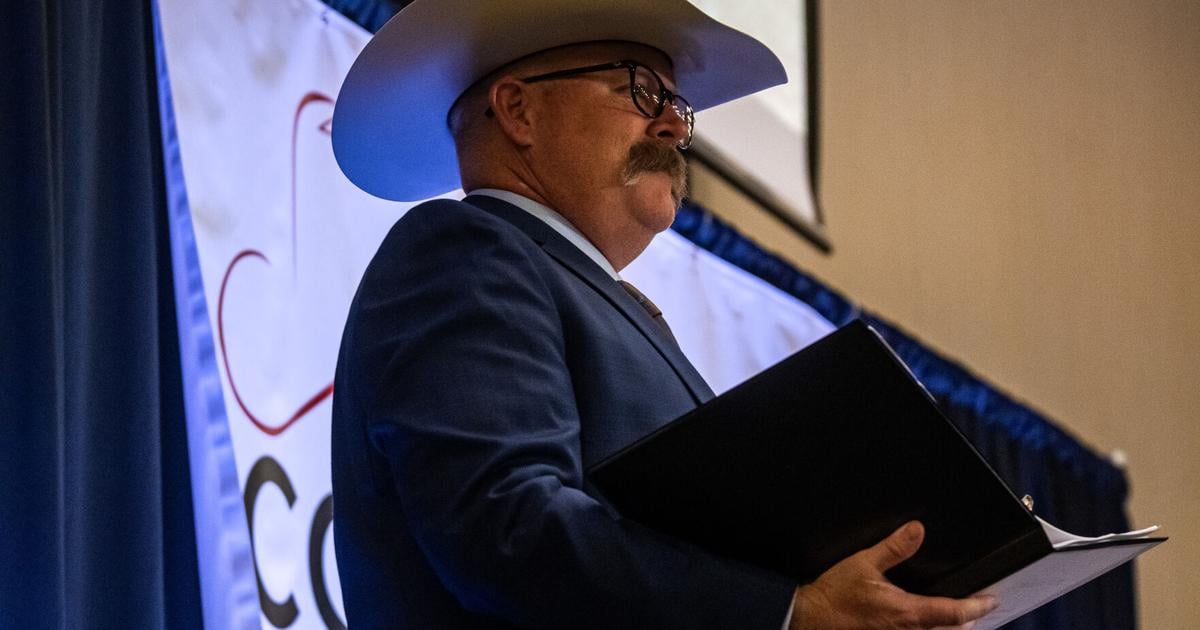
The Kansas Livestock Association wrapped up its yearly convention Friday after swearing in its new president and approving two new policies.
The event was Wednesday through Saturday at the Manhattan Convention Center and Hilton Garden Inn. Last year, its 130th anniversary, KLA had its convention in Manhattan for the first time.
Ty Breeden, a 2003 Kansas State University graduate and Quinter, Kansas, native, began his year-long term as KLA president on the final day of the conference. Members selected Jeff George, a cattle feeder from Garden City, as next year’s president-elect.
“Last year was our first year in Manhattan, so we had a really big boost, but we stayed strong this year,” Breeden said. “It’s great for me to bring my family back here and reconnect with some old friends. So Manhattan has been a good move for KLA.”
Breeden said the convention will remain in Manhattan next year.
Troy Sander, 2024-25 KLA president, said this week on Within Reason with Mike Matson that KLA assists its members through policy and national lobbying.
“So what we try to do is, you know, take all the voices of our members, of our livestock and ag producers across the state, and listen to them, listen to their concerns, listen to their issues,” Sander said. “And we take all that, put it together, develop some policy and help them solve those issues or provide support to them — or perhaps, when there’s lobbying to needs to be done at the state or national level, we have the ability, we have the experience, we have the people in place to do that for them.”
“Value-Based Conservation,” the first policy resolution approved this week, “supports market-based payment rates for participation in voluntary conservation programs.” The policy is intended to combat the loss of intact grasslands in the Great Plains and under-compensation for ranchers who make significant conservation efforts.
“Basically, if people want to participate voluntarily in conservation programs, we have policy on the books that if something comes up, that allows our staff to then have a position on that,” Breeden said. “As stewards of the land, conservation is always a high priority for us.”
Through this policy, KLA will support higher technical assistance payment rates and expanded access to private technical service providers associated with programs administered by the United States Department of Agriculture.
The second policy, “Dairy Checkoff,” expresses support for the Dairy Promotion and Research Program (National Dairy Checkoff) and the Kansas Dairy Checkoff. Dairy checkoff programs are industry-funded marketing and research programs that support dairy demand and fund research to benefit dairy farmers.
The policy requests that administrators of the dairy checkoff programs produce regular reports that are accessible to Kansas dairy producers, allowing them “to understand the financial position of the checkoffs and the effectiveness of checkoff-administered programs.”
It also requests the Kansas Dairy Checkoff maintain “an efficient, user-friendly refund process” for dairy producers that choose that route.
KLA has over 5,600 members. Breeden said his goal is to energize the association’s membership base while expanding its reach.
“We have a tremendous amount of members,” he said. “We have members from all ages … I want people to participate. I wish everybody knew how important it was to show up and share what is important to you. If you don’t show up, your voice can’t be heard. I’ve always had an interest in and fondness for Theodore Roosevelt, and there’s a quote that Theodore Roosevelt says that ‘Complaining about a problem without posing a solution is called whining.’ So show up, participate, bring good ideas and bring solutions, and we can make this industry the strongest it’s ever been.”
The U.S. recently chose to halt imports of feeder cattle from Mexico after confirmed cases of New World screwworm in Central America and Mexico.
“In the last year, if you think back to some of the challenges that we’ve had, we’ve worked through announcements of avian influenza, we’ve worked through announcements regarding New World screwworm, we’ve worked through some of the social media comments that have affected the cattle markets,” Breeden said. “We’re going to have to continue dealing with those. As far as New World screwworm, that’s going to be an ongoing, ongoing process for several years to come.”
Breeden said another challenge often present in agriculture is inaccuracies spread on social media.
“A goal of mine is to start working toward factual, science-based information on all the social media outlets,” he said.
“Whether it’s Facebook or Twitter, there’s so much noise out there, and I don’t think we want to get down in the weeds where emotions and opinions go back and forth and people have a lot of anger and conflict with each other. We want to make sure that as an association, we’re reaching members how they receive their news, or how they participate with other people on social media. And we want to put out factual information.”