
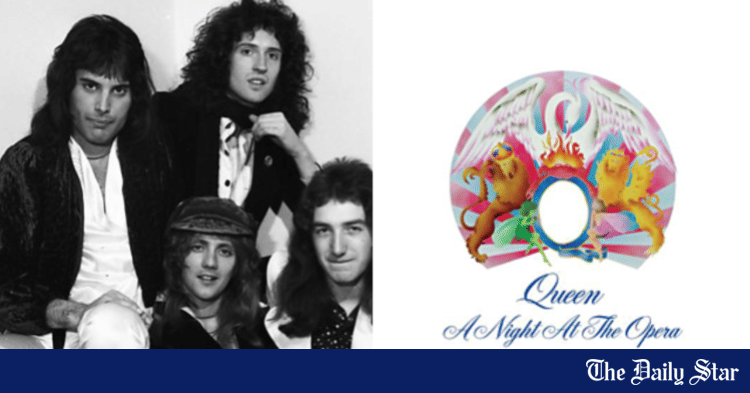
Half a century after its release, “A Night at the Opera” still behaves like a guest who refuses to enter a room quietly. The 1975 album arrived bursting with confidence, theatrical flair, a level of ambition and going against the norm that seemed almost unreasonable for four musicians who were, at the time, nearly broke. Yet it became the record that launched Queen into the international stratosphere.
Before the album took shape, the band itself had to. Mercury first connected with May and Taylor during their Smile days and Deacon joined soon after. The early years were a mix of cramped vans, cheap hotels, and long stretches of touring that hardly paid enough to keep the equipment repaired. By 1975, after disagreements with management and a discouraging financial situation, this album came as a final shot at proving what they could do if given full freedom, and also as a last stand against the very real possibility that their career might collapse.
 For all latest news, follow The Daily Star’s Google News channel.
The recording sessions reflected the chaos. They moved between studios, sometimes on the same day, dragging their ideas and frustrations with them. The tape machines were pushed to their maximum capacity. Vocal stacks grew so dense that the engineers occasionally wondered whether the equipment would simply give up. The title, borrowed from a Marx Brothers film, suited the mood: theatrical, excessive, technical, and occasionally absurd, but still somehow controlled in its own strange way.
“Bohemian Rhapsody” the lead single and the album’s (maybe even the band’s) towering centerpiece and earned a permanence that few other songs ever reach. Even now, people who cannot remember what they had for breakfast can sing the entire thing. People of every age still shout the lyrics in cars, kitchens, and karaoke rooms, often attempting all the harmonies at once, and they still imitate the guitar solo with whatever sound their mouths can manage. Each fragments of the song were written at different times and with Mercury’s insistence and the band’s curious acceptance, were merged together into one. The operatic section took weeks to record, requiring countless vocal overdubs. The critics were unsure how to respond to a six-minute single that seemed to change genres mid-sentence. Audiences had no such uncertainty. The song reached number one in the United Kingdom and quickly grew into a cultural landmark. It remains one of the most recognizable compositions in music history.
Mercury also contributed “Love of My Life”, a gentle and pleading ballad built around a fragile piano line with the addition of harp to the arrangement by Brian May. May describes it as one of Mercury’s finest emotional works. During concerts, particularly in South America, the audience frequently sang the song so loudly that Mercury sometimes stepped back and let the crowd take over.
Other songs reflect the individual voices within the band. “Death on Two Legs” was a sharp and hostile message aimed at their former management. “You’re My Best Friend,” by Deacon and Roger Taylor’s “I’m in Love with My Car” were two ends of the sincere- humorous spectrum. The long vocal canons and layered harmonies of “The Prophet’s Song” demonstrated how far they were willing to push studio technology.
When the album was finally completed, it was the most expensive recording project ever undertaken in Britain. For a band with limited finances, the risk was enormous. And it paid off. “A Night at the Opera” topped charts across multiple countries, establishing them as one of the most daring and imaginative acts of the decade.
Today, fifty years later, the record still sounds bold. Its mix of emotional vulnerability, technical experimentation, humour, and theatrical scale has aged with surprising grace. Modern artists continue to study its production as a blueprint for ambition. Listeners continue to embrace its sincerity and inventiveness. “A Night at the Opera” stands as proof of what happens when a band refuses to limit its imagination and pursues every idea, even the ones that demand an entire choir of “Galileos” from three exhausted singers.