
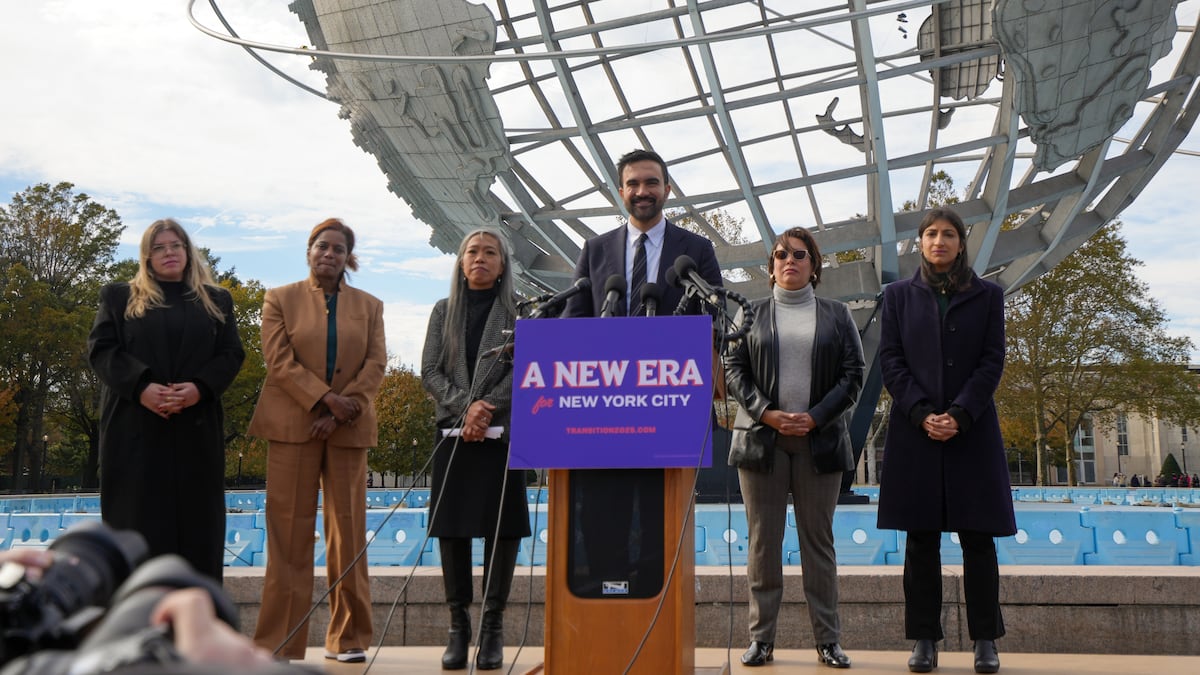
It’s one of those unmistakably Washingtonian customs: at the end of a successful election campaign, there’s an urgent need to identify the mastermind sitting quietly behind the scenes who made it possible. There’s James Carville (“It’s the economy, stupid!”) and Bill Clinton; Karl Rove, architect of George W. Bush’s success; David Axelrod, who knew how to complement Barack Obama’s political talent; and Susie Wiles, the woman who added method to Donald Trump’s return to the White House in 2024.
Behind the meteoric rise of the socialist Zohran Mamdani, who recently won the mayoral race in New York City and has transformed from being virtually unknown just a year ago to a global figure, there is a group of people, mostly young, some even younger than him (he is 34), who helped him design a highly effective social media campaign that has also created a “movement” of over 100,000 volunteers.
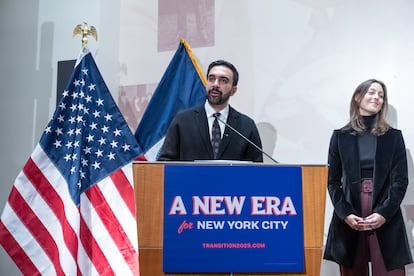 Zohran Mamdani and Elle Bisgaard-Church, his chief of staff, at a news conference in November.Pacific Press (Pacific Press/LightRocket via Ge)
Some of those collaborators are ready to join his team when he takes office on January 1. Elle Bisgaard-Church is one of them. “Without a doubt, there hasn’t been anyone as important as her in the campaign,” notes Gustavo Gordillo, co-chair of the New York chapter of the Democratic Socialists of America (DSA), the party the candidate has been associated with since 2019 and without which his rise would also be impossible to understand.
The mayor-elect appointed her chief of staff a couple of weeks ago, the same day he added to his team, in a balancing act between the new and the old, a veteran of New York City budget policy, 74-year-old Dean Fuleihan, who had already helped a former mayor, Bill de Blasio, deal with Donald Trump. Joining the team of experienced professionals who will work with Mamdani on Wednesday is current police commissioner Jessica Tisch, whose record includes achieving a record drop in crime and shooting rates, as well as a campaign to remove thousands of illegal weapons from the city’s streets.
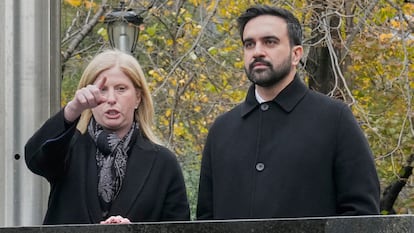 New York City mayor-elect Zohran Mamdani and New York City Police Commissioner Jessica Tisch.Richard Drew (via REUTERS)
Bisgaard-Church, who had never managed a campaign before, is one of the few individuals who can say she was there from the beginning. She is a member of the DSA and has worked as Mamdani’s chief of staff since 2020, when the mayor-elect was a member of the Albany State Assembly. At 34, she is a discreet woman, described by her aides as “quiet.”
She also seems modest. She hasn’t done much to take credit, except for an article titled “How This Campaign Was Won,” published by the monthly magazine The Indypendent shortly after the primary victory. In it, Bisgaard-Church explains how Mamdani went from polling at 1% in a February survey to defeating her main rival, former governor Andrew Cuomo, by almost 13 points, thanks to a communication strategy heavily focused on the internet and based on three principles: “consistency, clarity, and authenticity.” She also attributes her success to the fieldwork with volunteers; the forging of a “multiethnic, multigenerational” coalition that won over influential political allies, such as Alexandria Ocasio-Cortez and Bernie Sanders; and the successful fundraising of numerous small donations.
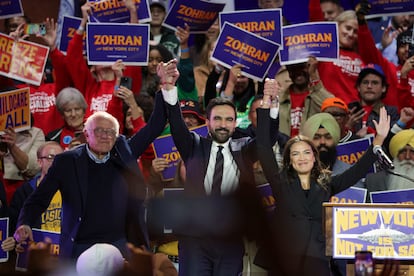 Left to right: Bernie Sanders, Zohran Mamdani and Alexandria Ocasio-Cortez at a rally in New York. ANGELA WEISS (AFP / Getty Images)
“For the first two months, until the money started coming in, Mamdani’s campaign was a very small operation,” explains journalism professor Theodore Hamm, author of Run Zohran, Run, a book about the candidate’s meteoric rise, in a telephone conversation.
This core group includes names like strategist Andrew Epstein, the campaign’s creative mastermind; Zara Rahim, an exceptionally well-connected communications specialist in the city; and 26-year-old Morris Katz, who, along with other young strategists, is working to redefine the Democratic Party after Kamala Harris’s defeat in the last election. As he told NPR in an interview, “what people are frustrated with is a politics of politeness in the face of deep division, in the face of deep income inequality.” People, he said, see the Democrats as overly complacent with the status quo. “We don’t need to be this party. We don’t need to be scared of our own shadow. We don’t have to be scared of billionaires and lobbyists and corporations. And I think we started that work in New York and hopefully can continue it,” he added.
Zara Rahim’s contribution
Rahim, 35, has a resume that includes stints at Vogue, Uber, and the presidential campaigns of Barack Obama and Hillary Clinton. She has helped Mamdani connect with celebrities who boosted his candidacy and refine his media image. Rahim, active in the pro-Palestinian cause, has also been crucial in convincing Mamdani to “forget the idealized New York of political strategists,” as an advisor told The New York Times this summer, and to focus on “running a campaign about the real New York City.”
As for Epstein, he’s another product of Albany politics. In the first part of the campaign, he worked as communications director and is credited with a double-edged strategy: heavily focused on social media, but simultaneously reinforced on the ground, by knocking on voters’ doors in all five boroughs of New York City. “After the primaries, Epstein stepped down as spokesperson (let’s just say talking to CNN wasn’t his thing) and focused on the creative side. Basically, he and Zohran came up with most of the videos that have caused a sensation in recent months,” explains biographer Hamm, who points out that beyond these individual names, “Mamdani’s victory is due to the building of a movement, and that’s thanks to the DSA.”
Gordillo, co-president of the DSA in New York, explains that the work began long before the candidate decided to run for mayor. “It took 10 years to build a network of elected officials at the local level, and he was one of them. Thanks to that, we developed a broad infrastructure. When we launched his campaign, we already had dozens of organizers who knew how to set up field interventions and train people to knock on doors and campaign directly on Twitter. That was a huge advantage he had going into the race, an advantage other candidates didn’t have,” says Gordillo.
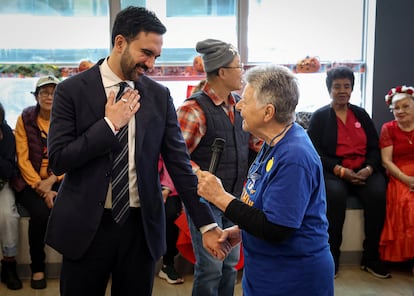 A supporter of Zohran Mamdani addresses him at a campaign event at a senior center in Manhattan, on October 31.Brendan McDermid (REUTERS)
The DSA also helped Mamdani define his cost-of-living platform: free buses and childcare, and a rent freeze on rent-controlled apartments. With that simple message, Gordillo recalls, he broke the record for support in the city’s recent history, garnering a million votes. Now, the party is ready to continue its fight elsewhere with its focus on the working class. “Democrats have to choose between defending the working class or continuing to champion the billionaires. Otherwise, they will continue to struggle to win elections,” explains the young socialist leader, who admits that, “despite the candidate’s talent,” he never believed, not even in his wildest dreams, “that Mamdani would go so far.”
And that’s another lesson Washington has learned well. No matter how much political strategists rack their brains trying to identify patterns, a successful campaign like Mamdani’s is impossible to replicate without a candidate like him — “the great political talent of his generation,” according to Ocasio-Cortez — and without the alignment of the stars within his inner circle that propelled him to make history.
It will be on January 1, when he becomes the first socialist and Muslim mayor of the largest city in the United States.
Sign up for our weekly newsletter to get more English-language news coverage from EL PAÍS USA Edition