
 Listen to this article
The Blueprint
Initial phase includes a 73- or 86-unit building designed by Pope Design Group.
Developer seeks TIF, gap financing, tax credits, and reduced land cost.
Concept plan under review as city updates its Brooklyn Boulevard Corridor vision.
Less than a year after cutting the ribbon for its Wangstad Commons project in Brooklyn Center, JO Companies is testing the waters for another affordable housing development in the northwest Twin Cities.
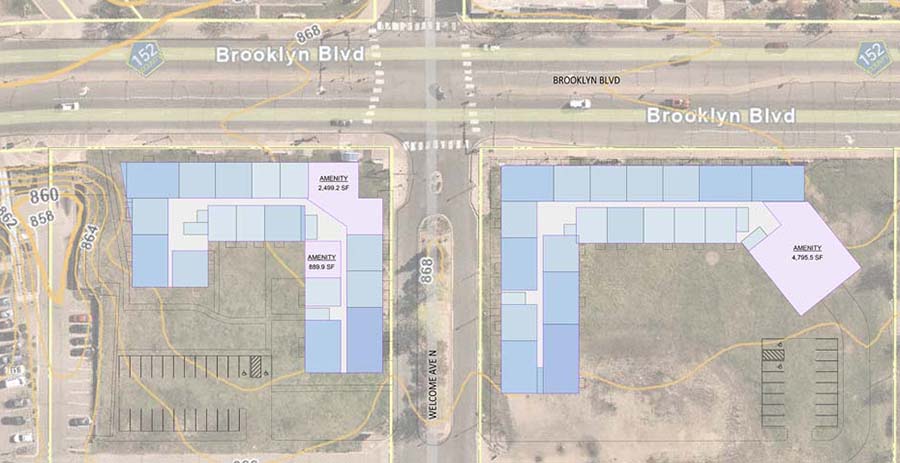
The Brooklyn Park Economic Development Authority recently reviewed the developer’s concept plans for vacant sites at 7621 and 7601 Brooklyn Boulevard, which could eventually accommodate 160 or more apartments in multiple phases.
Located in the Village Creek neighborhood, the “Welcome Avenue sites” include EDA-owned parcels of 1.71 and 2.07 acres at Brooklyn Boulevard and Western Avenue.
For now, JO Companies is focusing on the western parcel. For the “west building,” the developer envisions either a four-story, $31.7 million, 73-unit building or a five-story, $36.7 million, 86-unit development, according to city documents.
The project, designed by Pope Design Group, would be affordable for households ranging from 50% to 70% of area median income.
City documents also reveal that the developer is seeking “free or reduced land price” valued at $860,000, $1.1 million in tax increment financing, an additional $2.1 million in gap financing, Low Income Housing Tax Credits and “additional public funding.”
Johnny Opara, president and CEO of JO Companies, said Monday that the project is in the early stages. But the idea, he said, is to deliver a “very beautiful, high-quality building” that’s affordable for people in the community.
“At the end of the day, we are really helping transform the narrative, the perception of affordable housing. Brooklyn Park is no different. We think that we have a huge opportunity to do something really impactful and really beautiful in Brooklyn Park,” Opara said.
City documents note that the “Welcome Avenue sites” have been vacant for “several years as the EDA has sought appropriate development opportunities that align with community needs and economic development goals.”
For its part, the Village Creek neighborhood “is characterized as a lower-income area where market-rate rents closely align with affordable housing rates.”
Tim Gladhill, Brooklyn Park’s community development director/EDA executive director, said in an email that the EDA didn’t take formal action on the concept plan at its Nov. 17 meeting.
“This was the developer’s opportunity to introduce our EDA to their proposal,” Gladhill said. “The EDA has not taken a position on this proposed development, but asked for some additional information on the financials to better understand the stated gap in financing. The developer will need to finalize the application and fees to have the financials reviewed by our financial adviser.”
Gladhill added that the city is in the process of updating its “plan and vision for the Brooklyn Boulevard Corridor,” which includes a market study.
“This concept plan will likely be reviewed in the context of that plan update,” he said.
JO Companies is no stranger to the northwest suburbs.
In December, the company celebrated the grand opening of Wangstad Commons, a $23 million, 54-unit affordable apartment project at 61st Avenue and Brooklyn Boulevard in neighboring Brooklyn Center.
Wangstad Commons is about 90% occupied, said Opara, a Brooklyn Park resident.
Also doing well is JO Companies’ first development, The Hollows, an $18.4 million, 62-unit workforce housing project at 520 Payne Ave. in St. Paul.
In addition, JO Companies is one of the housing development partners for The Heights, a project that will create 1,000 homes at Larpenteur Avenue East and McKnight Road North on the East Side of St. Paul.
The developer is also moving forward with Penn Station Apartments, a $23 million new construction development that will bring 42 units of affordable and supportive housing to 6501 Penn Ave. S. in Richfield.
“We’re still fighting the good fight, trying to work with city councils and EDAs to let them know the importance of affordable housing and why we need it in our communities,” Opara said.