
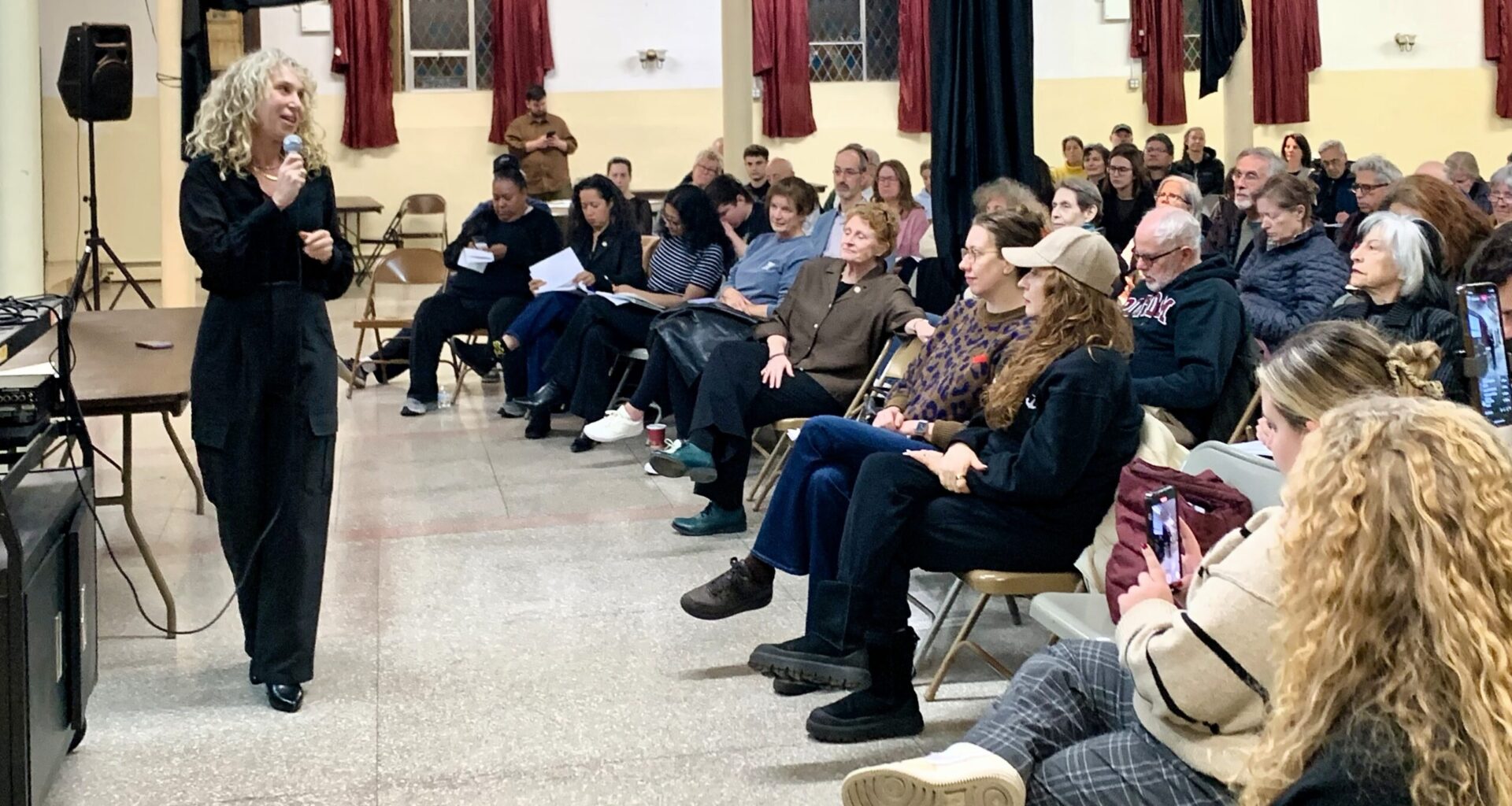
Hilary Semel, director of the Mayor’s Office of Environmental Conservation, explains the environmental scoping process for the Brooklyn Marine Terminal project to a crowd in Carroll Gardens Monday night. Photo: Mary Frost, Brooklyn Eagle
CARROLL GARDENS — The city’s final environmental scoping hearing on the $3.5 billion redevelopment of the Brooklyn Marine Terminal takes place Monday, Dec. 1, and locals are cramming in lessons on how to craft their testimony in a process that many believe to be deliberately rushed by the city’s Economic Development Corporation.
Roughly 200 residents of Cobble Hill, Carroll Gardens, the Columbia Street Waterfront District and Red Hook packed Cabrini Hall of Sacred Hearts Church for three hours Monday night for a community forum that resembled city-planning night school. They recorded the presenters and scribbled expert advice onto notepads. Bundles of documents were set out on tables.
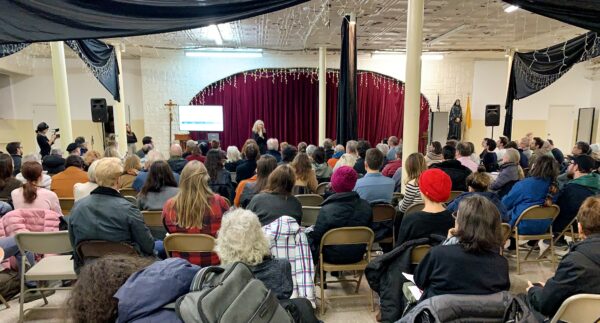 Roughly 200 people gathered in Carroll Gardens on Monday night to prep for the Dec. 1 Brooklyn Marine Terminal environmental scoping hearing. Photo: Mary Frost, Brooklyn Eagle
The final BMT Vision Plan will transform the 122-acre maritime site stretching from Atlantic Avenue to Red Hook on the East River, bringing a smaller (half the size) but modernized port, public open space, and 6,000 new units of housing (40% affordable), with roughly 15,000-18,000 new residents.
Current residents say this is the equivalent of 30 30-story buildings, and note that a host of issues — from the area’s already-congested streets to the crumbling Brooklyn-Queens Expressway, lack of mass transit, inadequate sewage and other infrastructure, and nonexistent land-use analysis — were never addressed in the final BMT Vision Plan.
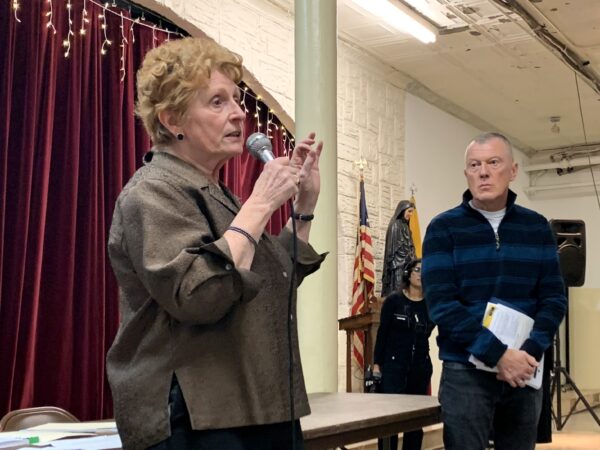 Assemblymember Jo Anne Simon speaks to the crowd, while James Morgan, a Columbia Waterfront resident, awaits his turn to comment. Photo: Mary Frost, Brooklyn Eagle
Officials assured the crowd that their input on the Draft Scope of Work, used to develop the project’s Environmental Impact Statement, could make a difference to the outcome.
Conducting the seminar were Assemblymembers Jo Anne Simon and Marcella Mitaynes, Councilmembers Alexa Avilés and Shahana Hanif, leaders from the community organizations Voices of the Waterfront and Columbia Street Waterfront Association including Randy Gordon and Summer Sandoval, and Hilary Semel, director and general council of the Mayor’s Office of Environmental Conservation, who did a deep dive into the intricacies of the DSOW and EIS.
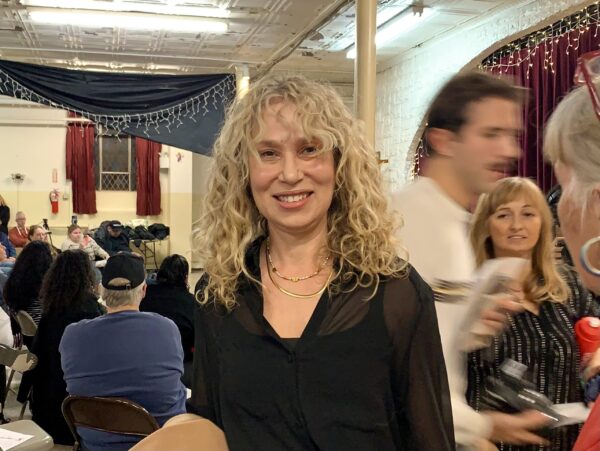 Hilary Semel, director of the Mayor’s Office of Environmental Conservation. Photo: Mary Frost, Brooklyn Eagle
‘Just do it’
The main takeaway from the experts was “just do it.” Speakers said locals don’t need to be land-use experts when they testify — they should just speak up about the issues that matter the most to them and where they have local expertise, whether it’s traffic, transportation, port operations, infrastructure including sewers or schools, parks or resiliency.
While the methodology is complex, “Only the community really knows what the potential environmental impacts are. It’s only when the community gets their voice in that the agencies can really start looking at particular issues,” Semel advised, giving examples of past situations where a study area was expanded based on residents’ intimate knowledge of local conditions, such as underground water flow. “We don’t just take whatever the consultants say at their word.”
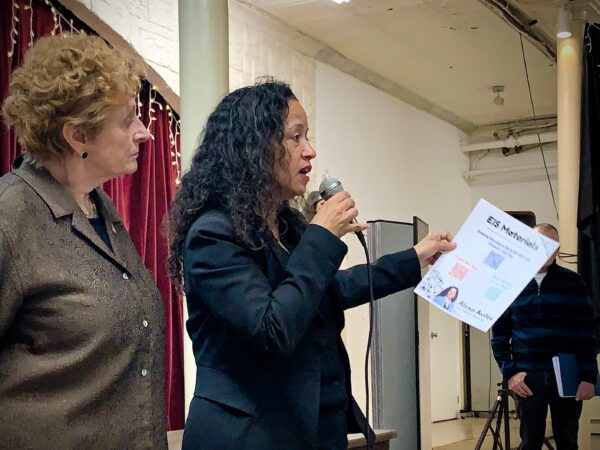 (From left) Assemblymember Jo Anne Simon, with Councilmember Alexa Avilés. Photo: Mary Frost, Brooklyn Eagle
Simon said the Draft Scope of Work is where the community can have the most impact. “We need local expertise” on the study area, such as resiliency issues or specialized maritime knowledge, she emphasized. Simon urged people to read the DSOW document, posted online by EDC, and to consider looking beyond the boundaries of the 19 categories listed in the City Environmental Quality Review Manual, which include land use, socioeconomic conditions, air quality, hazardous materials, noise, shadows, neighborhood character and others.
“If transportation is your thing, look at the health impacts — air pollution, greenhouse gases and other factors, too. Noise? The noise from pile driving goes quite a ways. Look at the mitigation chapter, too,” Simon advised.
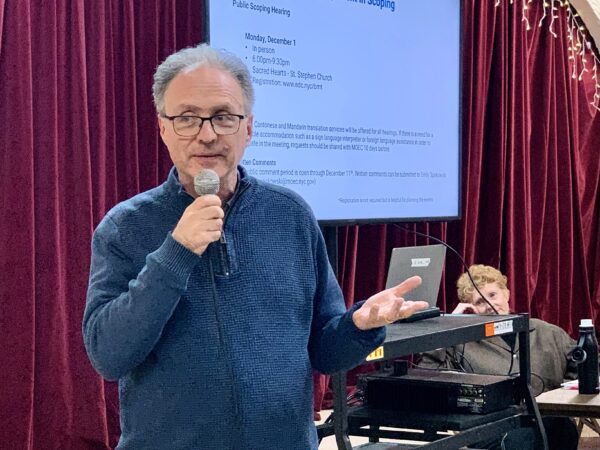 Randy Gordon, resident of the Columbia Street Waterfront District, led breakout groups at Monday’s BMT prep session. Photo: Mary Frost, Brooklyn Eagle
She noted that while the study employs a 400-foot impact perimeter, there might be numerous instances when that perimeter should be enlarged to take into consideration effects from factors like traffic and construction related to the BQE. “An expanded study area in some places might be warranted,” she said.
Simon also said it was possible to push for the expansion of timelines, since the city has set a date of 2038 for project completion. In reality, the build will likely take longer, and factors like climate change may come into play.
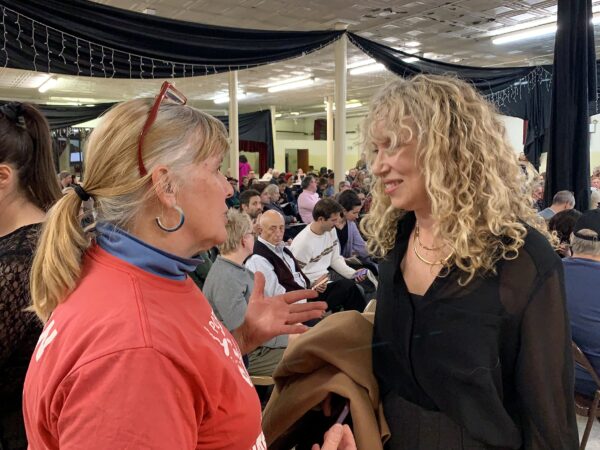 PortSide NewYork executive director Carolina Salguero, left, discusses the scoping process with Hilary Semel, director of the Mayor’s Office of Environmental Conservation. Photo: Mary Frost, Brooklyn Eagle
Voices of the Waterfront’s Sandoval advised participants to submit both written comments and deliver oral testimony (limited to three minutes, or roughly 400-450 words) to “create the optics for the decision makers that this is important and the community is watching.” Make your written comments as long as you want and feel free to add attachments, she said. (Bring 20 copies to distribute.) Written testimony can be submitted until Dec. 11.
Voices of the Waterfront has created a document with tips and resources for those who want to testify or submit comments.
To testify on Dec. 1, RSVP on Eventbrite.
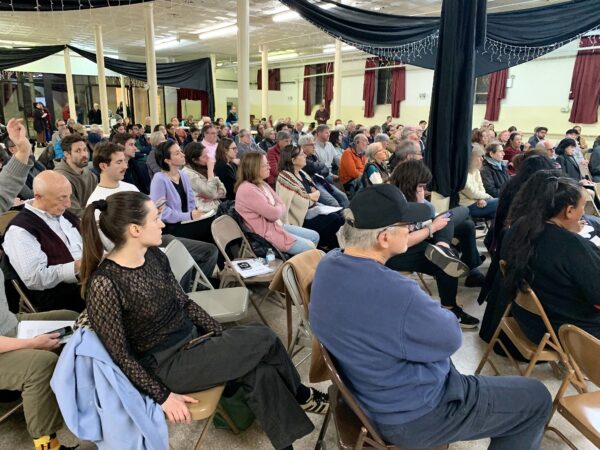 Roughly 200 residents of Cobble Hill, Carroll Gardens, the Columbia Street Waterfront District and Red Hook packed Cabrini Hall of Sacred Hearts Church for a community forum on the Brooklyn Marine Terminal. Photo: Mary Frost, Brooklyn Eagle

Community forum on Brooklyn Marine Terminal project takes place Monday
November 14 |
Mary Frost
EDC will present final Brooklyn Marine Terminal Plan on Thursday via Zoom
October 21 |
Mary Frost
Video sheds harsh light on Brooklyn Marine Terminal redevelopment process
October 16 |
Mary Frost