
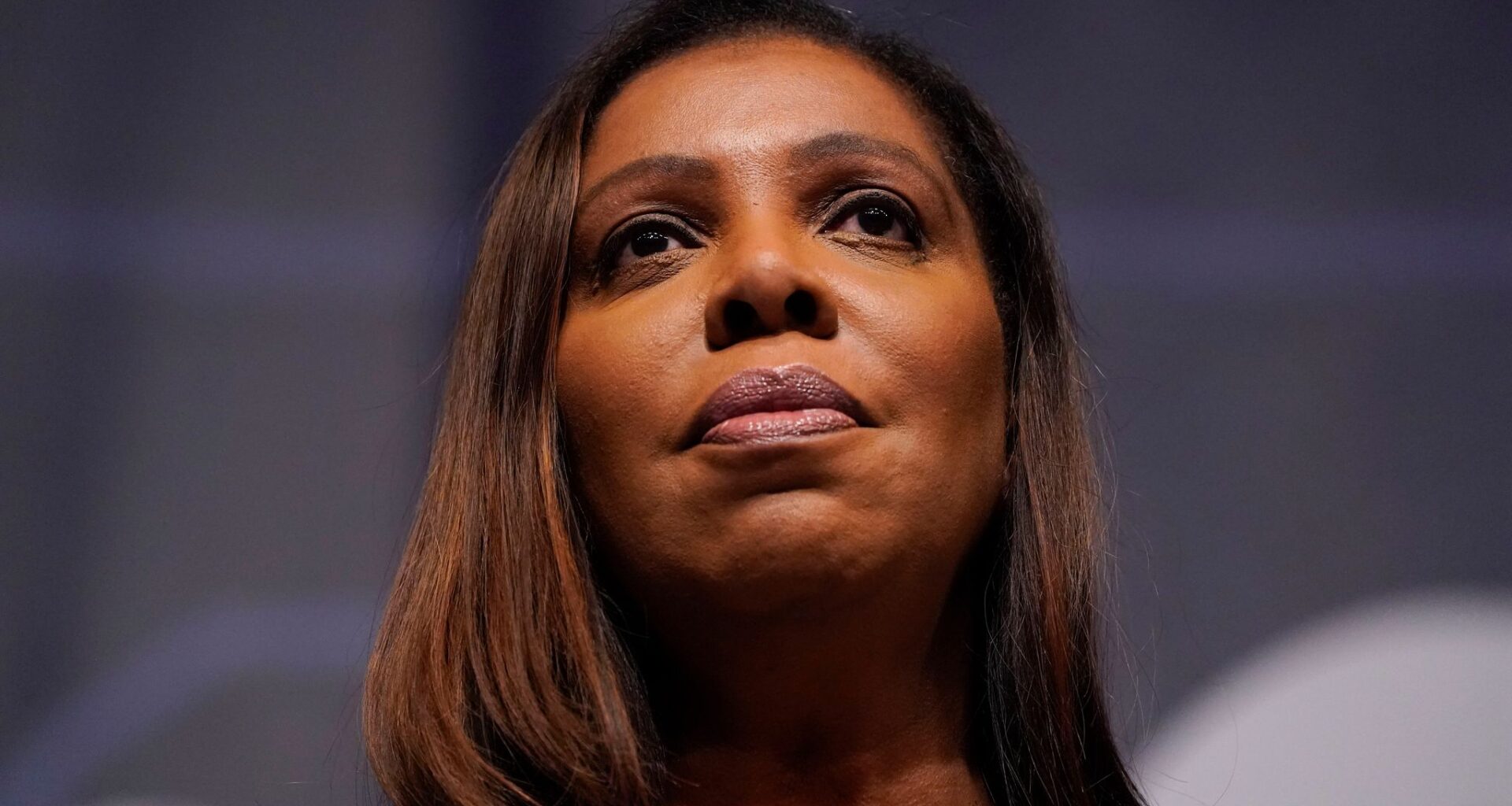
New York Attorney General Letitia James is leading a bipartisan coalition urging Congress not to prohibit states from regulating AI.
Seth Wenig/AP
Republicans in Congress have reportedly considered including language in an upcoming spending bill that would prohibit states from regulating AI.
Mariam Zuhaib/AP
Assemblyman Alex Bores, a Democrat who’s running for Congress, said federal lawmakers have failed to craft protections against the misuse of AI.
Will Waldron/Times Union
Gov. Kathy Hochul is currently considering the RAISE Act, an AI safety bill sponsored by Bores. Hochul hasn’t said if she’ll sign the bill.
Jim Franco/Times Union
ALBANY — New York is leading an effort to pressure members of Congress to reject a proposal that would prohibit states from creating and enforcing their own rules around the development and use of artificial intelligence.

That proposal was apparently under consideration as recently as last week by Republican leaders in the U.S. House of Representatives as an add-on to a larger spending bill.
Article continues below this ad
That bill — the annual National Defense Authorization Act — is expected to receive a vote in Congress in the coming weeks. It’s one of several appropriations bills that federal lawmakers still have to resolve.
New York Attorney General Letitia James and her counterparts from 35 states and U.S. territories sent a bipartisan letter to leaders in Congress on Tuesday, urging them to remove a ban on state-level regulation of artificial intelligence from the legislation.
“Broad preemption of state protections is particularly ill-advised because constantly evolving emerging technologies, like AI, require agile regulatory responses that can protect our citizens,” the letter said. “This regulatory innovation is best left to the 50 states so we can all learn from what works and what does not.”
Republicans have not said the restriction will definitely be included in the final bill that emerges from both chambers of Congress, where they hold a slim majority.
Article continues below this ad
But it’s not the first time that such a proposal has been pitched in recent weeks. President Donald J. Trump was considering an executive order last week that would have had the same effect as preempting state regulation.
Trump instead issued an executive order this week to launch what his administration is calling the “Genesis Mission,” a federal effort to position the U.S. ahead of other countries on advancements in artificial intelligence.
The order directs the U.S. Department of Energy to build an integrated platform for artificial intelligence that will accelerate scientific research across the country using supercomputers fed by decades of federal data.
“Throughout history, from the Manhattan Project to the Apollo mission, our nation’s brightest minds and industries have answered the call when their nation needed them,” U.S. Secretary of Energy Chris Wright said. “Today, the United States is calling on them once again.”
Article continues below this ad
That doesn’t mean federal legislation restricting state regulation of artificial intelligence is off the table.
Developers of that technology have argued that having to comply with a patchwork of state-level laws will stifle growth and innovation at a time when the U.S. is racing to compete with other countries in the industry.
But that’s a misnomer, said state Assemblyman Alex Bores, a Democrat who’s authored multiple bills to set guardrails for the future of artificial intelligence.
“These companies already operate in more than 50 countries,” Bores said. “They very much can comply with a few differences in different places.”
Article continues below this ad
Bores and others like him aren’t opposed to federal laws regulating artificial intelligence. Congress could design a national framework intended to prevent malicious use of artificial intelligence, for example, or pass laws to protect workers from being displaced by the technology.
“But to say we’re not going to solve the problem and we’re going to stop you from solving the problem is just a nonsensical position,” said Bores, who’s also running for Congress next year.
“It’s f—d up,” state Sen. Andrew Gounardes, also a Democrat, said after it was reported last week that the federal government could limit state regulation of artificial intelligence.
Gounardes and Bores sponsor a bill called the RAISE Act, which would require developers of artificial intelligence models to create safeguards to prevent their products from being used to cause widespread harm or to commit crimes.
Article continues below this ad
It passed both chambers of the state Legislature earlier this year but hasn’t yet been considered by Gov. Kathy Hochul.
The bill has been the target of strong lobbying efforts from tech giants like Amazon, Google and OpenAI, the developer of ChatGPT. Chamber of Progress, a trade group that represents those and other technology companies, has urged Hochul to reject the bill.
“The result will not be safer tools,” the group wrote in a letter to Hochul. “Instead, there will be fewer open models, slower development, and less innovation within New York.”
That argument could appeal to Hochul. She hasn’t signaled her intentions with the bill but said in August that she doesn’t want to do anything that could be viewed as a setback for New York on artificial intelligence.
Article continues below this ad
She’s often touted the state’s launch of Empire AI, a consortium of public and private universities that have partnered to advance research using artificial intelligence. It launched last year.
“I do support sensible regulations, but not to put us at a disadvantage as a state,” Hochul said. “So that’s the delicate nuances I’ll have to be looking at with this legislation.”
Hochul has until the end of the year to make a decision on the bill.
Article continues below this ad