
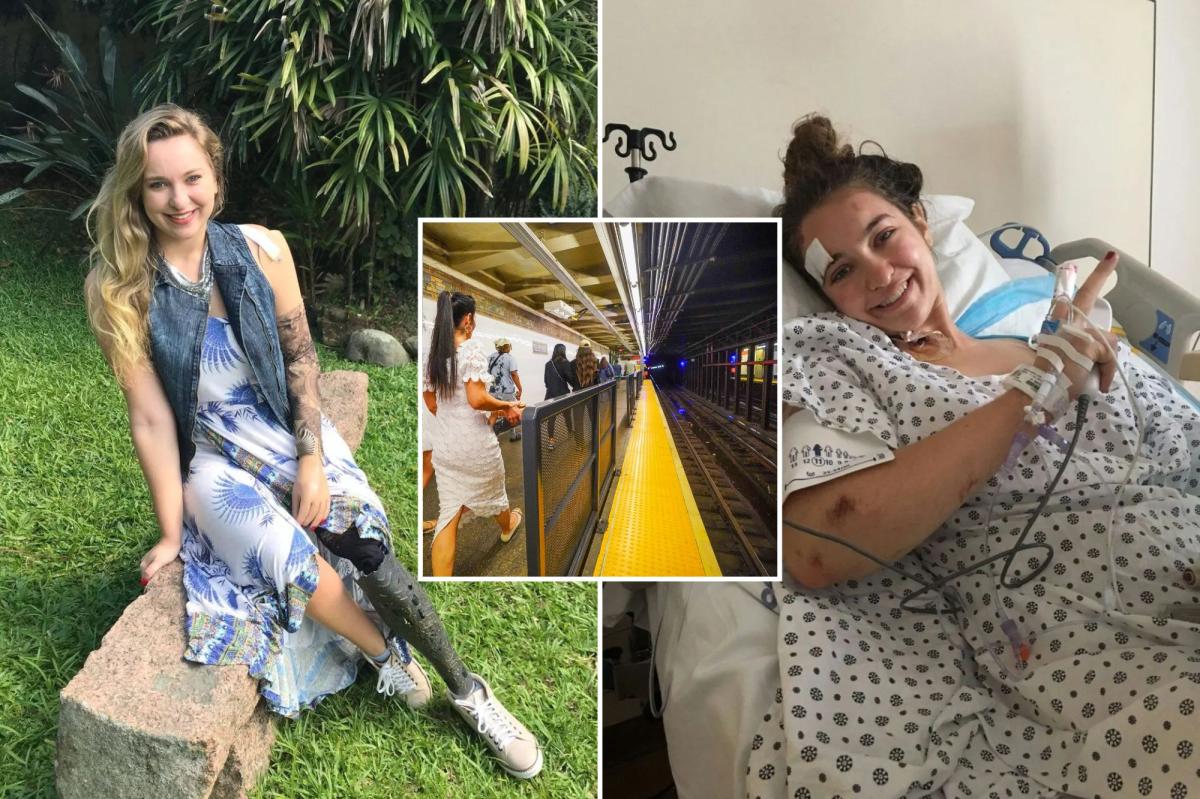
A student tourist whose left arm and left leg were severed when she fainted and tumbled in front of a Brooklyn subway train has landed a nearly $82 million jury verdict.
Luisa Janssen Harger Da Silva of Brazil was awarded the massive sum last week in Brooklyn federal court over her rail horror in 2016, when she was 21.
A jury awarded Luisa Janssen Harger Da Silva nearly $82 million last week after her left arm and left leg were severed in a 2016 Brooklyn train tragedy. Facebook/Luisa J. Harger da Silva
Da Silva was on a platform with her boyfriend when she fainted and fell onto the Atlantic Avenue tracks, where an oncoming train ran her over.
Nearly a decade later, a jury sided with her and her legal team in finding that the MTA failed to take the issue of people falling onto train tracks seriously.
The woman’s suit argued the MTA had 15 years of data showing “that it was a moral certainty that innocent people, such as the plaintiff, would fall onto the tracks if the Authorities did not take steps to install platform edge safety devices.”
One of the plaintiff’s lawyer, David Roth, said, “The failure to act in the face of a known, preventable hazard is the definition of negligence.”
The plaintiff argued that the MTA had 15 years of data showing “that it was a moral certainty that innocent people, such as the plaintiff, would fall onto the tracks if the Authorities did not take steps to install platform edge safety devices.” Robert Miller
The MTA has appealed the case, saying it “disagrees with the verdict,” rep Tim Minton said.
Last year, another man who lost an arm and leg when he drunkenly fell on the tracks and was hit by a subway train was initially awarded a staggering $90 million by a jury. The award was knocked down by a judge in June to just under $40 million.
At trial, internal MTA documents revealed that the transit agency was offered proposals to install platform doors at no cost as far back as 2011, with the idea being the company would make money by being allowed to offer advertising on the structures.
Da Silva spent 24 days in Bellevue Hospital after she fainted, fell onto the tracks and was run over by a train. Courtesy of family
Da Silva, who was 21 at the time and was in town from Brazil, visiting her boyfriend, is pictured here just hours before she lost her left arm and leg. Courtesy of family
“Several of those companies, the largest in the world, submitted detailed plans showing they could overcome every engineering challenge and install platform screen doors system-wide,” said another of Da Silva’s lawyers, Bob Genis.
One of the no-cost platform-door proposals from industry leader Faiveley Transit was called “impressive” by the MTA “due to the substantial amount of technical analysis into existing challenges with NYC Transit infrastructure.”
Yet no further study of platform barriers occurred between then and when Da Silva lost half of her appendages, Genis said, adding that the “MTA walked away” from the free offer.
Train strikes are rising, with 241 people hit by trains in 2023, according to MTA data reported by THE CITY. Gregory P. Mango
“We can’t speak to historical choices made decades ago,” Minton said in response, adding that the MTA has installed some type of platform barriers at 109 stations so far.
Minton said the agency claimed at trial that the offer and financing wasn’t confirmed at the time.
Costs aside, Minton said platform doors at a vast majority of stations wouldn’t work due to “physical feasibility and accessibility reasons.”
The MTA says it has installed protective barriers at 109 stations so far. Robert Miller
In 2012, the MTA weighed its annual litigation costs from train strikes as “part of an overview of the costs and benefits of platform edge doors.”
It found that its cost of litigation amounted to $7 million annually for the previous five years, according to emails surfaced by the same legal team in another lawsuit filed by a 2021 subway shove victim
Train strikes are rising, with 241 people hit by trains in 2023, according to MTA data reported by THE CITY.