
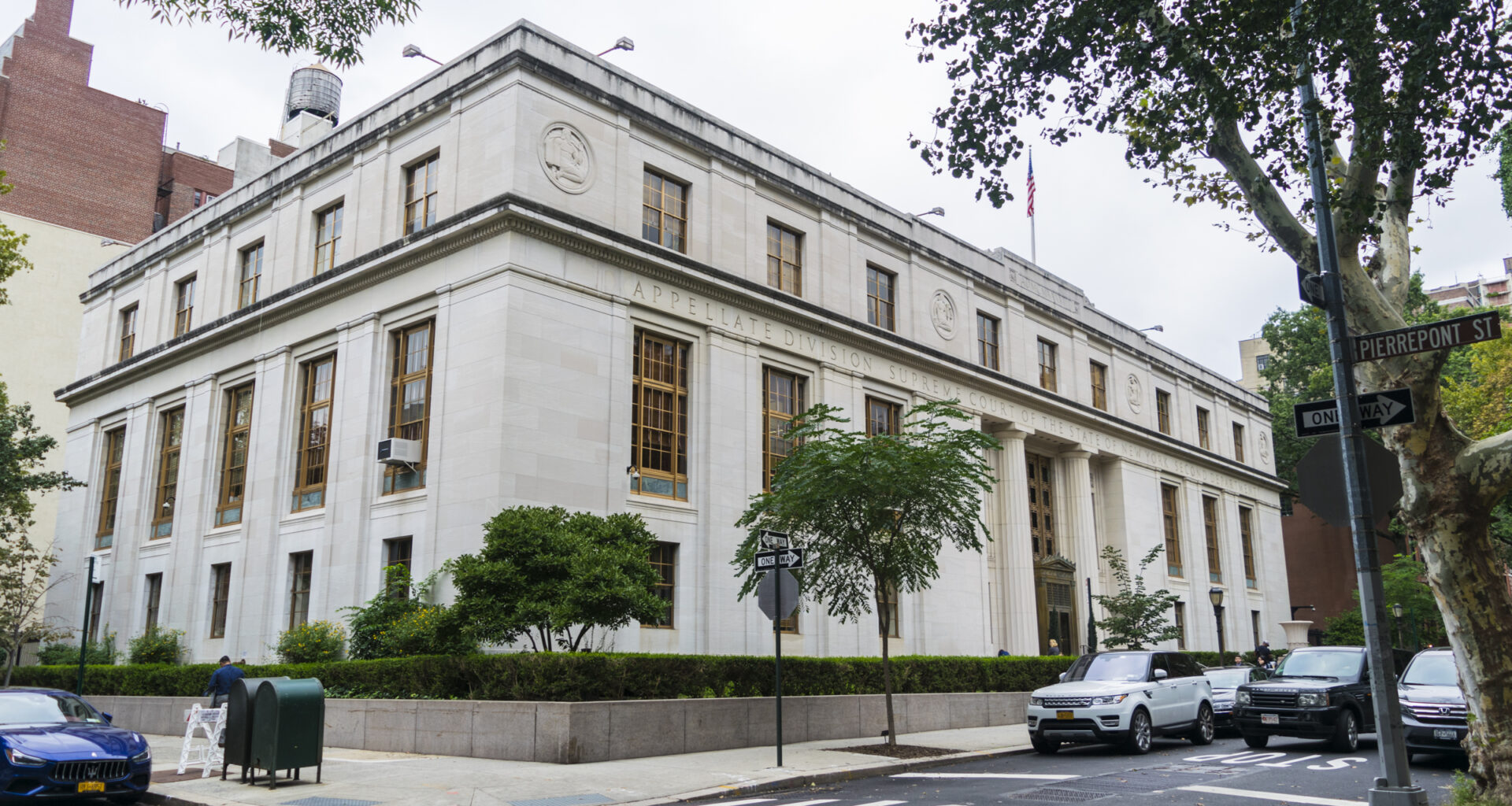
The home of the Appellate Division, Second Department, on Monroe Place in Brooklyn Heights. Eagle file photo by Rob Abruzzese
 BED-STUY — A panel of the Appellate Division, Second Department, has allowed New York City to continue pursuing repayment from the owner of a Brooklyn apartment building after tenants were forced to vacate due to unsafe conditions.
In a decision released Wednesday, the court refused to summarily discharge a mechanic’s lien that the City filed to recover the cost of relocating residents.
The case, City of New York v. Tuesdai Family Irrevocable Living Trust, centers on a property where, according to the complaint, living conditions deteriorated so badly that the City had to relocate tenants and cover emergency housing.
Under the Administrative Code, the City can seek reimbursement from the owner and secure payment through a lien on the property.
The City’s complaint paints a stark picture of what was happening inside 343 Jefferson Avenue.
According to the complaint, after a fire at the property in April 2012, a Department of Buildings (DOB) inspector reported that three apartments had been converted into 13 single-room occupancy units with no secondary means of egress.
The DOB issued a peremptory vacate order, citing “imminent danger to life or public safety” and directed all residents on the upper floors to leave immediately.
Seven households were relocated to alternative housing from April 29, 2012, through Feb. 28, 2018.
Over nearly six years, the City alleges it spent $384,195 on temporary housing and another $3,065.23 in administrative costs, for a total of $387,260.23.
The complaint says those expenses arose from the owner’s negligent or intentional acts and its failure to maintain the building in accordance with housing and health codes.
The Trust, which owns the building, asked the Supreme Court to dismiss the case and discharge the lien at the pleading stage.
The Appellate Division affirmed the lower court’s denial of that request. The judges held that a mechanic’s lien can only be summarily discharged when the defect appears on the face of the notice. Here, they found no such defect.
The panel also rejected the Trust’s argument that the complaint failed to state a cause of action.
Construing the allegations in the City’s favor, as required on a CPLR 3211 motion, the court held that the record supported claims. Any dispute about whether the City was entitled to file the lien must be resolved at a foreclosure trial, the judges wrote.
The ruling keeps the case alive and leaves the lien in place while the litigation proceeds.
Although the decision does not address the merits of the City’s claims, it shows the courts’ reluctance to invalidate these liens without a full factual record, particularly in cases arising from buildings where tenants were displaced for safety reasons.
In New York City, conditions have to be extremely dangerous before officials order tenants out and begin paying for emergency relocation. It is not something that happens because of ordinary disrepair or code violations.
The law reserves these orders for situations where remaining inside the building poses an immediate threat to life, health or safety — such as when a building shows signs of structural failure, severe fire damage or electrical hazards that pose an immediate risk of shock or fire.
Vacate orders also follow gas leaks or failing boilers that could lead to explosions or carbon monoxide exposure, as well as winter conditions where the lack of heat becomes life-threatening.
Widespread contamination, like building-wide mold, sewage backups or vermin, and any condition that blocks a safe exit, including damaged stairwells or fire escapes, can also trigger emergency relocation.
Once a vacate order is issued, the City must move tenants immediately. That’s when the relocation costs begin: hotel rooms, temporary apartments, transportation.
Those expenses accumulate quickly.
For property owners, attempts to overturn tenant-relocation liens at the outset face a high bar.

Attorney who turned client’s home-sale proceeds into his own slush fund is disbarred
November 25 |
Brooklyn Eagle Staff
A law license 176 years late for Ely Parker, who had already done the work
November 25 |
Robert Abruzzese, Esq.
New York public housing bribery case ends with a milestone 70 convictions
November 25 |
Associated Press

Portland Trail Blazers coach Chauncey Billups pleads not guilty in rigged poker games case
November 24 |
Philip Marcelo, Associated Press
Leave a Comment