
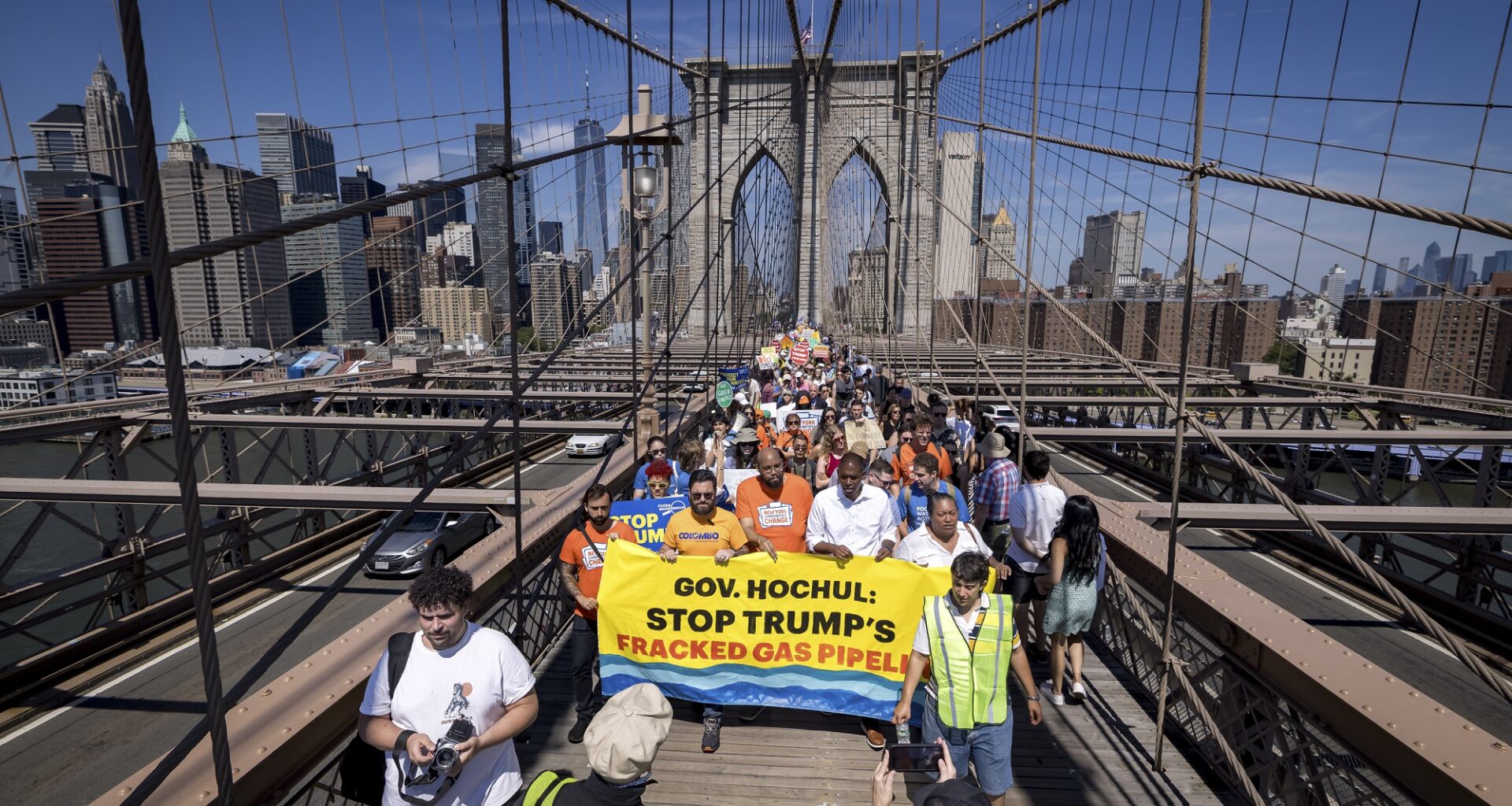
The true beneficiary of the natural gas pipeline Gov. Kathy Hochul (D-NY) approved earlier this month won’t be ratepayers, as she claims, but tech companies that are leeching enormous amounts of energy away from the state’s electrical grid, contend environmental advocates, researchers, and lawmakers. Artificial intelligence companies and other tech outfits are burdening the grid so severely that it will be 1,600 megawatts short of power within the next four years, according to the New York Independent System Operator (NYISO).
To put that shortfall into perspective: It’s enough to power 1.28 million homes.
More from Whitney Curry Wimbish | James Baratta
Hochul approved the Northeast Supply Enhancement pipeline in early November after the state had rejected it three times previously. Proposed by Williams Companies, which has spent more than $162 million to settle environmental, racketeering, and other types of offenses since 2000 according to the violation tracker from Good Jobs First, the pipeline will cost $1 billion to build and add to a 10,000-mile line between Texas and New York. It would carry gas ripped out of the earth by fracking in Pennsylvania, through the waters of Raritan Bay and New York Harbor, and end in Rockaway Beach. There it will connect with another pipeline off the Long Island coast. Williams alleges that the project will send natural gas to 2.3 million homes in New York City; though it does not benefit New Jerseyians, it required a permit from that state, too, which officials granted earlier this month.
New York environmentalists warn that building the pipeline will rip up 20 miles of the harbor floor, poison the water by churning up copper, mercury, and other toxic material, harm marine life, and sicken swimmers. Environmental groups have so far filed three separate lawsuits against New York and New Jersey over their approvals, arguing that Williams never resolved the initial problems that led to the pipeline’s multiple earlier rejections.
“It is a real slap in the face to New Yorkers and the democratic process to approve this pipeline,” said Liat Olenick, a member of the activist group Climate Families. “It also is the opposite of what we should be doing at this moment to combat the climate crisis, which is getting worse by the year. We don’t need this pipeline to meet our energy needs. Renewables are cheap, abundant, much cheaper than fossil fuels.”
The energy won’t even go to the people who are paying for it, she added. “It’s a lose-lose-lose situation for New Yorkers.”
A spokesman for Hochul said he couldn’t comment on the pipeline given pending litigation, but directed the Prospect to earlier comments that emphasized the need for affordable energy.
“Recognizing today’s economic and political realities, the Governor has made clear she is pursuing an all-of-the-above energy strategy to ensure reliable, affordable power for New Yorkers while supporting economic growth,” Ken Lovett, Hochul’s senior communications advisor on energy and environment said previously. “With a federal government increasingly hostile to clean energy, continued post-pandemic inflation, and the potential for downstate energy shortages as early as next summer, the Governor believes New York must expand its energy options.”
NEW YORK IS HOME TO 144 DATA CENTERS, with more on the way. Dallas company Stream Data Centers got approval this year to plunk a 900,000-square-foot data center into the upstate city of Alabama. Stream is spending $6.3 billion on the 59-acre project, which will need 250 megawatts to run and will also include a 600-megawatt substation. (The company wants $471.6 million in sales and mortgage tax exemptions.) Another data center that TeraWulf wants to build in tiny Lansing, New York (population 11,000), would require 400 megawatts to operate, “sucking up around 16 percent of the total power capacity of the Robert Moses Niagara Hydroelectric Power Station, the state’s largest power producer and the second-largest plant of its kind in the country,” as Inside Climate News reported this month. The company signed an 80-year lease for the project in August. Digital Reality and Oxford Quantum Circuits announced their own data center project for New York City.
Boosting power capacity to meet surging data center demand has been costly and logistically challenging. Interconnection queues have prolonged the amount of time it takes to hook up new energy sources to the grid. As of October, NYISO had a backlog of 36 projects in need of energy, which together would demand 10,000 megawatts. “National Grid alone is reviewing 10 active requests totaling 2.28 gigawatts of new demand, with 65% of that coming from manufacturing or industrial projects and 35% from data centers,” ABC affiliate WTEN reported.
The electrical system is buckling under the weight, state lawmakers said at a hearing in October. Energy prices are soaring as a result, and ratepayers are struggling to keep up. In a report released ahead of the hearing, the Climate and Community Institute and Public Grids found that the poorest households in the state spend more than a third of their income on energy. More than 1.3 million households were at least 60 days behind paying their energy bills; as of last December, they owed more than $1.8 billion.
Oklahoma-based Williams Companies has spent more than $67,000 this year to resolve two legal violations, one for air pollution and one for pipeline safety. But the biggest penalties they’ve ever faced were over financial violations, including $55 million in cash plus equitable relief valued at more than $57 million, for allegedly breaching their fiduciary duties to their 401(k) participants by making material misrepresentations to the market to inflate the company’s stock and the stock of a subsidiary.
Williams is a client of Davis Polk & Wardwell, the big law firm that William Hochul, the governor’s husband, works for. The same day Hochul approved the pipeline, she also approved a permit for a cryptocurrency mine in central New York, the fossil fuel–powered Greenidge Generation, which runs 20,000 computers nonstop to create new Bitcoins. Greenidge is a portfolio company of private equity firm Atlas Holdings, which is also a client of Davis Polk & Wardwell.
Williams has been seeking approval for this pipeline for years; the Department of Environmental Conservation denied it three times, in 2018, 2019, and 2020. The agency cited the same concerns as environmentalists, and also said that the pipeline would violate the state’s mandated transition to renewable energy. But then Hochul made a deal with President Trump, trading her permission for multiple new gas pipelines for his permission to continue building a $5 billion wind farm off Long Island.
Empire Wind, as the Long Island project is called, has potential capacity of over two gigawatts. Getting that much renewable power online is something Hochul apparently saw as a necessary trade-off for the gas pipeline. But advocates disagree, arguing that fossil fuel infrastructure will have a negative climate impact for decades.
“When she first came into office, she was doing some things on climate action that we thought were good,” said Pete Sikora, climate and inequality campaigns director at New York Communities for Change (NYCC). “That has completely gone away.”
Hochul has floated using “advanced nuclear power” to supply data centers in upstate New York. It’s a risky bid to bring down energy costs, not only because nuclear is plagued with many of the same issues as other energy sources in hooking up to the grid, but the high up-front costs associated with small modular reactors mean that nuclear power is a long way off from meeting current demand growth. Although the idea has drawn the ire of some environmental advocates, it has resonated with organized labor, whose members fear the green transition could undermine their standing.
PIPELINES AND FOSSIL FUEL INFRASTRUCTURE more broadly are long-lived assets, meaning state governments, the oil and gas industry, and utilities will be heavily invested in not letting those assets go to waste. “Building out fossil fuel infrastructure creates a giant cost problem for ratepayers who are paying for an asset that is meant to last 40 or 50 years, but if the pipelines and the gas networks are being used at their capacity, the world is going to be destroyed,” Sikora told the Prospect.
“There’s no affordability in New York City or the world on a dead planet,” he said. “It’s almost like the movie Don’t Look Up, where there’s this willful disregard of the calamity that’s barreling down on us.”
According to Sikora, the likely outcome will be a “huge stranded asset problem” that could force low-income consumers to bear the costs of the entire network. “That death spiral is going to be financially very damaging for the communities that we organize in,” he said.
As Hochul repels chants of “tax the rich,” her second-in-command, Lt. Gov. Antonio Delgado, has mounted a challenge in next year’s Democratic primary for governor. Delgado has picked up several endorsements from Democratic organizations and civil society groups since launching his campaign, and supporters say his platform is firmly rooted in economic populism. NYCC endorsed him earlier this month.
“Governor Hochul has been, on issue after issue, on the side of the real estate industry, Wall Street, and polluters, so it’s very hard to point to any issue area where our priorities are reflected in the way that Hochul has governed,” Sikora said. “Antonio Delgado, on the other hand, is running as an economic populist, and he is embracing the kind of FDR-like vision of government as a force for good that can make people’s lives better.”
The fossil fuel and investor-owned utility industries have spent millions of dollars lobbying the state’s executive to stall climate action, but the sharpest contrast between Hochul and Delgado—who has marched with NYCC organizers and attended their events—is their divergence on climate and energy issues. NYCC and Climate Families were among the groups whose members protested in front of the governor’s office following Hochul’s decision to approve the pipeline. For its part, NYCC sent out “blast alerts” to its members, mobilizing between 100 and 300 protesters. It is now gearing up for “Deadline Hochul” in April 2026, the goal of which is to organize a march in Albany to protest Hochul’s climate inaction.
“We have to go from hundreds of people [protesting] to thousands of people,” Sikora told the Prospect.
Recommended Reading