
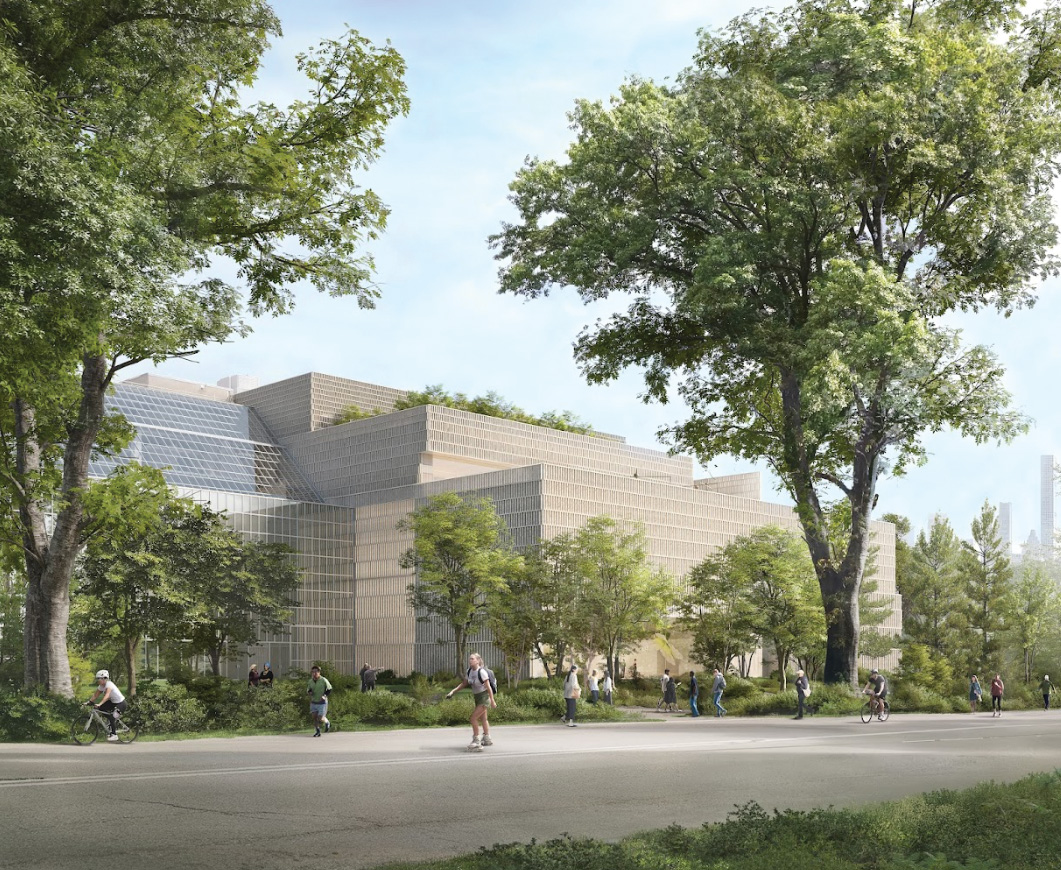
Rail: That’s architecture’s language. There’s a version of it that is literal—with blocks, modulation, a grid—that operates as a signature. Skidmore, Owings & Merrill (SOM) does it, Ludwig Mies van der Rohe did it. But you’re getting at something beyond the language of architecture, which is not just an aesthetic project, but a way to organize space to produce more elaborate sentences, or something that doesn’t even use the same language everywhere.
Escobedo: Maybe language extends to the idea of the symbol. I imagine that for certain architects, this might be a curved wall, or the juxtaposition of very specific geometries. I’m interested in the idea of the module because it can tell different stories, and because it’s a symbol in itself. You can see a brick, and in it a synthesis of very specific social agreements, like the fact that it needs to be the size of the bricklayer’s hands, and other consequences of industrial production, manufacturing, and construction. When you see a building, you can actually tell how many times a human has been laying bricks. In the same way, a massive Brutalist building tells a different story of its materials and making. Symbolism might be intrinsic, even though it doesn’t rely on these big gestures. It happens by looking at very simple elements to determine their origins and the condition under which they were produced. That’s what I am trying to experiment with.
Rail: Do you experiment with material or with construction? Your smaller projects especially contain a critique of how we build.
Escobedo: Yes. I think it has to do with understanding that humble materials could also be very sophisticated, and many of them still show the human hand. The sense of scale is important in a module. It’s not just the scale of the building itself, but the scale in the way that it was constructed. You see a building from a distance as a complete object that is part of the urban landscape. But when you approach it, you need to be able to understand how it was built by a human being.
Rail: You have a lot of projects in non-urban contexts too. Most of these are on stilts or contain screens: gestures that indicate a distanced relationship between architecture and nature. I get a sense that there’s a very particular perspective about how architecture and the natural world should relate.
Escobedo: Maybe it’s a little bit voyeuristic, you’re right. Maybe it’s a projection of my personality. I’m very aware of the need for intimate spaces, and how temperature, light, breeze, and sound all help to locate yourself in time and space. Time is probably the most relevant element of architecture; it is a compass of how time is passing. Breeze blocks allow for that passage of time, but also provides opportunities for making more comfortable architecture without having to include a lot of sophisticated technologies. On the other hand, the stilts have to do with attempting to not touch the ground as much. Sometimes, it’s better to integrate the architecture into the land, so that it’s emerging from the ground and is a part of the topography. Other times, it’s better to just lift a little, beyond the canopy of the trees, to allow for things to continue their life and way of being below, and have as light a foot as possible.
Rail: There is a sense of protection, not as a heavy wall or similar, but from lightness that creates a sense of safety. It reminds me of Lina Bo Bardi’s Casa de Vidro—a big observational platform in the forest, where you feel protected. Did you have a relationship with modernism growing up?
Escobedo: Mexican modernism was not necessarily about functionalism—that was one aspect of it. There’s a different type of expression—elaborate murals from Juan O’Gorman, which you can also see on the Biblioteca Central of the National Autonomous University of Mexico. It’s a box, and a very functional repository of books, but it’s also super ornate, and so full of meaning. The material itself is telling a story of a country—the catalogue of colored stones show the geographical variations, all the temperatures, all the different types of soils, and you could even imagine the gastronomy that emerges from that. It’s telling you so much, and it’s not trying to become a perfect machine. It’s quite the opposite. It’s trying to become very complex and to allow for art to be integrated into it. I didn’t grow up in a building like that, but now I’m living in one. So you just see it every day.
Rail: I am curious to hear more about what’s coming up for you. You’re working on a project at the Met and a collaboration on Centre Pompidou, both of which have experienced change differently in their histories. It’s an exciting position to be in, doing projects of such cultural significance. It’s exciting seeing these institutions take a risk of sorts—which shouldn’t really be a risk at all—with a young architect. It seems like there’s no commissions, fewer competitions—the types of projects that often launch architectural careers.
Escobedo: I feel like I’m in a very privileged moment right now, but at the same time, I think many of the architects that have been doing cultural institutions of this magnitude did start at my age. I’m relatively new to the city, but I see it changing very much—the Brooklyn and Manhattan skylines, museum extensions and additions at the Frick, the New Museum, the Met. I think this is a city that will continue to change and evolve. I understand that there’s complexity in the world right now that, of course, is changing things. Maybe it’s a very American perspective.
I wish I could just say, “Yes, I feel extremely lucky and grateful for these two opportunities.” But I’m also thinking about what comes after that, and I don’t think it’s just about moving into the path of super visible museums or institutions with astronomic budgets. It’s trying to go back to where we can actually focus our attention that is meaningful. Lesson one: what is the next step? It’s not necessarily becoming a larger office, either. Rather, how do we start choosing our clients, and have more time to develop a project which sounds crazy? The idea of slowing down is very attractive to me, because I think we’re just speeding things up constantly.