
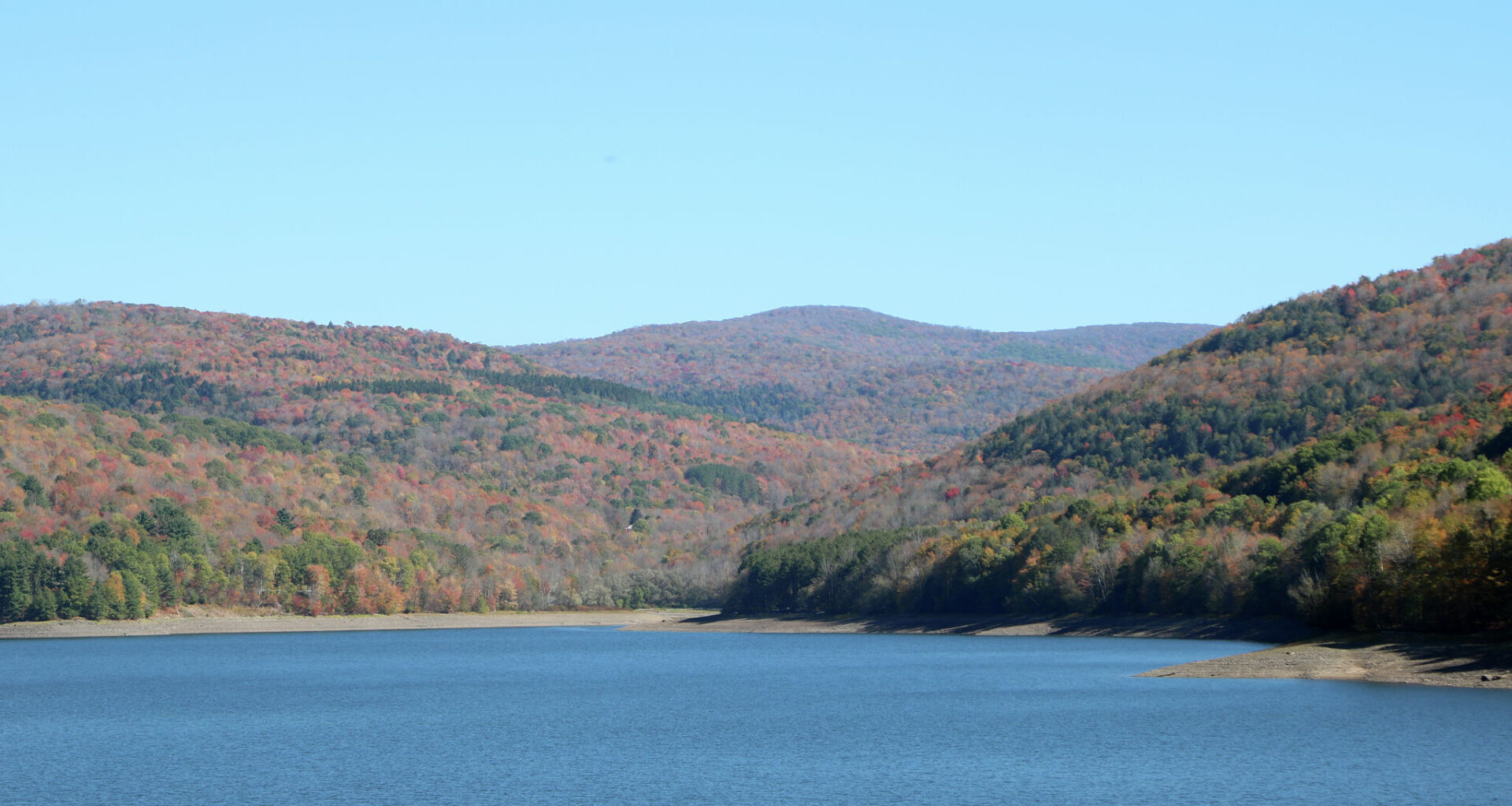
Pepacton Reservoir in the Catskill Mountains, one off the water bodies that feeds New York City. The city and Catskill leaders reached an agreement about how the former will purchase land around the reservoirs Tuesday.
Tyler A. McNeil/Times Union
DELHI — The Delaware County Board of Supervisors and New York City reached an agreement Tuesday that clears a major hurdle in determining how the city buys land in the Catskill Mountains.

The two-year agreement satisfies several requests local leaders made during the four years of negotiations over how the city purchases land around its reservoirs in the Catskills. It also extends city-funded programs that offset the impact the purchases have on towns and further protect the reservoirs’ watersheds.
Article continues below this ad
The leaders of the two other parties to the agreement — the Coalition of Watershed Towns, which comprises local leaders from Ulster, Greene, Sullivan and Schoharie counties, and the nonprofit Catskill Watershed Corporation — both said they expect to ratify it next month. But environmental groups that had been part of the negotiation process were cut out of the talks during the final months, fomenting displeasure in the local environmental community.
The New York City Department of Environmental Protection has bought more than 220 square miles of land in the Catskills since a 1997 agreement with the state Department of Health allowing the city to continue piping the reservoir water to customers in the city and parts of the Hudson Valley without a filtration system, which would cost billions of dollars to build. The land purchases are meant to protect the drinking water from runoff.
Town and county leaders have often chaffed under the purchases, saying they depress local economies and undermine the self-determination of the region. But Delaware County, which had been the loudest voice of opposition in the negotiations, signed the agreement Tuesday in Delhi with DEP Commissioner Rohit T. Aggarwala in attendance.
The agreement incorporates many previously agreed-upon items. Its most significant part is codifying a change to the land-buying program negotiated in October 2024. That program, the Land Acquisition Program, began after the 1997 agreement and allowed the DEP to solicit land purchases from property owners. It is responsible for the vast majority of land purchases by the city.
Article continues below this ad
The modified program does away with these purchases in most of the Catskills watershed. The main reason was a 2020 report commissioned by the city from the National Academies of Sciences, Engineering, and Medicine that said the Land Acquisition Program had successfully protected the reservoirs, rendering further large land purchases unnecessary. The report suggested a better use of the city’s resources would be to focus on smaller purchases near streams that feed the reservoirs. Those began under the Streamside Acquisition Program, which focuses on parcels of fewer than 10 acres in these areas.
The new agreement modifies the Streamside Acquisition Program and expands it to include the entire watershed, except Delaware County, which has the option of joining in the future. It also requires the DEP and the town to agree on the purchase before contacting the landowner, and requires a group of stakeholders to develop a stewardship plan for the parcel.
Under the agreement, cell towers and renewable energy projects can be constructed on vacant, city-owned land in the watershed, Delaware County Board Chair Tina Mole said at the signing. This was a major sticking point for the Catskills, where cell service is sparse.
The agreement also extends various efforts the DEP says preserve the purity of the reservoirs and aid locals. These include a program for repairing and replacing septic systems, which aids homeowners and keeps refuse from leeching into reservoirs. The DEP committed $30 million to the program until Dec. 26, 2029.
Article continues below this ad
Negotiations
The negotiations over the agreement, which included town leaders, the DEP, the Catskill Watershed Corporation and environmental groups, were often fraught, and the DEP withdrew from negotiations in early June.
When the parties reconvened in October, environmental groups were not invited to the table. Riverkeeper Legal Program Director Michael Dulong said the organization was not given a reason and has not received a copy of the agreement. He expressed concern “that watershed protection would be undermined without being first informed by our scientific expertise and our 30 years of knowledge in the watershed.”
Article continues below this ad
Riverkeeper is a signatory to the original 1997 agreement that started the land-buying program. DuLong said he expected the group would be part of future negotiations.
The new pact lasts only two years and is intended to buy time for the parties to negotiate a new, 10-year agreement for the city to continue to use unfiltered water.