
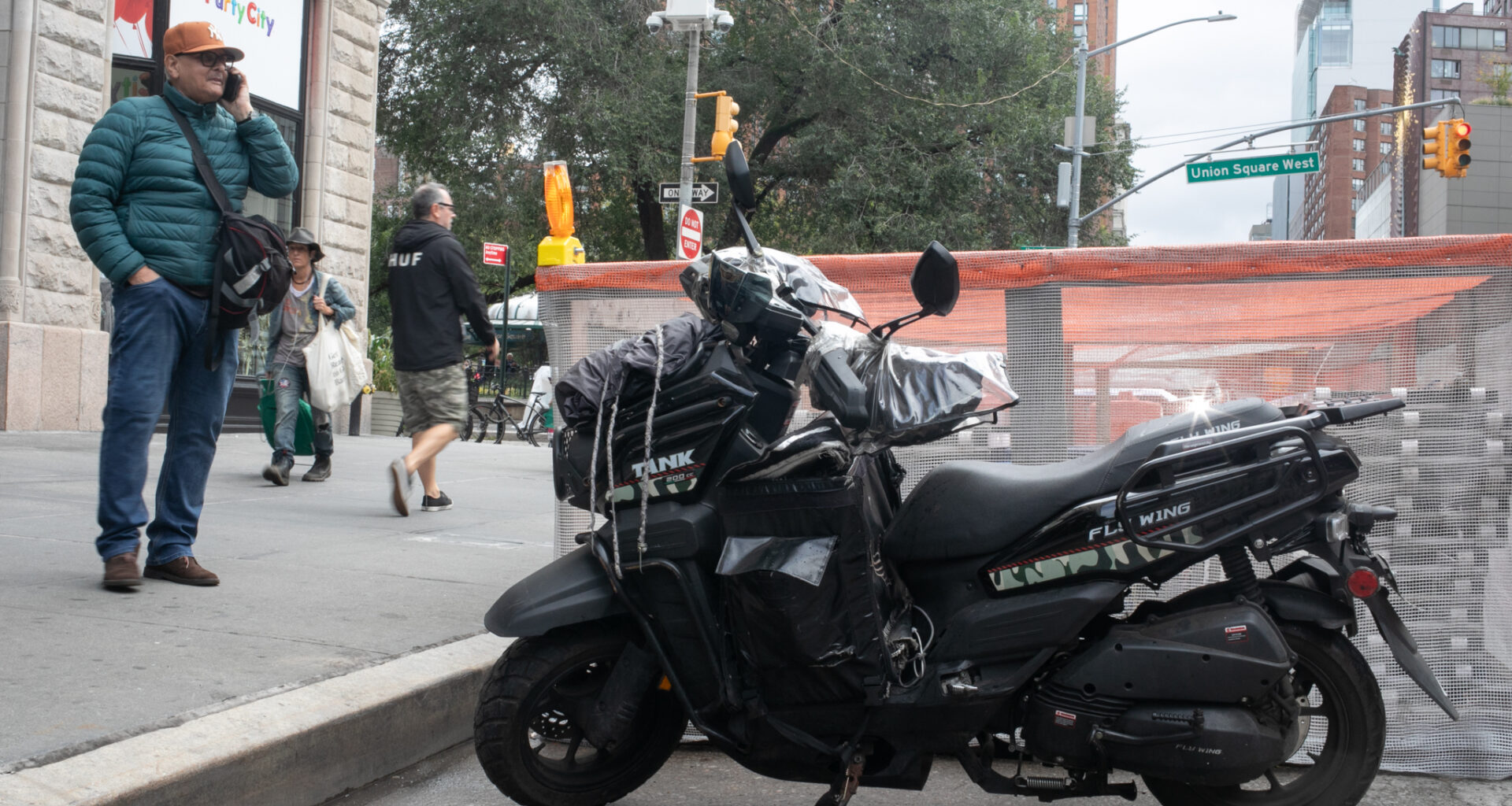
On the afternoon of January 2, a 26-year-old Guatemalan construction worker on a moped was pulled over by NYPD officers in South Brooklyn in a traffic stop that could shape the rest of his life.
The NYPD stop set off a chain of events that has left J.I.T, who had been living in the United States for a decade, locked up inside an ICE detention center in Orange County for eight months and counting as he fights for his release and the right to stay in the United States.
THE CITY is referring to the man as J.I.T., the initials used in federal court filings, due to his ongoing immigration case.
Because J.I.T was fingerprinted during his traffic stop arrest, a record was transmitted automatically from the NYPD to a statewide database, and from there to the FBI’s national database — where it was crosschecked against ICE’s database of all known immigrants who are not citizens.
On February 2, a month later and days after President Donald Trump’s inauguration, ICE agents came knocking on his door, taking J.I.T. away in handcuffs. His arrest was part of an interagency sweep across New York City that the Trump administration described at the time as targeting immigrants who are “violent criminals.”
The incident, advocates say, highlights how minor infractions can raise a red flag for immigration authorities even in sanctuary cities like New York, where outright coordination on immigration enforcement is banned.
“I know we’ve committed an error, we’re here illegally, I understand that,” Erwin, J.I.T.’s 29-year-old brother told THE CITY in Spanish. THE CITY is also withholding Erwin’s full name because he fears government retaliation. “But they’re going to shut him up for eight or nine months, just because of a moped. It’s not just.”
 The NYPD had thousands of mopeds, scooters and motorcycles impounded at their Red Hook, Brooklyn facility, July 14, 2025. Credit: Ben Fractenberg/THE CITY
At the time of the Jan. 2 stop, J.I.T. had been riding on an unregistered moped, without insurance and with a fake plate, NYPD officers alleged at the time. He was pulled over in the type of traffic stop that later soared under Mayor Eric Adams, as his administration cracked down on the unregistered motorcycles and mopeds that have proliferated on city streets, confiscating and sometimes then destroying thousands of them.
The officers wrote J.I.T. four violations, for driving on a suspended license and operating the motorcycle without insurance, court records reviewed by THE CITY show. They also arrested him for “possession of a forged instrument in the third degree,” a criminal charge, citing the fake license plate.
J.I.T. was handcuffed, fingerprinted, held at Brooklyn’s 62nd Precinct for hours, taken to central booking and then arraigned in Brooklyn Criminal Court, an ordeal that lasted almost two days, his brother recalled.
“One hour, two hours, nothing, the next day, nothing,” Erwin recalled. After his release, J.I.T. decided to abandon the moped with the police instead of reclaiming it. “‘Better I just leave it there. I don’t want to have any more problems,’” Erwin said J.I.T. decided at the time.
An ICE ‘Encounter’
But J.I.T.’s problems didn’t end there. By the end of January, new Department of Homeland Security Kristi Noem came to New York for a dramatic day of raids targeting what she said were “violent criminals, including a ringleader of Tren De Aragua.”
J.I.T. was one of the people arrested in that first wave of ICE raids. Federal agents came pounding on his apartment door in South Brooklyn where he lived with three other brothers early on a Sunday morning in February.
While J.I.T. had pending criminal charges at the time of his ICE arrest, none of those would have made him a “violent criminal.” In addition to the charges from his traffic stop, he also faced petty larceny and criminal possession of stolen property in the fifth degree charges from a 2017 arrest for allegedly picking up a wallet he found in a bodega. Both cases have since been dismissed and sealed, Kings County court records reviewed by THE CITY show.
Because the forged instrument charge is a misdemeanor, requiring a person’s fingerprints by state law, J.I.T.’s arrest was flagged for ICE as part of a routine and automated process that happens thousands of times a month.
When the NYPD fingerprints someone, that information is uploaded to a statewide database that automatically checks for New York State warrants and criminal history and also crosschecks them with the FBI’s national database for criminal history in other states, sending a report back to the NYPD within minutes. In querying that national database, the FBI also logs a record of the arrest, which is then run against ICE’s database of immigrants.
In J.I.T.’s case, ICE became aware of his arrest four days later, on Jan. 6, according to ICE “encounter” data obtained by the Deportation Data Project through a Freedom of Information Act Request. In addition to a record of actual arrests, “encounters” include a record of every time ICE matches FBI booking information with someone in its database of immigrants, according to the Deportation Data Project.
Between January and July, THE CITY was able to identify 246 other examples similar to J.I.T.’s, where an electronic ICE encounter in the New York City area occurred before that person’s arrest by the federal immigration enforcement agency. That was nearly three times the number of people arrested that way during the same period last year.
Most of those records had no details about the criminal cases of people detained, and the data don’t appear to track pending criminal charges, only convictions. For the thirty percent that did have convictions detailed, the most common one was “disorderly conduct” followed by driving under the influence of liquor, with 14 and 11 convictions respectively, followed by eight assault convictions.
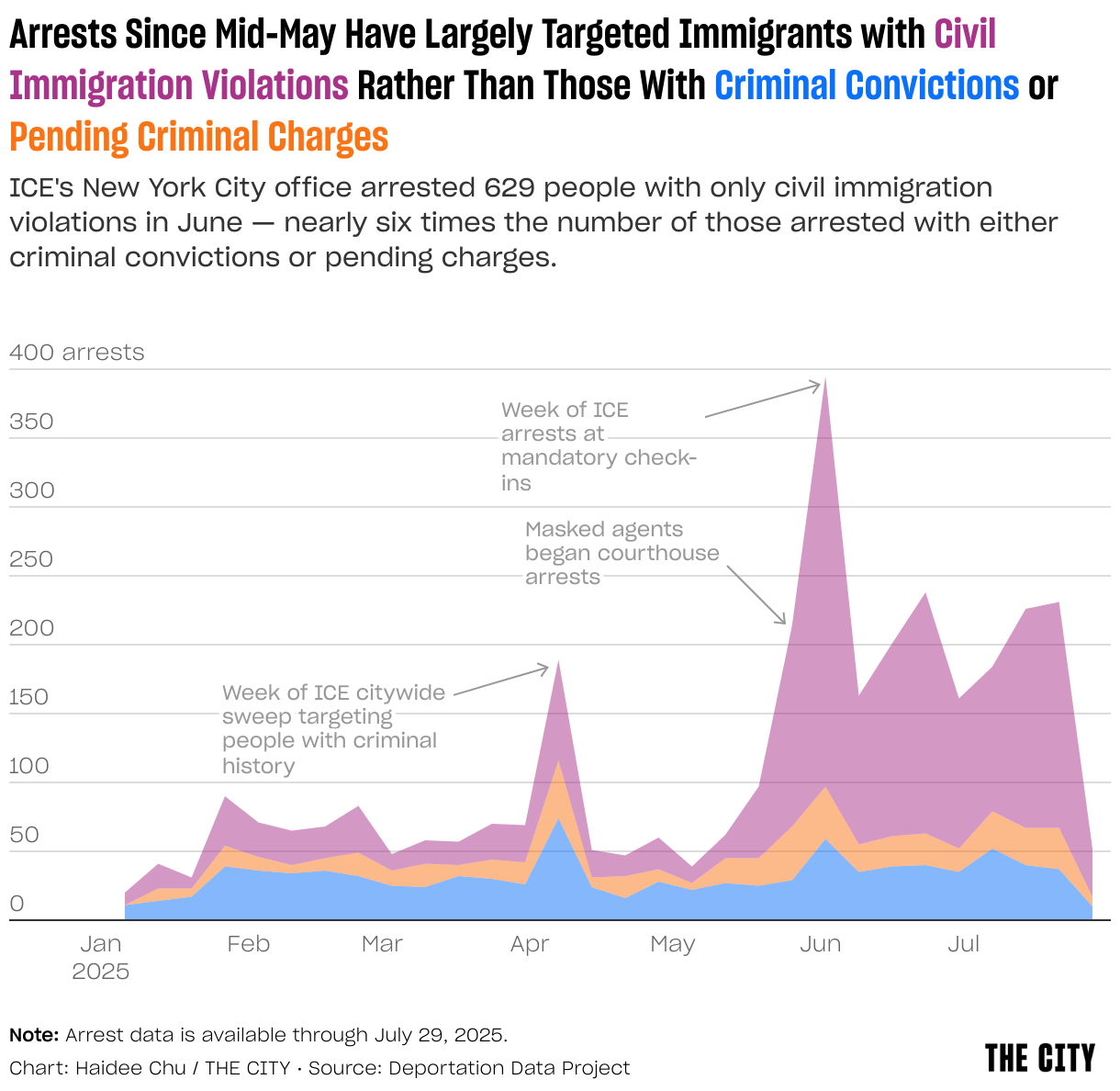
During the first few months of Trump’s second term, data shows overall ICE arrests focused on people with pending charges or criminal convictions, like J.I.T.. But as the administration widened its dragnet, ICE is increasingly arresting people who have no prior interaction with law enforcement.
Janine Kava, a spokesperson for the state’s Division of Criminal Justice Services, which oversees the statewide fingerprint database, said the office “has no role in civil immigration enforcement.”
“State law outlines when law enforcement agencies are required to send fingerprints of individuals arrested to DCJS,” she said. “Upon receiving arrest prints, we are statutorily required to provide the arresting agency with any New York State criminal history records and/or warrants, and/or any out-of-state records and/or warrants.”
A spokesperson for the Department of Homeland Security and ICE hasn’t returned THE CITY’s request for comment on its priorities for deportation.
Sarah Vendzules, the director of the Immigrant Justice Team at The Legal Aid Society, said low-level arrests triggering ICE enforcement before the person had been convicted had been rare before this year. Now she said, the agency is “bragging about rounding up all these criminals, and so it doesn’t really matter to them if it’s somebody who bought a motorcycle with a fake plate, as long as they can say he’s a criminal.”
The NYPD did not immediately respond to a request for comment about its efforts to crackdown unlicensed motorcycles or its fingerprinting policies.
Albert Fox Cahn, director of the Surveillance Technology Oversight Project, said it may be time for New York state to rethink its fingerprinting policies.
“In this sort of environment, given the weaponization of federal law enforcement even going beyond ICE, there’s a real question of whether it’s worth it to run a warrants check for someone who’s arrested for a petty offense,” he said. “Cops may claim that the sky falls if you don’t, check every person for a warrant, but the cost is increasingly intolerable.”
A spokesperson for the NYPD didn’t return a request for comment on its fingerprinting practices.
‘It’s Me They’re Looking For’
J.I.T. arrived in New York City after crossing the border alone when he was 17-year-old back in 2016. He was the second youngest in a large family of seven siblings from the Maya K’iche indigenous community in the small city of Nauhala, Guatemala, but the first to make his way to the United States, determined to find a better life for himself.
While J.I.T. initially dreamed of studying, with no one to support him, he started working right away, first as a dishwasher in a restaurant, Erwin said.
J.I.T. was soon making enough to start sending money back to his older siblings and parents in Guatemala, inspiring five other siblings to make the journey over the course of Trump’s first presidency. “That motivated all of us,” Erwin said.
As ICE agents banged on J.I.T’s door in the predawn hours of Feb. 2, the family cowered inside debating what to do, Erwin recalled.They tried to call a lawyer but couldn’t get one on the line. They asked for a warrant, but ICE agents didn’t show one. The agents threatened to break down the door, though they made no move to do so. The standoff lasted for hours with the agents eventually leaving the building and waiting in cars parked outside.
After around six hours J.I.T. decided to surrender, concerned about jeopardizing the rest of his family. In addition to his three brothers, a sister and neighbor had also been staying the night, visiting to mourn the recent death of a brother-in-law.
“I don’t want to get you all in trouble. And it’s me they’re looking for,” he told the family, Erwin recalled.
The last time Erwin saw his brother, J.I.T. had his arms raised in the air as he was swarmed by the awaiting officers. They put him in handcuffs and shackled his feet together, loading into a car and driving away, as his siblings watched from the apartment window in horror.
J.I.T.’s prolonged detention has rocked the tight-knit siblings, their little brother, who’d inspired all his siblings to seek a better life in this country, caged for months with no end in sight. Because of their own immigration statuses the siblings fear going to visit him in Orange County, though it’s just a short drive from New York City. Attorneys with the Legal Aid Society are representing J.I.T. in his asylum case, which is currently on appeal, as well as in a federal lawsuit seeking his release.
Over phone calls with J.I.T., the siblings are trying to keep up his spirits, and despite his eight months behind bars, he still hasn’t given up on the prospect of a better future here, Erwin said. “He still has hope that he’ll be able to stay.”
Haidee Chu contributed to this report.
Related