
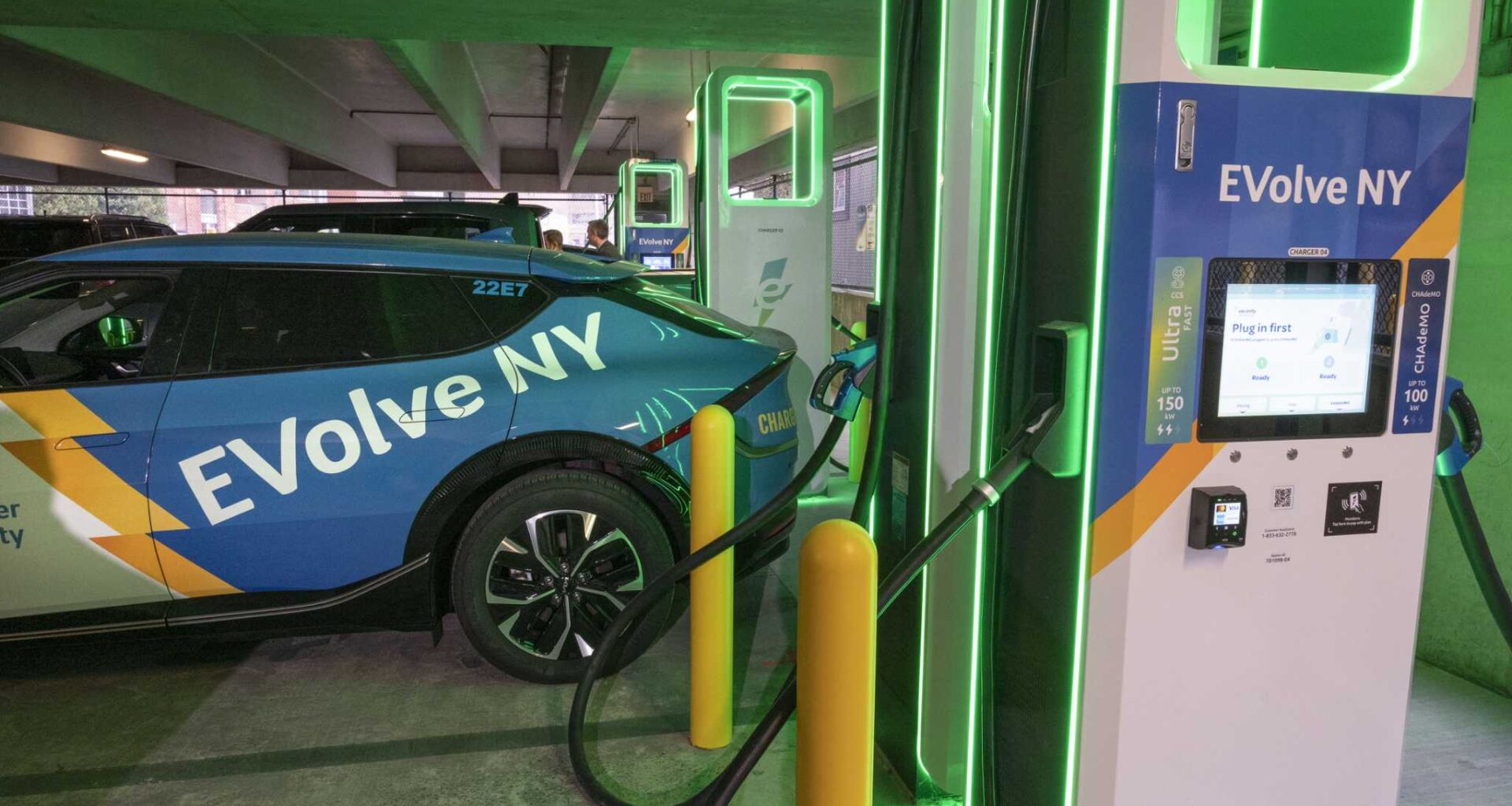
New York’s Climate Act mandates that beginning in 2035 all new vehicles purchased in the state need to be electric.
Lori Van Buren/Times Union
Former Gov. Andrew M. Cuomo championed the 2019 Climate Act but later shut down a productive nuclear power plant, slowing the legislation’s implementation.
Darren McGee/New York State Governor’s Office
The 22-member Climate Action Council published recommendations on how the state should meet Climate Act mandates.
Will Waldron/Times Union
Solar power is essential in the state’s energy plan but is expensive to develop in New York.
Jim Franco/Times Union
Some home builders are leaving the state because of an impending requirement that new construction use all-electric appliances.
Will Waldron/Times Union
Offshore wind projects were envisioned to be a critical resource but are being developed at a slow pace.
Rick Karlin/Times Union
ALBANY — New York’s sweeping 2019 Climate Act set strict mandates for shifting away from fossil fuels to more “clean energy” sources. But with progress stagnating and consumers bearing more costs, it’s increasingly harder to ignore the gap between policy ambition and the state’s ability to deliver.

The Climate Leadership and Community Protection Act established into law a series of priority requirements:
Article continues below this ad
Greenhouse gas emissions in the state need to be reduced 40% by 2030 and 85% by 2050 relative to 1990 levels.
The state’s electric system should use 70% renewable power by 2030, and be 100% clean energy in 2040.
The “beauty and the beast” of the Climate Act is that while it sets strict mandates, it does not lay out how to meet them, said Vincent M. Nolette, who maintains a tracker of the state’s progress on climate action for Columbia Law School.
A year after the legislation passed, the state formed the Climate Action Council, whose 22 members included energy sector experts, state officials and other stakeholders who were tasked with mapping out a plan on how to meet the law’s directives.
But some say the state never fully considered the cost of implementing the law or what it would take to meet the decarbonization requirements.
Article continues below this ad
“There was no fiscal (analysis) and there was no statement of how effective this will be, it was just like we have a crisis,” said Ron Epstein, a former executive deputy commissioner at the state Department of Transportation.
Epstein agreed climate change is a “crisis,” but he said the plan was never studied for its financial effects on New Yorkers.
“To be determined” is what’s listed under the “fiscal implications” section of the law on the New York Senate’s website.
National Grid customers pay an extra 9.5% on their electric bills to fund components of the law, according to a recent state Department of Public Service report. But more than $8 billion in transmission projects to connect renewable energy development to the grid has yet to be added to New Yorkers’ electric bills.
Article continues below this ad
There have been areas of success toward meeting clean energy and emission reduction requirements, but overall the state is far behind. The Department of Public Service’s report also found the renewable energy requirement won’t be met until at least 2033, three years after the law requires.
New York’s grid is also dirtier today than it was when the law passed. That can be largely attributed to former Gov. Andrew M. Cuomo’s decision to close Indian Point, a nuclear power plant in Westchester County.
Even though certain sectors like electricity and large industry have seen emissions declines, there’s only been about a 9% decrease in carbon dioxide emissions relative to 1990 levels, according to the state Department of Environmental Conservation.
Article continues below this ad
It will take until at least 2036 to reach a 40% reduction in emissions, according to the state Energy Research and Development Authority. The authority recently acknowledged that fossil fuel energy sources will be necessary through 2040, including petroleum and natural gas.
Gov. Kathy Hochul has signaled willingness to delay the mandates. She also is embracing building more energy sources like nuclear power plants and adding natural gas pipelines, winning praise from many of the plan’s skeptics but angering progressive lawmakers and environmental advocates.
The 2022 scoping plan laid out more than 100 recommendations to achieve the Climate Law mandates. Five components will determine whether the law will be achieved and at what cost.
All-electric buildings
Buildings make up 31% of the state’s fossil fuel emissions, more than any other sector. The Legislature passed a law requiring new homes be built without fossil fuel appliances starting next year and, in 2029, it will apply to all new buildings.
Article continues below this ad
But when those rules will go into effect remains unclear because the state abruptly agreed to pause implementation of the policy until a legal challenge brought by home builders and labor unions is resolved. Attorneys for the state had been defending the mandates in legal disputes until Hochul publicly said she was open to delaying the electric building requirements, which critics contend will drive up construction costs and contribute to the housing shortage.
Environmental advocates Building electrification advocates counter electrified homes will not only be better for the environment but also cheaper in the long run. The policy is critical to moving the state off natural gas for home heating. Instead, electric homes utilize heat pumps, which extract warmth from cool outside air. More than 22,000 heat pumps were installed in homes and businesses across the state last year.
The electrification mandate will only worsen the state’s punishing housing crisis, said Michael Fazio, executive director of the New York State Builders Association. It will cost around $5,000 more to build an average-sized home in Albany County that is in compliance with the new rules, according to data from a state study and the Federal Reserve Bank of St. Louis. Those homes would have lower energy bills, but it will take around 11 years for those savings to catch up with the additional construction costs.
A group of 19 Assembly Democrats signed onto a petition calling for the rules to be delayed “pending thorough reassessment of grid reliability, cost impacts and risk mitigation.”
Article continues below this ad
Assemblyman William Conrad III, who drafted the petition, said he’s worried about grid reliability as large electric users like AI data centers and Micron’s chip fab plants expand in western New York.
Solar on every roof
The Climate Act requires the installation of six gigawatts of rooftop and small-scale solar by the end of this year, enough to power roughly 1 million homes. The state reached that goal a year early and is anticipating more than 10 gigawatts being online by the end of the decade.
Incentives, funded in part by fees on New Yorkers’ utility bills, cover a large share of the cost to install solar on rooftops. Low- to middle-income New Yorkers can get more assistance to cover the upfront cost of rooftop solar. Growth may slow as a federal tax credit covering up to 30% of a system’s cost is scheduled to end this year as a result of the Republican-led Big Beautiful Bill Act.
Article continues below this ad
New York is a national leader in community solar projects, with three times more installed than any other state. The arrays take up less than 100 acres, with nearby homes and businesses getting the biggest share of the electricity produced. Larger solar projects are sited at the state level, limiting the role local governments and residents have in their construction.
Matthew Antonio, director of National Grid’s transmission control center, said the proliferation of small-scale solar projects “has made our hot days a little bit easier to manage.”
The same progress hasn’t been made in building up large-scale wind and solar power projects.
New York is 19th in wind and solar energy capacity, despite seeing above-average growth over the last year, according to the U.S. Energy Information Administration.
Article continues below this ad
New York has 20 times the population of South Dakota but produces about the same amount of wind and solar power.
Cost can be a huge factor.
Because other states are usually sunnier and windier than New York, more renewable energy can be produced at the same upfront cost, thus lowering the eventual amount paid by residents.
Article continues below this ad
It’s 42% more expensive to develop solar power in New York than in mid-Atlantic states like Ohio, Pennsylvania and Virginia, according to the Lawrence Berkeley National Laboratory.
Gavin J. Donohue, president and CEO of the Independent Power Producers of New York, said the state should incentivize more forms of zero-emission energy than just nuclear and renewable power sources. Zero-carbon energy sources like carbon capture, and renewable natural gas where carbon emissions from a fossil fuel plant are captured and stored underground, can be developed at the sites of aging natural gas plants, noted Donohue, who was a member of the Climate Action Council.
Build it offshore
New York’s 2,625 miles of Atlantic Ocean shoreline make the state an optimal place to build up offshore wind. The slow rollout of those resources is indicative of the unending setbacks to the Climate Act. Wind blows much faster over the ocean’s surface than over land, meaning those facilities more often produce at maximum capacity.
Article continues below this ad
The Climate Act mandated that by 2035 the state should have nine gigawatts of offshore wind. About 1% of that goal is in service.
When former Gov. Andrew M. Cuomo signed the mandates into law, he concurrently announced two offshore wind projects off the coast of Long Island. When completed, Empire Wind One and Sunrise Wind are expected to provide nearly two gigawatts of electricity. Cuomo promised they would be in place by 2024, but they’re both delayed three years.
In May, Hochul fought a federal halt on the Empire Wind One project, allowing it to continue construction. Offshore wind development relies on federal approval because it’s built in federal waters.
It may be a challenge for New York to make further progress on the offshore wind mandate as President Donald J. Trump’s administration has questioned the ability of those projects to provide energy versus the costs associated with fossil fuels.
Article continues below this ad
The Department of the Interior is “halting future offshore wind lease sales,” Secretary Doug Burgum announced in July.
Burgum said he’s also examining more than 3.5 million acres offshore that were designated as pre-approved wind development zones under President Joe Biden’s administration.
The industry was suffering before Trump took office. In 2024, developers canceled another offshore project near Long Island, citing inflation, high interest rates and supply chain issues. After a decade of declining prices thanks to low interest rates, the cost of offshore wind projects increased 40% to 60% between 2020 and 2024, the consulting firm McKinsey reported last year.
Yet to launch
Implementing a cap-and-invest program where large manufacturing and fossil fuel power plants pay to emit greenhouse gases is a core component of achieving the 2019 law’s mandates. About 30% of payments are then given back to New Yorkers in rebates.
Article continues below this ad
The rest goes toward investments to “support the transition to a less carbon-intensive economy,” according to the Department of Environmental Conservation.
Hochul directed state agencies in early 2023 to develop the program to “create a cleaner, greener future while helping New Yorkers with the costs of the transition.”
The rules were completed by state agency staff early this year but never released, Politico reported.
Without guaranteed revenue from cap-and-invest, the climate law Climate Act is an “unfunded mandate,” Donohue said.
Article continues below this ad
And for Hochul, the risk of implementing the measures under the timeline set in the law is too likely to increase living costs for New Yorkers.
Low-income New Yorkers would see a small savings from the program, while costs would rise for middle-income residents, according to state research on cap-and-invest.
But the state’s cap-and-invest study doesn’t “include estimates of the program’s full fiscal and economic impacts,” wrote the Citizens Budget Commission, a New York-based nonpartisan think tank.
“It’s going to make businesses less likely to do business here, or to create jobs or to expand here,” state Senate Minority Leader Robert G. Ortt said.
Article continues below this ad
Delaying implementation may be out of Hochul’s control. In October, Ulster County state Supreme Court Judge Justice Julian Schreibman ruled the state is violating the Climate Law by not initiating strong enough greenhouse gas reduction policies The state needs to meet the Climate Law deadlines unless the Legislature amends the law, Supreme Court Justice Justice Julian Schreibman ruled in October.
Schreibman gave the state Department of Environmental Conservation until February to release its rules to bring down carbon emissions.
Hochul signaled the state will appeal the ruling while she works with the Legislature to amend the Climate Law and push back the mandates.
‘Guinea pig’
By 2035, all newly purchased passenger vehicles in the state are required to be electric. And the state’s roughly 45,000 school buses need to be zero-emission by the same deadline.
Article continues below this ad
About 10% of new car purchases in New York are electric. That’s about half the rate of other states with zero-emission vehicle encouraging adoption, including California.
So far, New York has 229 electric school buses in operation, with about 800 more on the way, according to the Electric School Bus Initiative. Purchasing enough buses for the mandate will cost more than $9 billion, according to the Empire Center, an Albany-based research organization. Incentive programs will cover 10% of that added cost, the center said.
Almost half of school districts told the state Education Department they need to make significant upgrades to their local electric system to support electric bus charging. Electric buses are one and a half to up to two-and-a-half times more expensive than fossil fuel alternatives, the Education Department reported last year.
Article continues below this ad
Electrifying the state’s school bus fleet would have the greenhouse gas reduction effect of taking 180,000 cars off the road, according to state estimates. Exposure to diesel exhaust, which the vast majority of school buses emit, leads to asthma and respiratory illnesses, according to the U.S. Environmental Protection Agency.
“Why are we making our school districts and local property taxpayers be the guinea pig for this social experiment,” state Assemblyman Philip A. Palmesano said of the school bus mandate.