
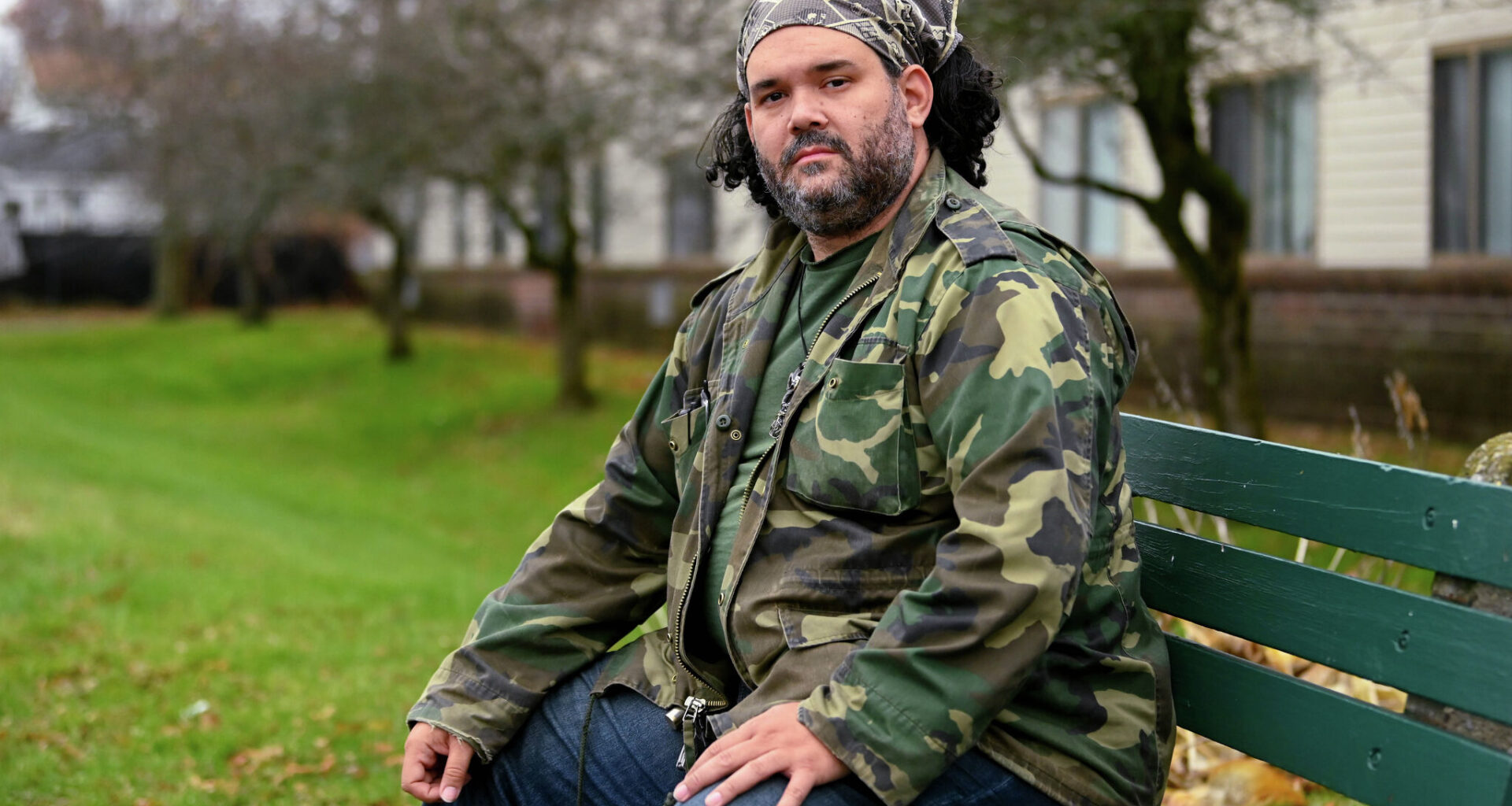
Tenant Eric Dinnen is seen in front of his new apartment building on Wednesday in Colonie. He won his case against his landlord in court, but is still waiting to get paid.
Lori Van Buren/Times Union
ALBANY — The day Eric Dinnen’s bathtub rained water into the apartment below, he had no idea it would cost him nine months of court hearings, hundreds of dollars in fees, missed work, and a slow unraveling of his health.

When the landlord allegedly did little to address the damage and raised the rent on Dinnen’s one-bedroom apartment on Elizabeth Street in downtown Albany, the 45-year-old photographer took her to court.
Article continues below this ad
Again and again, he walked to the courthouse to ask a judge to order repairs and reduce his rent. In February, he won: Albany City Court Judge Ricja Rice ordered his landlord to pay him almost $4,000 in past rent. While he is still waiting for his landlord to pay him, Dinnen managed to withhold enough future rent to move his family out.
“It was vile, it was exhausting, it was another thing that needed to be scheduled,” said Dinnen, who represented himself because he was unable to find an attorney who would take his case and didn’t qualify for nonprofit legal aid services.
Dinnen’s nine-month legal saga is one of 320 cases plodding through upstate New York courts since 2024 under a new legal process lawmakers enacted two years earlier, according to a Times Union analysis of state data.
Renters, often living in squalid conditions, are now emboldened by the Tenant Dignity and Safe Housing Act. They spend months, sometimes more than a year, suing their landlords, property managers or housing authorities.
Article continues below this ad
Most of the cases, which under the statute are known as article 7-D petitions, are playing out at Albany City Court, across the street from the Capitol, according to data from the state Office of Court Administration. Albany saw 70 cases, more than any other city reviewed. Syracuse followed with 63 cases.
Landlords can be sued much like tenants in eviction cases. Judges can order repairs, set the rent owed until those repairs are completed and refund past rent.
City Hall, left center, on Nov. 25 in Albany, is across the street from the New York Capitol. The courthouse on the second floor of City Hall has heard the most repair cases since 2024.
Jim Franco/Times Union
Before the law, upstate tenants could only pressure allegedly negligent landlords by withholding rent, a risky move that could trigger a nonpayment eviction. Now, eviction proceedings can be combined with repair cases.
Article continues below this ad
While slow to catch on, housing advocates say the petitions afford tenants new power to target landlords who have allowed properties to fall into serious disrepair.
“It is a big shock to tenants that they can bring a claim against a landlord themselves for repairs,” said Allison Dentinger, a tenants’ rights attorney for the Hudson Valley Justice Center. “It’s new for landlords as well to be held to account.”
Multiple landlords named as defendants in the petitions who were contacted by the Times Union either didn’t respond or declined to comment. Most landlord groups interviewed said they were unaware of the Tenant Dignity and Safe Housing Act, which passed without much publicity.
Some landlord groups said that local authorities, such as code enforcement, already closely enforce housing standards, and tenant legal action is unnecessary. Others said they worry that it could be misused because any complaint about the property is permitted.
Article continues below this ad
“Tenants use maintenance issues as an excuse for not paying rent,” said Richard Lanzarone, the executive director of the Housing Providers of New York State. “It’s a well-worn defense.”
Lanzerone said that while bad landlords exist, most maintain safe conditions and truly negligent owners “won’t be deterred by this law.”
Some judges have embraced the law, said Dentinger, a former tenant organizer who helped champion the law’s passage in 2022 and educates tenants about it in the Hudson Valley. Newburgh has had 10 of the cases since 2024, the most in the region, data shows.
Other judges, especially in smaller courts, initially refused to hear the cases or declined to enforce orders, at least in the early stages of the law’s implementation, Dentinger said.
Article continues below this ad
Meanwhile, statewide tenant protections remain inconsistent, said Sal Curran, executive director of the Volunteer Lawyers Project in central New York.
The law lost key enforcement tools in 2022 after Gov. Kathy Hochul removed what supporters said were stronger provisions from the original bill.
Courts still have the authority to order remedies under a broad clause, but the law doesn’t spell out concrete penalties, like requiring landlords to pay for temporary housing when apartments are uninhabitable.
As it stands now, outcomes vary widely, Curran said.
Article continues below this ad
“It’s difficult to counsel tenants because so much of it is discretionary,” Curran said. “Tenants have to decide how hard to push.”
‘Potentially costly and time consuming’
The law’s most powerful tool is that a judge can rule that past and future rent be abated.
An early case in Syracuse City Court in 2024 saw a judge reduce a tenant’s rent to $0 a month until the landlord addressed a list of repairs. In October, a renter in Albany agreed to pay her landlord $4,400 in back rent in exchange for the landlord fixing plumbing issues and hiring a permanent handyman.
Article continues below this ad
The largest award came from a Utica tenant in February, who secured $55,264 in damages after enduring deplorable living conditions and retaliation from her landlord.
For Curran, whose organization assisted in that case, success means an apartment is fixed so that it’s safe for human habitation and the tenant gets to stay.
Repair work being done on Eric Dinnen’s tub on Elizabeth Street in Albany. Dinnen took his landlord to court to force repairs in his apartment.
Eric Dinnen
“We’ve had tremendous cases where heat gets restored, water gets restored, windows are replaced, all sorts of things where the apartments do become fit for human habitation and the tenants do get to move forward,” Curran said.
Article continues below this ad
But a tenant’s success often depends on the judge and how far the tenant is willing to go.
Among the adjudicated cases, proceedings lasted an average of over two months, state data shows. One lawsuit in Albany went as long as 485 days. The longest active case, also filed in Albany, has lasted 588 days.
Dinnen represented himself and he’s not alone. The law allows renters to bring cases without an attorney, much like in small claims court. About 40% of tenants do so, while 45% have attorneys, state data shows.
Only 9% of landlords represent themselves, and some don’t show up at all. Tenants missed court 16% of the time, and landlords 43%. In some cases in Albany, judges have moved cases forward without the landlord and issued judgments.
Article continues below this ad
Dinnen’s situation made it possible for him to pursue his case. He worked a nontraditional job, his child was in school, and he lived within walking distance of the courthouse, he said.
“It’s a bunch of things that sound like they aren’t privileges but they very much were,” he said. “Without that very lined up manner of things, this would not have been pursued.”
Landlords and city officials have a different view of the law’s reach.
Lisa Benware, a board member of the Capital District Association of Rental Property Owners, said that she is vaguely aware of the Tenant Dignity and Safe Housing Act.
Article continues below this ad
“But I had discounted it because I believe that the local regulatory authorities should be and were taking care of these issues,” she said. “They certainly seem to be keeping a tight rein.”
A case filed under the new statute doesn’t take the place of code enforcement. Tenants don’t have to complain to code enforcement and the new law requires that the court send a copy of any petition to local officials.
While the law allows a new legal avenue, it can be tricky to get landlords to make repairs, especially those that don’t live locally or if they simply refuse. The court can issue further judgments against a landlord, put a lien on the property, or order them held in contempt of court.
Still, in practice, compliance isn’t always easy.
Article continues below this ad
“It’s a shame that some residents are going this route because it’s potentially costly and time consuming to get a landlord to comply,” said Rick LaJoy, Albany’s director of the Department of Building and Regulatory Compliance. “We’ve got a fairly good track record of getting compliance.”
Typically, code enforcement will issue a notice of violation and, if the landlord doesn’t comply, the city’s legal counsel will take them to court. Albany averages about 1,300 cases a month and city attorneys prosecute about 120 cases in that same timeframe.
LaJoy called the new court proceedings a “secondary measure” for tenants, who typically call code enforcement when there are outstanding issues.
However, he thinks that the law could be “another tool in the toolbox” for tenants.
Article continues below this ad
‘Tenants can be code enforcement’
A second powerful element is that the 2022 statute can head off nonpayment eviction claims, which are often tied to the hundreds of new repair cases working their way through local courts.
“It creates a fair playing field because now both parties have cases open and they’re able to request things on each side,” said Crista Edroi, a court advocate for the advocacy group United Tenants of Albany, which is helping to guide most tenants filing such cases in New York’s capitol city.
Edroi estimates that about half of the court cases filed under the statute that she’s seen are tied to eviction proceedings. There were only a handful of cases where the landlord didn’t also take action against the tenant for nonpayment, she said.
Article continues below this ad
In response to the law, MCV Law, a central New York firm, has promoted defending landlords against court claims. One recent blog post reads: “Has your tenant ever called code enforcement? Now your tenant can be code enforcement.” It calls the cases “a powerful new weapon in your tenant’s hands.” A representative for the firm declined to comment.
The floor sinking behind Eric Dinnen’s stove. Dinnen took his landlord to court to force repairs on his Albany apartment.
Eric Dinnen
Roland Nzaou, president of the Capital District Association of Rental Property Owners, owns one duplex and heads an organization of small mom and pop landlords.
He said the landlords he represents aren’t wealthy and do their best to follow the law and help tenants.
Article continues below this ad
“Most of us have a very good relationship with our tenant,” he said. “The law was made in good faith to make sure the house provided is safe for the tenant to live.”
But the law should reflect the interests of both tenants and landlords, Nzaou said. He pointed to stories of tenants destroying a landlord’s property. Landlords have few options to force the tenant to make repairs.
“Unfortunately, when it comes to a landlord trying to deal with the courts, it can often take months to have anything resolved,” he said. “Sometimes they give up because it seems like the court is really unbalanced when it comes to these issues.”
‘It almost killed me’
In March 2024, the United Tenants of Albany helped Dinnen file his petition under the safe housing act, asking a judge for a 50% rent reduction. He was in court every month from May through September last year.
Article continues below this ad
He declined to pay his rent for about five months. Until that September, he was without a working shower and his bathroom faced other bathroom code violations. Conditions worsened in November 2024 after his upstairs neighbor’s apartment leaked water into his residence.
“It rained literal gallons of dirty pipe water into my living room,” he said, an issue only addressed when code enforcement got involved.
Throughout the process, his landlord became “increasingly hostile, increasingly combative,” he said.
The stress took a physical toll. He experienced a sudden onset of Bell’s palsy, which he attributes to the ordeal. But he also suffered financially.
Article continues below this ad
Nine months ago, the judge ordered that his landlord didn’t “make a good faith and timely effort to remedy” repairs to the bathtub and bathroom flooring.
He was out hundreds of dollars in filing fees, as well as the $3,780 the court says his landlord owes him. His landlord did not respond to a request for comment.
Dinnen moved to an apartment in Colonie in April. However, he’s been unable to restart legal proceedings because he doesn’t have the funds to do so.
But through it all, taking his landlord to court was worth it, he said.
Article continues below this ad
“It still almost killed me,” he said. “I have nothing to show for it, except having been able to successfully get out of that apartment.”
Emilie Munson contributed reporting.