
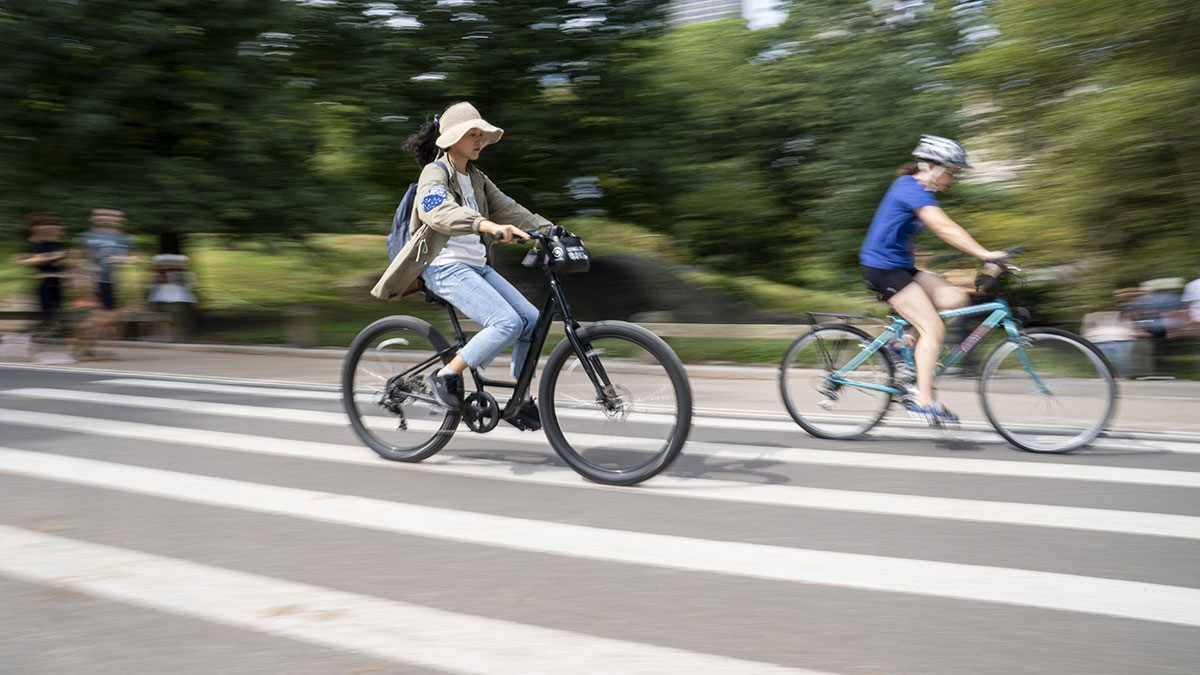
Describing his vision of Central Park in 1870, Frederick Law Olmstead said, “we want a ground to which people may easily go when the day’s work is done, and where they may stroll for an hour, seeing, hearing, and feeling nothing of the bustle and jar of the streets where they shall, in effect, find the city put far away from them.”
Well, sorry, Freddy, but the bustle and jar of the streets have taken over your park. Visitors today dodge e-bikes, delivery vehicles, and pedicabs at every turn.
Finally, a reason to check your email.
Sign up for our free newsletter today.
The situation might soon get worse. The Central Park Conservancy, Parks Department, and the Department of Transportation have proposed to allow e-bikes inside the park permanently, remove routinely ignored traffic signals, and redesign the park drive—or rather “reimagine” it—into an e-vehicle and delivery-bike superhighway.
Building on its Central Park Drives Safety and Circulation Study, the Conservancy is seeking to redesignate the park drive into three not-quite distinct lanes: one for pedestrians, one for moderate-speed wheeled devices, and one for “higher-speed” devices or vehicles. On paper, this seems simple—just turn the outer lane that once served cars into a faster-moving lane.
But this solution relies on two glaring flaws: crashes are massively underreported, and it’s unlikely that the murky rules aimed at the thousands of unregistered e-bikes zipping between pedestrians and disobeying traffic signals will ever be enforced.
Transportation advocates like to point to the relatively low numbers of collision reports in the Central Park Precinct (121 reported this year). But there’s good reason to believe injuries are much higher than reflected in this figure. Janet Schroeder, the founder of the NYC E-Vehicle Safety Alliance (EVSA), says that only seven of the 111 victims of e-vehicles her group represents have police reports. Of those seven, the vehicle stayed on the scene in only five.
Since medical staff tend to arrive and transport victims to hospitals before police arrive, victims rarely file reports. While victims can still file an M-104 report online, those forms don’t have a box to check for e-vehicles. They also provide convoluted instructions for reporting these incidents, including asking for a vehicle or license number, which rarely exist.
“I see [an e-vehicle injury] every single day,” said Ashley Pfaff, a trauma and critical care surgeon at Bellevue Hospital. Between January 2023 and August 2024 alone, her hospital saw 220 admissions from micromobility incidents. But she believes the real numbers are much higher, as the patients in her care are mostly severe cases requiring surgery.
Additionally, many medical charts provide minimal information, such as “struck pedestrian” or “bicycle accident,” without going into detail on the type of vehicle involved. Pfaff calls the influx of e-bikes, scooters, and delivery bikes on New York City streets an “increasing problem.”
But park goers don’t need to look at accident numbers to know that things are out of control. In a safety survey included in the Central Park Conservancy redesign study, the most common concern was “speeding bikes and e-bikes” (31 percent), followed by “dangerous pedestrian crossings” (17 percent).
Then there are the pedicabs, the vast majority of which are now motorized. The city has provided 850 pedicab licenses, but the actual number in use is somewhere between 1,200 and 3,000. On any given day, you can see them driving against traffic using expired or forged licenses, blasting loud music, and swerving onto the runner and pedestrian lanes to pick up tourists. They have become such a citywide hazard that a small group of operators have formed their own advocacy group, arguing, among other things, for harsher enforcement of existing rules on their own industry.
Central Park’s solution to these problems: give all these e-vehicles their own lane and remove the traffic signals aimed at slowing them down, because they are “largely ignored” anyway. The Conservancy tells pedestrians, “we recommend making eye contact or waving to alert approaching cyclists before crossing for added safety.” The message is clear: the reward for not following the rules is that the rules don’t apply to you.
The Conservancy has elected to turn its attention to other forms of transportation in the park—namely the four-legged, three mile-per-hour variety. Earlier this year, Conservancy president Betsy Smith decided to support banning horse and carriage rides in Central Park, claiming that it was “a matter of public health and safety for park visitors.” The 68 slow-moving horse carriages offering tours have long been a thorn in the side of those wishing to make Central Park more accessible to e-vehicles. Christina Hansen, who has operated a carriage in the park since 1976, claims it’s easy for city officials and advocates to scapegoat the horse “industry,” while making room for other, more hazardous forms of transportation like the new fleets of delivery bikes, which weigh about the same as horse and carriage combined but move five times as fast.
Though the horses’ working conditions tend to arouse public concern, Hansen notes that the industry is well regulated. Carriage operators are overseen by five separate city agencies, are insured, are licensed, and all use the same three stables. The horses work an average of four hours a day and receive a five-week vacation every year. Twice a month, horses are visited by a veterinarian. One recently told Hansen that, if anything, the horses “could stand to lose a little weight.” When I asked Pfaff how many horse-related injuries she recalls treating, she said “zero.”
Instead of destroying a historic industry, the Conservancy, Parks Department, and Department of Transportation should listen to the cries for stronger traffic enforcement, fewer e-vehicles, and banning delivery vehicles from Central Park altogether. New York City should also pass Priscilla’s Law. Named after Priscilla Loke, a pedestrian killed by an e-bike in Chinatown in 2023, the bill would require proper registration and visible plates for e-vehicles.
Though it has been signed by 30 council members, the law has still not made it to the floor for a vote. The advocacy group Transportation Alternatives (whose executive director Ben Furnas has joined Mayor-elect Zohran Mamdani’s transition team and is rumored to be his pick to head the Department of Transportation) strongly opposes the law, claiming that it places an unfair burden on riders and calling it “a distraction from building out proper bike line infrastructure.”
Yet according to the Conservancy study, 68 percent of park-goers say they use Central Park primarily to walk or run. So why are we transforming it for the 4 percent who reported using it for electric mobility? Between pedestrian safety and the interests of bike lobbies, delivery services, and other political constituencies, the Conservancy and the city have clearly chosen the wrong lane.
Yael Bar Tur is a digital strategist who previously served as director of social media for the NYPD. She shares her thoughts on X @yaelbt.
Photo by Muhammed Selim Korkutata/Anadolu via Getty Images