
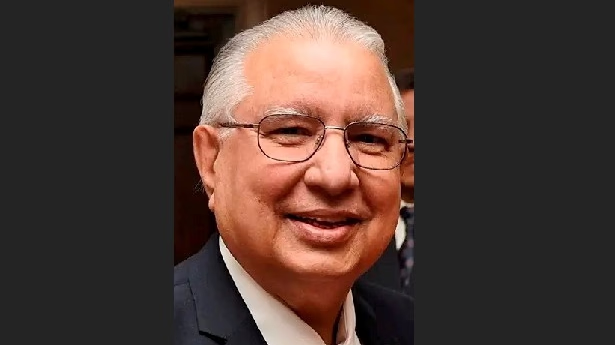
New York City Mayor Eric Adams is considering his choices for a new interim head of the Civilian Complaint Review Board, following the abrupt resignation weeks ago of the police watchdog agency chair who was found himself in a battle with the city’s largest police union.
“He is considering his options,” an Adams spokesman said when asked what the mayor planned to do to fill the vacancy, the second for the job within less than two years.
On Nov. 7, Dr. Mohammad Khalid, who was appointed by Adams as interim chair of the CCRB in late December 2024, resigned after the Police Benevolent Association of the City of New York raised questions about a potential conflict of interest for his job with a local Staten Island community board and his alleged bias in handling complaints against officers. PBA President Patrick Hendry asked that Khalid resign.
“Dr. Khalid’s biased voting record, his disregard for CCRB’s own rules and procedures, and his dangerous plan to strip away the police commissioner’s authority made it clear that police officers were never going to get fair treatment from CCRB under his watch,” Hendry said in a statement at the time. “His resignation is an important first step, but much more is required to make CCRB into the impartial agency mandated by the City Charter.”
WHAT NEWSDAY FOUND
Dr. Mohammad Khalid, who was appointed interim chair of the CCRB in December 2024, resigned Nov. 7 after finding himself in a battle with the Police Benevolent Association of the City of New York, the city’s largest police union.It is the second time in less than two years the CCRB, the agency which investigates complaints against NYPD officers, has lost its interim chair during a widely publicized dispute with a police union.New York City Mayor Eric Adams has the power to appoint a new interim chair before he leaves office. It is unclear when and if he would do that before his term expires come January 1.Two resignations in less than two years.
It is the second time in less than two years the CCRB C, the agency which investigates complaints against NYPD officers, has lost its interim chair during a widely publicized dispute with a police union.
Both the CCRB and the NYPD have dual responsibilities for investigating allegations of wrongdoing against the department’s 34,000 officers — close to a third of whom live on Long Island — ranging from minor violations to more serious cases involving deaths of civilians. Penalties can range from additional training to dismissal by order of the police commissioner, who has final authority over penalties.
In a statement, the CCRB gave no explanation for why Khalid, a dentist by profession, resigned but said that city lawyers believed Khalid had properly ended his community board job when he became interim chair. Khalid couldn’t be reached for comment. In an interview with the New York Times, he said the allegations he had been facing were false and caused he and his family stress that proved to be unbearable.
Khalid’s resignation came about a month after he asked that the CCRB be given final authority over its cases, effectively stripping away that authority granted under state law to the NYPD commissioner, something Mayor-elect Zohran Mamdani favors.
Any such change would require state legislation — Mamdani has no authority on the issue — and similar efforts recently have stalled in Albany. Arva Rice, who preceded Khalid as interim chair, also pushed for that change in final authority. But Rice quit in 2024 after she reportedly had a dispute with then-deputy mayor Phili Banks.
Unclear if replacement would happen before end of the year.
Adams has the power to appoint a new interim chair before he leaves office. But it is unclear when and if he would do that before his term expires come January 1.
To justify the proposed change in final authority, Khalid and other department critics noted how Tisch overruled a CCRB recommendation that Lt. Jonathan Rivera be fired for causing the death by gunfire of Allan Feliz during a Bronx car stop in October 2019. Tisch’s decision sparked outrage from family members and some advocates.
“Police misconduct must not go unchecked,” Khalid told the City Council in October. “We are tigers but we don’t have the teeth.”
Despite such high profile cases like that of Rivera, both Khalid and agency records show that relations between the CCRB and the NYPD had significantly improved since Tisch became commissioner in November 2024 and did away with the NYPD practice of dismissing cases over department statute of limitation issues.
“It is a positive trend,” Khalid said in a report earlier this year.
Distributing discipline.
In addition, both the NYPD and the CCRB appear to be more in agreement on disciplining officers than at any time in the recent past, something which union officials and law enforcement experts said undercuts the push to take final disciplinary authority away from the police commissioner.
“The dirty little secret between the CCRB and NYPD is that they don’t differ very much [on discipline], “ said Richard Aborn, head of the nonprofit New York Citizens Crime Commission. “When it comes to judging behavior, there is very little disagreement.”
In its report for the first half of 2025, the CCRB noted that the “disciplinary rate,” the number of the times the NYPD agrees with some or all of its recommendations on charges against officers rose to 78% since Tisch did away with the statute of limitations rule, compared to 28% in the last half 2024 when cases were dismissed over statute of limitation problems that exploded. Additional computations showed the agencies agreed on discipline to 94% of the time in 2025, records show.
Nevertheless, the Rivera case continues to be controversial. In overruling her own trial commissioner’s decision that Rivera should be fired, Tisch noted that since the CCRB didn’t bring administrative charges within 15-months as required by law, Rivera could only be charged criminally and not for violations of police rules. Tisch then noted that under criminal law standards Rivera was justified in using deadly force, something New York Attorney General Tisch James had earlier found as well.
Without an interim head, the CCRB board now has three vacancies on its authorized 15 positions. The CCRB is trying to train 20 new investigators but is facing a large backlog of cases. One agency staffer said during a City Council hearing last month that some 4,000 cases had to be closed without investigation.
Before he resigned, Khalid said that giving the CCRB final authority over discipline of police would do a great deal to build public confidence in the entire process of holding officers accountable.
How far the issue of changing the commissioner’s authority will go in Albany is uncertain, given the failure of past legislative attempts to change a system in place since the beginning of the 20th century. Police unions are sure to weigh in.
“Extending authority of the CCRB while reducing the power of the Police Commissioner is senseless, dangerous to every New Yorker and simply political,” said Scott Munro, head of the Detectives’ Endowment Association. “ Politics and policing don’t go together, ever.”

Anthony M. DeStefano has been a reporter for Newsday since 1986 and covers law enforcement, criminal justice and legal affairs from its New York City offices.