
By Roksana Amid
For more than four decades, New York Dance Theatre’s production of “The Nutcracker” has marked the arrival of the holiday season for thousands of Long Island families. This year, the 43rd annual performance — set for Dec. 20 and 21 at Hofstra University’s John Cranford Adams Playhouse — promises to deepen that legacy with an expanded immersive experience, celebrated guest artists and a renewed emphasis on the history that defines the company.
Since 1982, New York Dance Theatre, in partnership with the Ohman School of Ballet, has staged the full-length classic each December. Rooted in the Balanchine tradition handed down from founder Frank Ohman — a former student and soloist under George Balanchine — the production has grown into one of the region’s most recognizable holiday events. Yet for Executive Artistic Director Nicole Loizides, its staying power is not simply about technique or spectacle. It’s about belonging.
“We really feed ourselves in tradition,” Loizides says. “Especially around the holidays, people want a place where they can feel comfortable to come home, rest, relax and celebrate together. Our Nutcracker stays rooted in that.”
Long before the overture begins, audience members are invited into the world of the Silberhaus family — the setting of the ballet’s opening scene. When guests enter the Playhouse lobby, costumed Victorian performers greet them, musicians play seasonal melodies and the scent of apple cider wafts through the air.
Children are invited to hang ornaments on a Christmas tree, one of many ways the production blurs the line between audience and story.
Loizides describes it as a “semi-immersive pre-show experience,” one the company has been refining for several years. This season, the lobby experience expands through a new partnership with the Long Island High School for the Arts, whose student musicians perform as audiences arrive.
“As soon as people enter our lobby doors, they’re invited in by characters from our very first act,” Loizides says. “We serve warm apple cider, we have live music from some of our most talented youth on Long Island, and we try to capture the spirit of the season of giving within our community. Our audiences are growing tenfold because of that comfort.”
The lobby transformation mirrors the company’s mission: to create a space that feels familiar, nostalgic, and welcoming — something Loizides believes people crave amid today’s fast-paced, hyper-digital world.
“So many things get wrapped up in what’s new on social media or what’s trending,” she says “But this time of year, people want tradition. They want to feel grounded. That’s what we offer.”
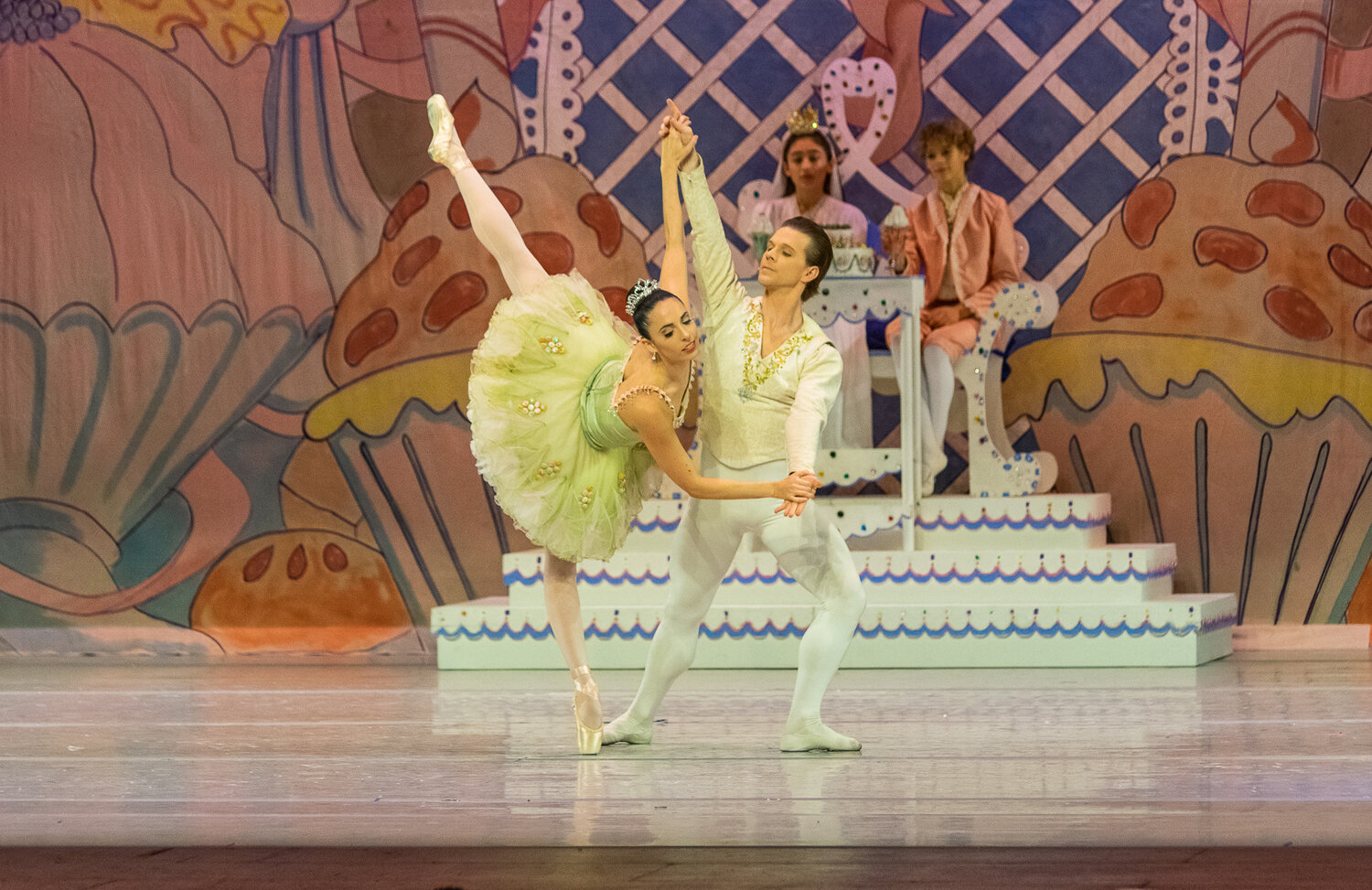
This year’s production — as always — features an impressive roster of professional dancers. Brittany Pollack, a soloist with New York City Ballet, and Daniel Ulbricht, a principal dancer with the company and artistic advisor for NYDT, take on the roles of the Sugar Plum Fairy and her Cavalier. Broadway performers Joseph J. Simeone and Samuel Colina also appear, joining New York Dance Theatre soloists Sandra Cieslak, Olivia Fohsz, Trevor Montgomery, and Craig Wasserman.
Loizides also returns to the stage, portraying Frau Silberhaus. It’s a moment she describes as both personal and symbolic, especially as the company prepares to enter its 50th anniversary year.
North Shore Village Theatre Artistic Director Christopher Moll returns for his third season in the featured roles of Lead Father and Mother Ginger, contributing to the intercompany collaboration that has become a production hallmark.
Children’s roles are danced by students of the Ohman School of Ballet and the School of American Ballet, the official training academy of New York City Ballet. For many young performers, “The Nutcracker” is their first experience dancing alongside professionals, a tradition that honors Frank Ohman’s commitment to nurturing the next generation.
NYDT’s devotion to tradition is not abstract — it lives in the steps, sets, props, and costumes that have shaped the production for decades. Ohman secured permission from the George Balanchine Trust to use the original Sugar Plum Fairy pas de deux, grounding the show in Balanchine’s distinctive style. He also created supplementary scenes and dances that appear in no other staging, adding 10 to 15 minutes to the ballet and expanding opportunities for young dancers.
“What Frank added doesn’t exist anywhere else,” Loizides says. “It gives more solo moments to our youth, especially the young Clara, and it brings additional cultural dances into the second act. It’s something very special.”
Many of the costumes and props used onstage were gifted directly from Balanchine and former New York City Ballet crew members and are now entering formal archival preservation. Some pieces, Loizides notes, are still durable enough to appear in performance.
“That tradition dates back over 50 years,” she says.“These items are a direct link to Balanchine himself. They’re part of our history.”
As the company prepares to embark on its 50th anniversary, she is focused on balancing innovation with the artistic values that first shaped the organization.
“For us, even with new opportunities and initiatives all year, the Nutcracker stays rooted in tradition,” she adds.
“This is where our community gathers. It’s where people feel at home.”