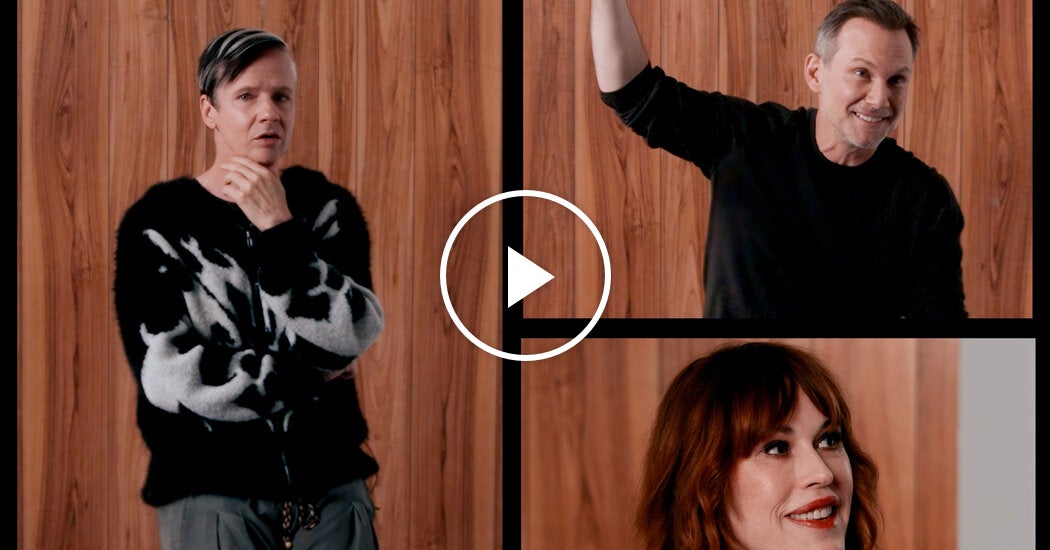
Everybody wants to be Gen X. We were kind of the last untethered generation. There was a true kind of freedom. ‘Cause it really was just like people in a room making stuff together. Words to describe Gen X — I would say … Riot grrrl. Hip-hop. The slacker. D.I.Y. Inclusivity. Queer. I’m sure at least 10 of them are gonna say Heathers, right? You know, Heathers? Spike Lee. John Hughes. Paul Thomas Anderson. Latchkey kids. I don’t know, flannel. [Beep] One word. They are angst-ridden, a bit bitter, and their chief talent seems to be the ironic aside. They’re called the Lost Generation. Technically I was the very first person to ever say, “Hey, Boomer.” So, I would like people to remember that. The X Generation, they’re very much the individual generation. Obviously in mathematics, X means an unknown. Back in 1989, ‘90, when I was writing the book “Generation X,” it just seemed like a very apt title. It is a reflexively skeptical group of people that I think grew up in an age when all of the sort of ecological, societal conditions that were happening were in some stage of collapse. All the messaging was always about not being your parents. Not being traditional, doing whatever you could to, like, not be anything like sort of 1950s America. We took some good stuff from the boomers, like we got work ethic. We just didn’t wanna do the traditional work in the same way that our parents did. But we also took a dreamers approach that we could dream things that our parents could not have. Where else would, you know, rap music and shows like “Jackass” pop up from, you know? If you didn’t have a bunch of kids that were willing to work their ass off to look crazy. Hi, I’m Johnny Knoxville, welcome to “Jackass.” Hiya! Whoa! Whoa! Most of the time our parents didn’t even know where we were. So, you kinda had to make your own fun and trouble. And with “Jackass,” I guess you could say, we made our fun and trouble our career. [Johnny screams] It’s seen as being a time, a generation of slackers, but I don’t believe it is. Slacker to me was a misnomer. It was like beatnik. It was never a word that the beats used. It was to make fun of them. But the beats were just trying to shatter conformism too and get to something deeper and feel alive. There was more of a monoculture that allowed for a subculture. And that was really rich and exciting. And now it’s all sort of pixelated, right? And kind of diffused. We weren’t oversaturated. It was very hard to break through in the artist world, and when you did, it was sort of a collective eruption of excitement. There was only MTV, one channel and they really played the same things over and over again. You couldn’t go to your computer and choose your own adventure quite as much. Videos were big-budgeted and million dollar, $2 million videos, that took days to do. Everything was big and glittery, and you were always produced, everything was produced. “Man Enough” for me was a lot of fun. We did that in three days. Now they could do it in three hours. What is the best Gen X work of art? Is it totally immodest to name my own movie? “Breakfast Club,” you know? The writer-director John Hughes was actually a boomer, and he was really writing for Gen X. I don’t really see the characters in “The Breakfast Club” as cynical. I feel like they’re very realistic about the way that the high school is run. Particularly my character in that movie, Claire. You know, are they going to talk on Monday? And she says, Do you want the truth? Yeah, I want the truth. I don’t think so. And she’s absolutely vilified for that. And it’s hurtful, but she’s being honest because that’s the way that high school works and it has not changed at all. It was a revolutionary moment in cinema. This idea of indie film was born. Soderbergh and Richard Linklater, Spike Lee. Paul Thomas Anderson a little after. My story about “Boogie Nights” goes like this. So, some guy sends me a script, I never heard of the guy. I called him up. And I go, “Bro, are they gonna even let you make this movie?” It was out there like something I had never read in my life. And so then we get into like, “How, how old are you, bro, ‘cause, you know, you captured this era so well.” And he mumbles something, I go, “Okay, you’re 35.” He goes, “No, I’m 25.” And I go, “What? You’re [beep] 25 years old and you wrote this?” Being a kid from Brooklyn, watching “Do the Right Thing” felt like someone just had a camera and was filming like real life. Again, going back to our time, even when you think about filmmakers, everyone had a very unique voice and it was celebrated. It was the beginning of like, kind of inclusivity. It’s kind of like every TV show, movie, everybody started showing like, you know, queer people, people of color. I mean, I don’t think anyone made a decision to be like, “Let’s be inclusive.” I think that we look around our communities and we see this is what’s happening. So it just becomes natural. “Hedwig” when I started making it was because I was bored with Broadway and this and that and was getting excited about punk and drag and I was like, I wanna combine all these things for a theater piece. The forge of all of this art for me and for a lot of my friends was AIDS. Unfortunately, AIDS started happening in the ‘80s, and that was a huge influence on me as a young queer man, and my queer identity became a very important part of my work and what I wanted to say. And, you know, it came in sort of the wake of, you know, ACT UP and Queer Nation, all that kind of activism. ACT UP, it was, you know, in response to the AIDS epidemic and the government’s mistreatment of people that had been infected with the disease. It was the first time that I ever participated in a peaceful protest. And I could actually see that what we were doing was working, and that people had empathy for each other and supported each other. So everybody came. It wasn’t just, you know, gay men and gay women. It was, you know, everybody came together to, you know, shut down these big cities to protest dismal healthcare. Why this rally is important? Because AIDS affects everybody in this country, that’s why. In New York City at that time, Puerto Ricans, African Americans, West Indians, white people, we all partied together. It didn’t matter. What mattered is if you were real and you were fly or not. The way we discovered artists back then was really if you went to a jam. That’s a party. Sometimes you had to pay $5 to get in. You know, there was this party called Car Wash, and it would travel throughout the city, and that’s when the first time I saw A Tribe Called Quest. It was at a Car Wash. [Crowd] Oh yeah. One more time. [Crowd] Oh yeah. Nice & Smooth, my God. Same thing with Public Enemy. I didn’t see them on wax, I saw them at a party, and that’s where we heard the music. We had beepers. That’s how we, like, communicated. There was no DMs. So your DM was in person, person to person. We connected. Hip-hop felt like mine with Run-DMC, with the Fat Boys. KRS-One, NWA, Public Enemy. It was ours. It was the moment. You know, you gotta understand, as we’re coming up in Atlanta, there’s a missing and murdered child phenomenon happening that put this overcast on the city. You were scared to go outside, you were taught to roll in groups. So as boys you would be these little packs of boys together on the trains, you know, moving around to and from school. I think that hip-hop gave you solidarity, it gave you soldiering, it gave you a place that felt sovereign, and it was yours and it was our music. And with arts and music being taken out of public schools at that time, record players and, you know, these primitive samplers became our instruments, and we were determined to let the creativity be expressed even if we couldn’t do it through conventional means. And at the time we weren’t first rewarded with, “Wow, these kids really are being expressive, being creative.” Because we were sampling and chopping records, we were told that what we did wasn’t music because we were rapping and not singing, it wasn’t art. And we had to fight even to be recognized as artists. I do think Gen X had the, you know, this flavor of we don’t care about that. We’re gonna do it ourselves and create our own world. Liz Phair’s first record, “Exile in Guyville,” like to me really represented that. Like there was a lot of pastiche of a lot of different kinds of sounds. There was this real vibe of maybe we’re not in a real studio, but we’ll put things together. Maybe part of it is a demo, part of it is something else. That was the idea with Pavement. It was to make that a badge of honor that the cover art was all done by amateurs, super fans. You know, you can be sort of crude and gestural in what you do. And just very exciting as an artist to see, you know, somebody like Elliott Smith talk about superdepressing subjects. And you know, to talk about his drug addiction and those really dark, traumatized feelings under his drug addiction was, you know, that was really revolutionary. The heyday of music kind of in the ‘90s was an up and coming, more middle class of artists who could make a living being on tour selling records, but that weren’t huge, you know, monoliths. I do think that with Generation X, it was the very last generation that had a middle class existence. As a group, it was like waving farewell to the 20th century as the train left the station. Had to happen. There really was a sense of we can make good stuff now and maybe even make a living out of it. My involvement in “Jackass” and doing stunts was my best guess at the time on how to support my 3-year-old daughter. And I’m like, I gotta do something quick, and this is my best guess. You can say a lot of things about “Jackass.” It’s silly, but it’s honest. And also things are just a little funnier when you’re naked. Can you help me put my pants up please? Thanks, bro. “Beavis and Butt-Head” is definitely my favorite animated series from that time. I absolutely love Mike Judge. He’s a genius. [Beavis and Butt-Head chuckling] I’m glad we’re getting back to animated series because a lot of times more truth can be packed in animated series than you can in series where you have real people, more truth can be told. So whether it’s the “Animaniacs” or “The Simpsons” or “Beavis and Butt-Head,” or “The Boondocks,” and I remember “The Boondocks” becoming an animated series. It was revolutionary as a comic, it was revolutionary as a series on television. It’s revolutionary now as you watch it. Dang! Don’t playing around here. – I really hated when we lost Saturday morning cartoons. Now Saturday morning college football makes a lot of money for networks. But when we were able to watch Saturday morning cartoons and at the end of the cartoon the “I’m Just a Bill” commercial pops up and it teaches children as young as 5, 6, 7 years old, how a bill is introduced, how it passed, how it goes through Senate and Congress, we were smarter people then. ♪ I’m just a bill ♪ ♪ Yes, I’m only a bill ♪ I don’t know if anyone remembers back in the 1990s when the worst thing you could possibly do was “sell out.” But nowadays you’ve got these younger people who are just bombarded by a billion more rules than just not selling out, that everything’s under the microscope. Everything’s forever. When you’re young, you should be absorbing everything in sight. Stop canceling each other, learn about punk, and get laid. Be bored. Be bored. Be by yourself. Let your mind wander. Let your imagination breathe and watch what comes. Watch what comes and have the courage and the audacity to just try. Try it out. Whatever comes into your head, try it out. When you make good art, when you make good things, when you make cool things, they tend to last longer or they tend to go get rediscovered and brought back up. When I hear a young R&B artist do something that feels like an Aaliyah run, it makes me know that she’s gonna live forever. There’s an inherent hope in youth. And the smart ones are looking back to, you know, the Gen X creative period for clues on how to live now. When I think of Gen Z, I look at them and I go, oh, they’re watching us. I see them studying us. And you can’t say, “Oh, my day was different than yours. Y’all don’t know what you got and it’s better now.” I hate that. Like my moment’s completely different from my parents’ that were baby boomers, and I just think every decade has its moment. The wheels are falling off. Oh boy.