
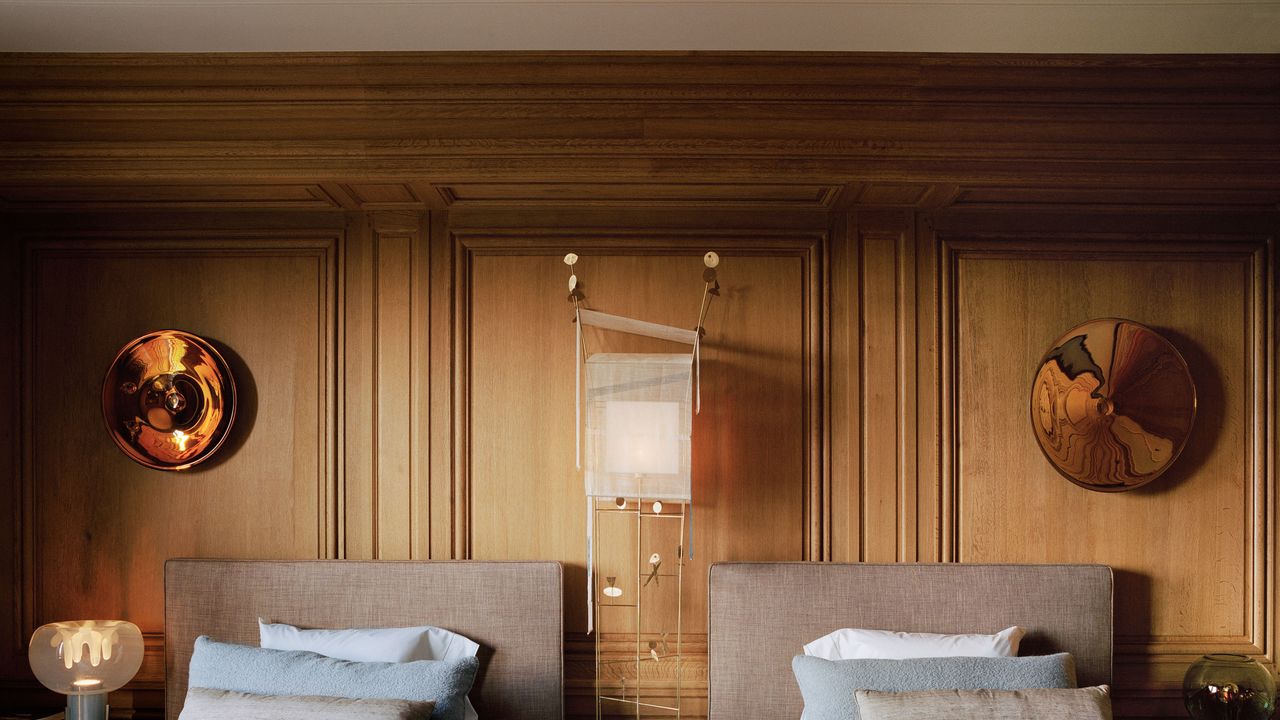
If this was something of a dream project, it was not without its challenges. Ceiling heights were low, the rooms were not large, and the layout was less than ideal. It was a puzzle. Then COVID struck, forcing delays. And as if that were not enough, well into the renovation, the couple had the opportunity to purchase the apartment next door. The merger offered space for a relaxed family room, a guest apartment that could be closed off for privacy, and the creation of a new powder room, which the original apartment lacked.
Of course, that kind of surgical augmentation requires skillful precision. “It’s so important to get the architecture right,” says Michael. “We spent a lot of time drawing.” It was only after they had mastered the complex layout that the designers turned to interior refinements. They specified new oak Versailles parquet flooring throughout to unify the spaces and collaborated with the renowned French firm Féau Boiseries to devise custom wall treatments. These range from silver-leafed plaster panels in the glamorous entry to creamy paneling complete with garlands and cartouches in the living and dining rooms (“More traditional than we would usually use,” Michael admits), gleaming mercury glass mirrors in the hall, and pale oak paneling in the son’s bedroom that’s evocative of an Ivy League library.


In the son’s room, a collage by Robert Rauschenberg hangs above a Jean-Michel Frank desk. 1920s Jean Besnard lamp.
Art: Robert Rauschenberg © 2026 Robert Rauschenberg
A painting by Jef Verheyen hangs on walls in finished oak paneling by Féau Boiseries in the son’s room. Custom rug by FJ Hakimian.

The bath features wainscot, casings, and floor in paneled marble by Precision Stone.

A 1922 Lalique “Boule de Gui” pendant glows in the dressing room.
While Atelier AM places as much emphasis on the spaces between as on the objects themselves, that doesn’t mean furnishings aren’t crucial. This apartment hosts an array of pieces by some of the most important masters of the 20th century. There are cabinets and tables by Jean-Michel Frank; lamps by Alberto Giacometti; chairs by Eugène Printz, Marc du Plantier, and Jean Royère; a screen by Jean Dunand; and a stool by Émile-Jacques Ruhlmann. That’s just in the living room, and that’s not even a complete inventory.

The son’s room features a Jan and Joël Martel sculpture, a Christopher Baker “Series One P” lamp, and a circa 1745 cabinet by Jacques Dubois.

A glimpse of the primary bedroom in an 18th-century Italian mirror.
But what is truly impressive is that none of these pieces shout for attention. Nothing commandeers your eye, angling for the spotlight. The immediate effect is one of harmony, an atmosphere of restraint, a balance of form and space. Much of the beauty in these rooms reveals itself only over time, at a second, third, or fourth look. Even the smallest items have presence and provenance: an umbrella stand by Pierre Chareau, a mirror by Line Vautrin, a side table by Jules Leleu, a tray by Claude Lalanne. “While adding the second apartment made things more complex,” admits Alexandra, “it also gave us the luxury of more time for acquiring the best pieces. It bought us another auction season or two. And fortunately, we had the enthusiastic buy-in of the clients.”