
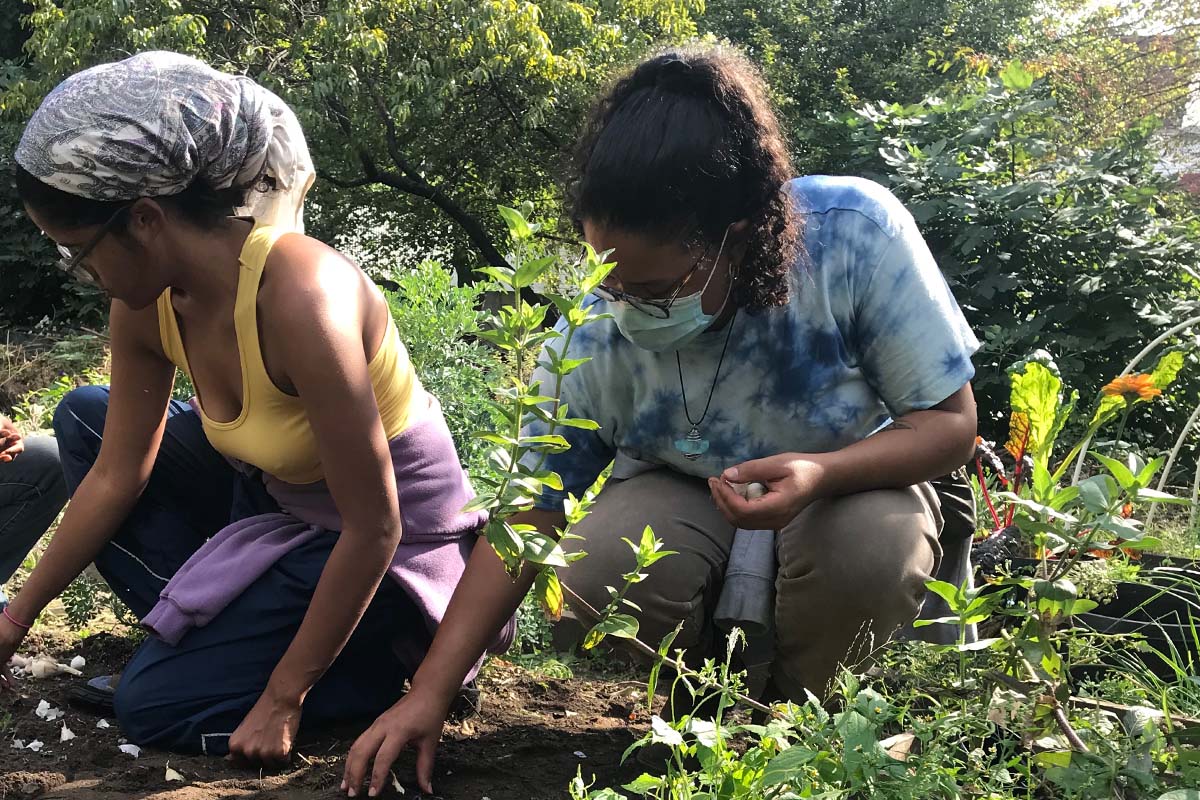
 Credit: Farm School NYC
On a humid Friday evening in early September, staff at Farm School New York City (FSNYC), an urban agriculture education organization, called an emergency town hall to share a critical update. They were at risk of closing—as early as the end of the year— and were starting an emergency fundraiser with a $250,000 goal. FSNYC staff shared that federal funding cuts had further deepened their funding gap and put their work with various community partners in jeopardy.
FSNYC equips NYC-based residents with the tools, training, and support needed to practice sustainable agriculture and advance food sovereignty, food justice, and liberation. It is one of the few urban agriculture education spaces that has a sliding-scale tuition model, making it accessible to everyone. With proper funding, organizations like FSNYC equip learner farmers and land stewards with the knowledge to build sustainable businesses, forge food justice movements, and rebuild relationships with the land. If FSNYC is forced to further reduce capacity or permanently close, what historical, cultural, and institutional knowledge will New York City lose?
An Uncertain 2025
This year has been full of questions and meetings for the organization’s staff, board, and alumni network. “At the same time, we are trying to figure out what will happen with our jobs and our programs,” said Frances Pérez-Rodríguez, the program coordinator for FSNYC, in an interview with NPQ.
If FSNYC is forced to further reduce capacity or permanently close, what historical, cultural, and institutional knowledge will New York City lose?
In 2024, FSNYC applied to several federal programs administered by the United States Department of Agriculture (USDA) and the United States Environmental Protection Agency (EPA), including the USDA Urban Agriculture and Innovative Production Grant program, Farm Service Agency Grants and Cooperative Agreements, and the Thriving Communities Grantmaker Program, among other opportunities. Its largest federal grant is part of a 27-organization cooperative agreement.
“We had organizations giving microgrants out to farmers, uncertain if they would get that money back and when,” said Dyaami D’Orazio, FSNYC’s programs director, in an interview with NPQ.
Once the Trump administration transitioned in early January, FSNYC’s grant awards kept getting delayed and were eventually frozen. This put the organization in immediate limbo between January and May. During that time, D’Orazio said, “we were planning our programs and starting to sound the alarm about whether Farm School was going to be able to make it.”
In analyzing their cash flow, staff worried that the organization might have to close as early as August. By early spring, FSNYC had to lay off three staff members, and reduce hours for some of the remaining staff. Fueled by a strong desire not to disrupt programming, FSNYC leaders successfully petitioned the federal government to apply for reimbursements. But while they were able to recover some funds, they are nowhere near being in the clear.
“Our cash flow is still uncertain, and we [still] have a pretty big gap,” D’Orazio said.
FSNYC has been operating at a deficit for some time, still striving to provide good pay and benefits for its staff. Despite these challenges, the organization has been able to maintain relationships and tap into its network.
The Way Forward
The current gap in FSNYC’s funding is $500,000—the amount needed to get them somewhat comfortably into 2026, keeping staff at full capacity with benefits. Most recently, FSNYC received a one-time $100,000 emergency grant, but that is just enough to close the gap for the rest of 2025. The organization’s fundraising campaign remains open for support.
At the emergency town hall, attendees discussed options for the organization’s future that included a possible merger and implementing a subscription model for FSNYC’s offerings.
“People are shocked, worried, and activated to help in ways that they can,” Pérez-Rodríguez said.
Sign up for our free newsletters
Subscribe to NPQ’s newsletters to have our top stories delivered directly to your inbox.
By signing up, you agree to our privacy policy and terms of use, and to receive messages from NPQ and our partners.
One critical part of FSNYC’s ethos is being part of the Black Farmer Ecosystem, a collective working to shift power and ownership to Black farmers in New York through advocacy, policy, and capital. The Ecosystem includes FSNYC, Soul Fire Farm Institute, Northeast Farmers of Color Land Trust, Black Farmers United-NYS, Corbin Hill Food Project, and Black Farmer Fund. Pérez-Rodríguez explained that the ecosystem is figuring out how they can better align to further fortify the network.
“The most powerful part of Farm School is that we are helping people understand the reality of what it takes to get food on someone’s table.”
Within the US context, farming has always been political for land stewards and farmers of color. “We teach urban agriculture but also have a social justice focus,” said Cris Izaguirre, a farmer, cultural worker and facilitator at FSNYC.
While American agriculture has actively sought to erase the knowledge and contributions of Black and Indigenous farmers, the organization makes a point to work in partnership with many queer, trans, and BIPOC growers managing farms and gardens across the city and state.
“No one wants Farm School to close,” Izaguirre said. “Oftentimes we don’t always see the long-term impact of our work, but seeing alumni out in the field, and applying the resources and skills that they learned during their time at Farm School makes it all worth it.”
Existing in the Current Moment
When asked whether FSNYC would apply for government funding again, Pérez-Rodríguez emphasized that “nothing that the government creates is for the benefit of QTBIPOC people.”
The US government, they explained, particularly under the current administration, is actively working to oppress and exploit the bodies and labor of QTBIPOC people.
“That is the framework that most people at Farm School are coming to the work with,” Pérez-Rodríguez said.
The Farm School community has urged the organization to stop relying on government funds because of how quickly it can be taken away. “It is hard to keep asking our oppressor for this when it is owed to us,” said Pérez-Rodríguez.
At the same time, the organization is wrestling with the fact that in the past it was able to leverage government funds to expand its work. The next phase for FSNYC, as for many nonprofits across the sector, is determining how to depend on its network with more creative streams of revenue.
“With the current administration, there are DEI words that we can’t even use in order for our funding to not be cut,” said Izaguirre. All those words, he explained, encompass exactly what the organization does and stands for.
“How do we exist in this [current] world and in these [grant] proposals when the government is clearly saying: You cannot have this money?” said Izaguirre. Along with attacking the agriculture and farming industry, the current administration is taking away basic rights and resources.
“It is so clear to me that the impact of our work is in our students,” D’Orazio said. “The most powerful part of Farm School is that we are helping people understand the reality of what it takes to get food on someone’s table.”