
Should NYC have a renewed mask ban? This question is weighing on the minds of many New Yorkers lately.
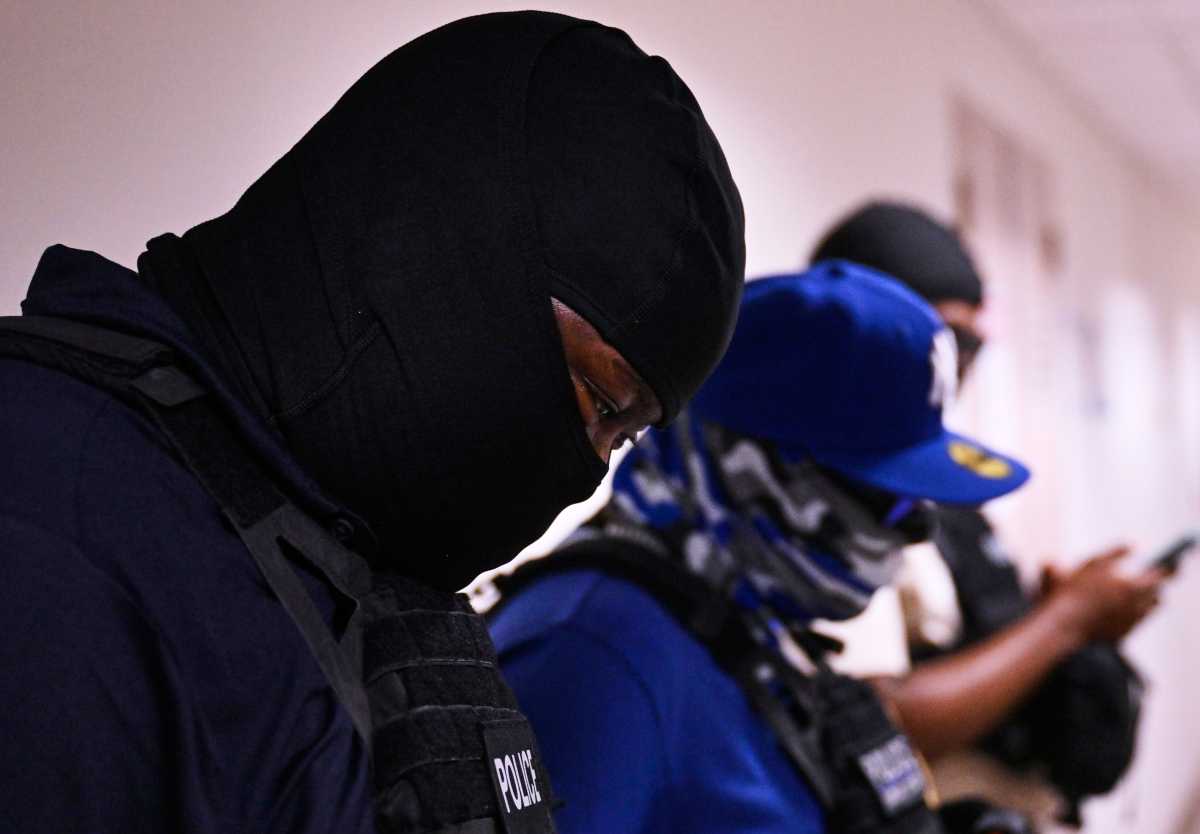
As masked individuals continue to participate in protests, sometimes leading to public disorder, and concerns rise over the anonymity of Immigration and Customs Enforcement (ICE) agents, who don face coverings during operations near immigrant communities and courts, New Yorkers are at a crossroads on whether they want elected officials to pursue a full-on public mask ban.
It has been a complex, years-long debate in both City Hall and Albany. Those passionate about the cause say the freedom to wear a mask in public pits concerns over public safety and crime prevention against the public health and civil liberty protections that emerged during the pandemic era.
Historically, New York prohibited wearing masks in public with certain exceptions, a ban that remained largely in effect until it was suspended for public health reasons at the onset of the COVID-19 pandemic in 2020. Over the next five years, masking regulations became dynamic, shifting from strict, universal mandates to targeted requirements in crowded settings lacking social distancing, before ultimately being rescinded, leaving no general mandate in place.
But the recent uptick in ICE raids and unruly protests are forcing some New Yorkers to rethink the issue of masks.
Barbara Reiss, of the Upper West Side, said some New Yorkers wear masks for health reasons. But it is “a problem” if they are wearing one to elude law enforcement, she added while reflecting on disorderly protests that resulted in months of all-out chaos at Columbia University last year.
“I think that police or other security personnel should have a right to ask someone who is wearing a mask to show their face, like they did at airports during COVID and still do,” Reiss explained. “If someone is doing, or is suspected of doing something illegal, take, for example, the protestors who took over Hamilton Hall; they should not be allowed to evade the law by concealing their identity with a mask.”
What is the current law in NYC and New York state?
As it stands, New York state does not have an outright ban on masks. However, per language in this year’s $254 billion state budget, anyone in the state who commits a crime while wearing a mask to conceal their identity is breaking the law.
The new mask law took effect on June 8, 2025, after the budget was approved.
The statute created a Class B misdemeanor to crack down on individuals who use a mask to conceal their identity when committing or fleeing from a Class A misdemeanor or higher.
Kevin, a New Yorker from Staten Island, is supportive of the state’s action.
“If worn while committing a crime, it should be considered an additional charge,” he said.
Whether or not this extra provision is enforced when a masked individual commits a crime is unclear. amNewYork contacted the mayor’s office to find out, and is awaiting a response.
Protections for health and safety
Gov. Kathy Hochul’s office, when contacted by amNewYork about the implications of the statute for people with health conditions, only provided comment on the criminal enforcement provisions of the law.
However, the state’s criminal provision does not appear to affect individuals who wear masks for legitimate health reasons, a critical consideration for immunocompromised New Yorkers.
Zeroing in on the flu alone, the state’s Department of Health on Tuesday announced that healthcare personnel who have not received this year’s flu vaccine must wear masks in areas where patients and residents may be present.
The department’s most recent data, through Nov. 22, shows a total of 17,783 positive flu cases across 62 counties in New York have been reported this season to date.
Meanwhile, the state Health Department recommended several flu prevention actions, including frequent handwashing, avoiding touching the eyes, nose, and mouth, and minimizing close contact with sick individuals. Notably, wearing a mask was not among the recommendations.
Wearing a mask to prevent the flu is only one medical reason New Yorkers choose to wear them. Leah of the Upper West Side has a condition called toxicant-induced loss of tolerance (TILT) that makes her allergic to elements in the air, such as cleaning products, exhaust and fragrance.
“I carry a mask with me everywhere I go in case I need it to save myself from hours, or days, of illness,” she explained. “Otherwise, I am very healthy and active. It’s like Kryptonite to Superman.”
She added, however, that she would support a ban for the general public, as long as it is applied “sensibly” and with people who need to wear masks for medical reasons in mind.
“I also understand why law enforcement needs to wear masks nowadays, and I support them being able to do their job safely, with accountability,” she said.
A mask ban in Nassau County
The mask law is clearer in nearby Nassau County, which has barred masks since August 2024. Since then, however, Bruce Blakeman, Nassau’s county executive, has made an exception for law enforcement officers.
Across the country, in Los Angeles, the opposite is almost true. On Tuesday, the city’s County Board of Supervisors took a first vote to approve an ordinance that would prohibit law enforcement, including ICE agents, from wearing masks or concealing their identities when conducting their business.
“This is about defending the constitutional rights of the people we represent,” County Supervisor in LA Janice Hahn said on Dec. 2. “We cannot stand down now and allow this type of policing to be acceptable in America. So, if this means a fight in the courts with the federal government, I think it is a fight worth having.”
The ordinance marks a significant step toward a ban for law enforcement, but it still needs to be approved.
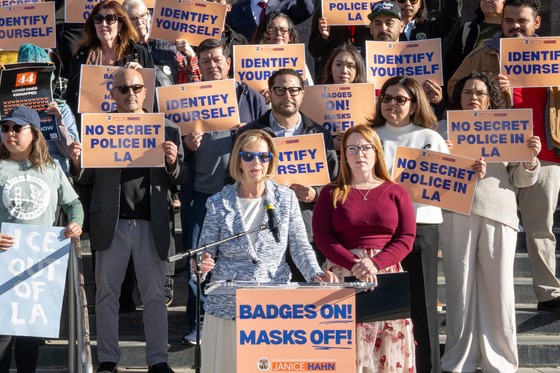 LA County Supervisor Janice Hahn and supporters of the mask ordinance.Photo by Martin Zamora
ICE officials have said masks help protect agents, many of whom and their families have been victims of death threats online and physical attacks.
“ICE law enforcement officers wear masks to prevent doxing, which can (and has) placed them and their families at risk,” the agency’s website states. “All ICE law enforcement officers carry badges and credentials and will identify themselves when required for public safety or legal necessity.”
Meanwhile, civil liberties groups have voiced strong opposition to measures that would broadly prohibit the wearing of masks. Their arguments have centered on freedom of expression and the effects mask bans could have on lawful protest, anonymity and health and safety.
“When ICE agents cover their faces to target immigrants, the masks are about evading government transparency and accountability,” Allie Bohm, senior policy counsel at the New York Civil Liberties Union, told amNewYork. “There’s a difference between people masking to protect against disease, more safely exercise their First Amendment rights, or follow religious practices, and agents masking to terrorize immigrant communities in secret on behalf of the government. In the effort to promote transparency and accountability for ICE, we must make sure we don’t overstep with responses like sweeping mask bans that would also prevent the public from protecting their voices, privacy, or their health.”