
We’re celebrating Lebanon County’s role in American history. Read more here.
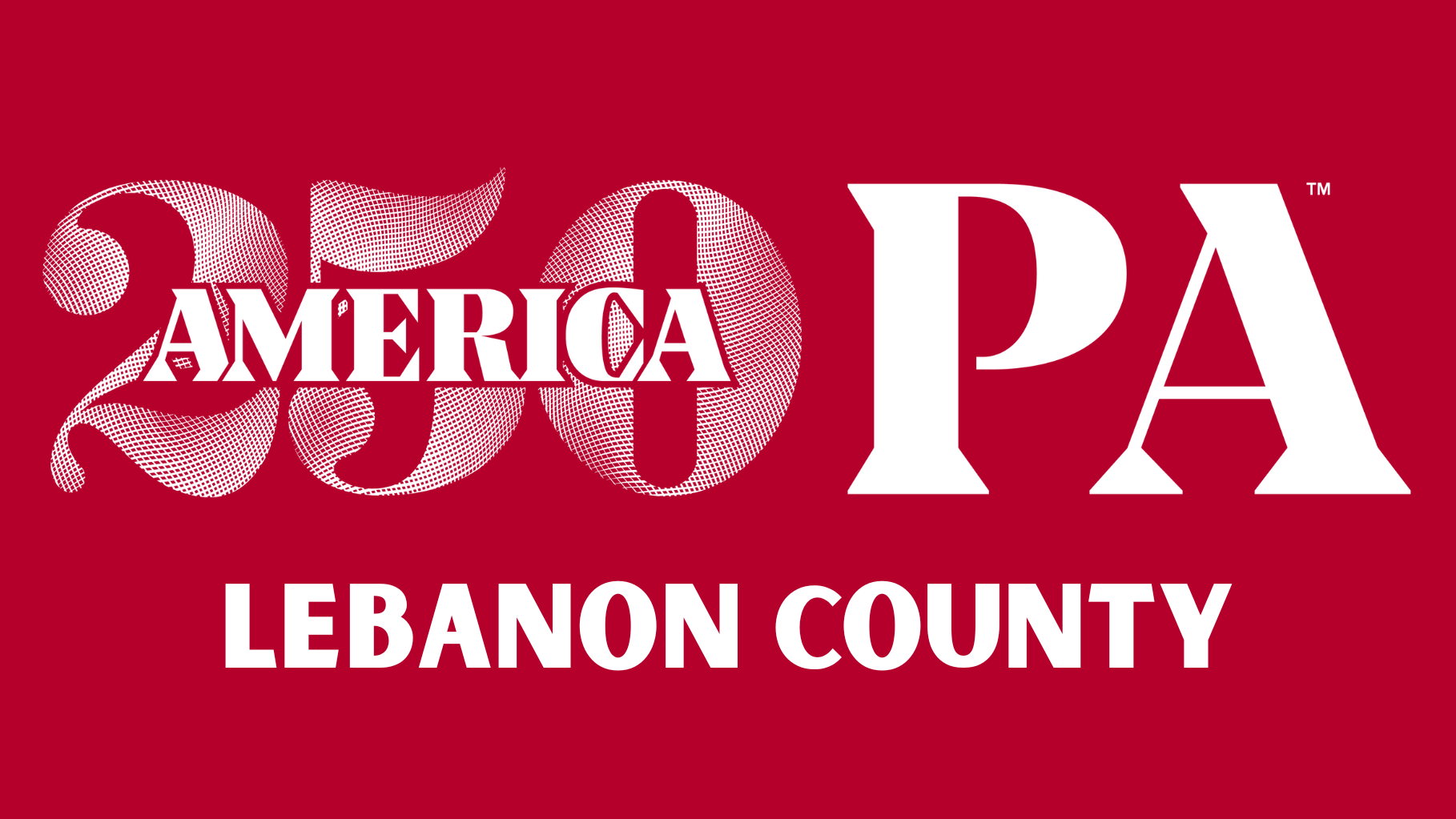
Founded in 1748, Hebron Moravian Cemetery in Lebanon was recently designated as a state historical site by the Commonwealth of Pennsylvania.
The Pennsylvania Historical Museum Commission announced its decision on Oct. 14.
There are several reasons for this designation, according to cemetery board members John Klahr and Susan Dieffanbach.
There are people buried there that have no grave marker, Klahr said, but everyone will receive one eventually. “If the family requests it, when there’s the service of internment the trombone choir comes and plays. We have been doing that since the 1740s, too.”
Then there’s the way the deceased are interred, which is a hallmark of the Moravian faith.
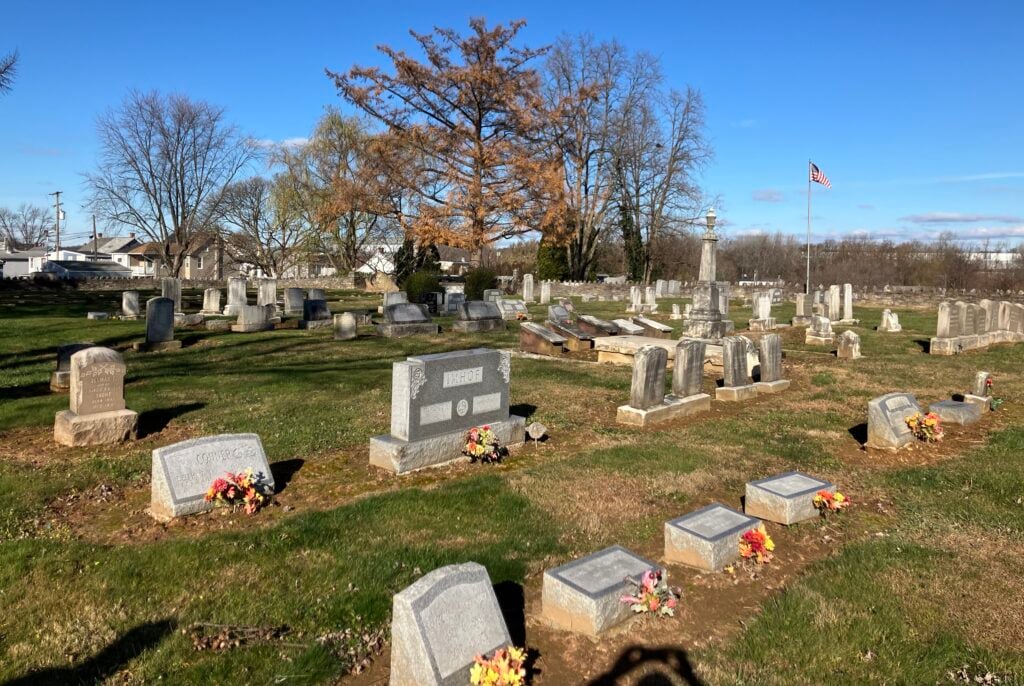
A view of the Hebron Moravian Cemetery, which recently received state designation as a historic site. The statewide designation is required before a site can receive national designation. (James Mentzer)
The “choir system” for burial is a Moravian church practice where the deceased are buried according to their age, gender, and marital status, according to the two board members. The choir system divides the graveyard into sections for men, women, and children to reflect how the congregation sat and socialized in life, symbolizing a continuation of the community in death.
“So that’s the women’s side, and this is the men’s side,” Klahr stated, pointing out the delineation. “And they’re buried in choirs, married. The male (side) has strangers. So those were people that were not in the congregation that needed a place to be buried. Infants, single and married. And then the women had married, single, and infants. And there are a lot of infants in here. Because there were (many) at the time.”
The cemetery, which is located off Cloister Street between Cumberland and Walnut streets in South Lebanon Township, used to allow non-church members, known as “strangers,” to be buried there, the historians explained. There are also several Native Americans buried there, since other cemeteries wouldn’t admit them.
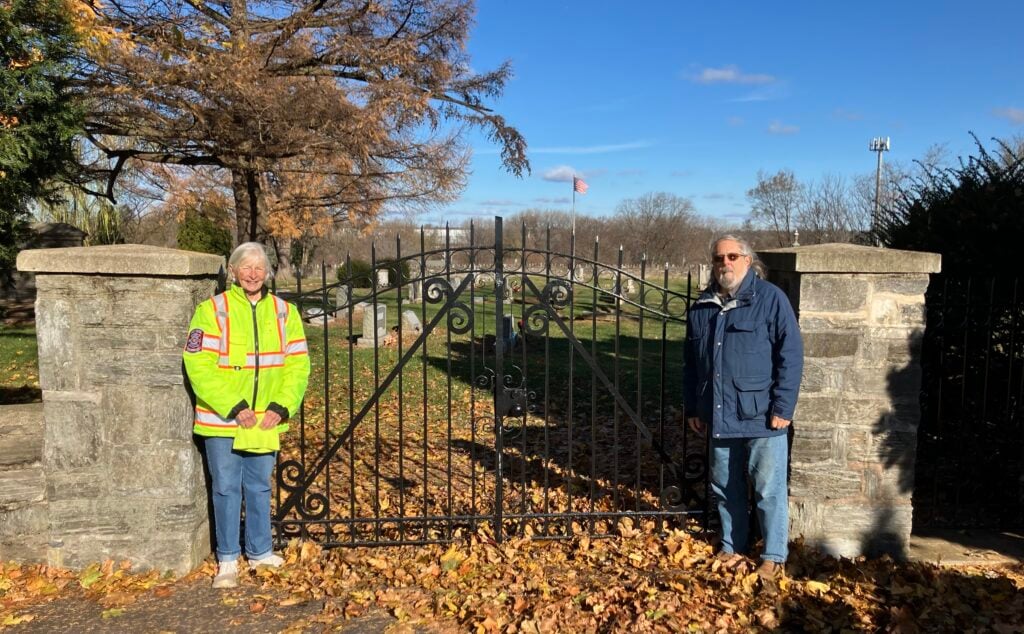
Moravian church members and cemetery historians Susan Dieffenbach and John Klahr at the main gate, which has recently been replaced, at the Hebron Moravian Cemetery in South Lebanon Township. The public is invited to attend a Wreaths Across America ceremony at the cemetery on Dec. 13 beginning at 9 a.m. (James Mentzer)
“They could be somebody that died that had no connection and no affiliation with anybody, and they just, they put them there,” said Klahr. “The Moravians opened up their hearts and put them in their cemetery.”
A cement rostrum in the cemetery bears the title “Grave Register Hebron Moravian Cemetery of the Unitas Fratrum (Moravian Church) 1748.”
It also pays tribute to several individuals and specifically the names and grave markers for those who served in the French and Indian War, Revolutionary War, and those who were “In Command of Scouts.”
“The veterans are listed here for the American Revolution, of which we have some. And the French and Indian War. Civil War. … War of 1812. And World War II all the way up to Korea,” said Klahr. He noted there is only one veteran who served during the Vietnam War on the site, who was buried before the National Cemetery at Fort Indiantown Gap opened.
The historians said there are 217 people buried in the cemetery’s “new” section and 223 in the old. All of those individuals in the old section – minus the two Native Americans – are listed on the cemetery’s grave register.
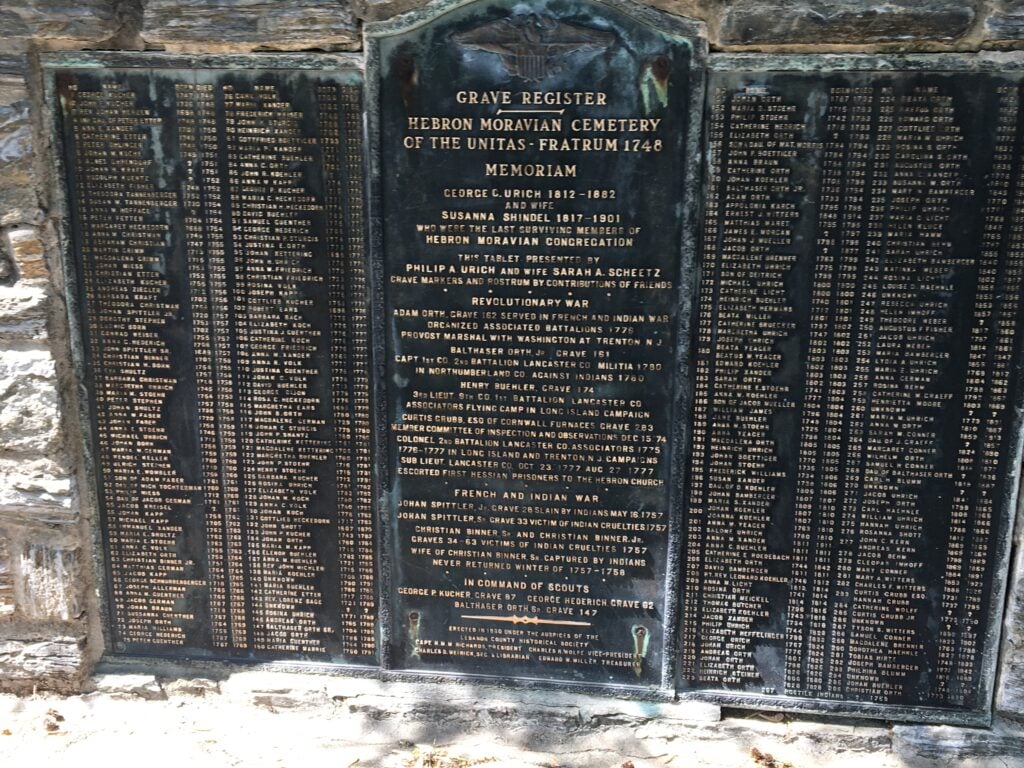
A closer look at the Grave Register that recognizes Moravian Church members and veterans who served the nation and who are interred at the church’s cemetery located in South Lebanon Township. (Provided photo)
One notable change over the years is who can and cannot be buried there. Now, Diefenbach said, “they have to be a Moravian to buy the plot. So that’s the restriction on the cemetery. And you go through the church.”
Tracing the cemetery’s early history is somewhat difficult, according to Klahr, because it was created 65 years before Lebanon County was founded. The cemetery was not next to the original church, which is a common practice today, but was located in Hebron on the eastern edge of what was Steitztown, which was founded in 1740, before it became Lebanon in 1885.
“This land was not owned by the church until some time later. The deeds are very, very hard to trace, because at the time when the internment started, this was part of Lancaster County,” Klahr said. “So the deeds for the very, very early years are in Lancaster County, and usually they’re in German.”
The settlers who came to America were from the nation of Moravia in Czechoslovakia. Moravia is a historical region in the east of the Czech Republic and one of three historical Czech lands. The church was founded on the teachings of Jan Hus, whose beliefs are believed to be the forerunner to the Moravian faith.
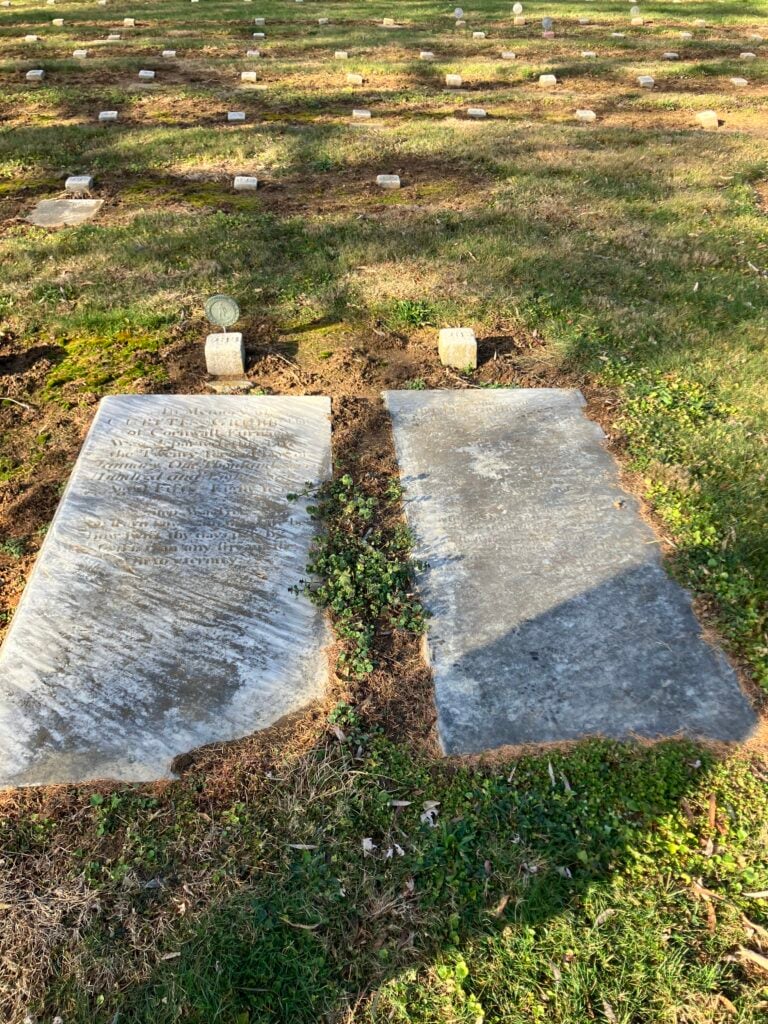
In the original section of the Hebron Moravian Cemetery, grave stones were placed into the ground since all were equal in death. The stones here are for Peter Grubb and family members. Grubb founded the Cornwall Iron Furnace. (James Mentzer)
“The people came onto the estate of Ludwig, Count Ludwig von Zinzendorf, seeking refuge as they were kicked out of Moravia,” Dieffenbach said. “So they were known as Moravians. And they established a community there called Hebron, which is still a thriving community today.”
Another hallmark of the church was flat grave stones, which are evident in the cemetery’s old section.
“The Moravian belief was that we are all equal in death. So nobody’s going to put up big money in the dead,” said Klahr.
There are a few prominent Lebanon Countians buried in this cemetery, according to Dieffenbach.
“Peter and Curtis Grubb formed the Cornwall iron furnaces,” she said. “The Felty family is here. They were prominent in Lebanon County. Dr. Felty was a dentist. His father is a veteran of World War I.”
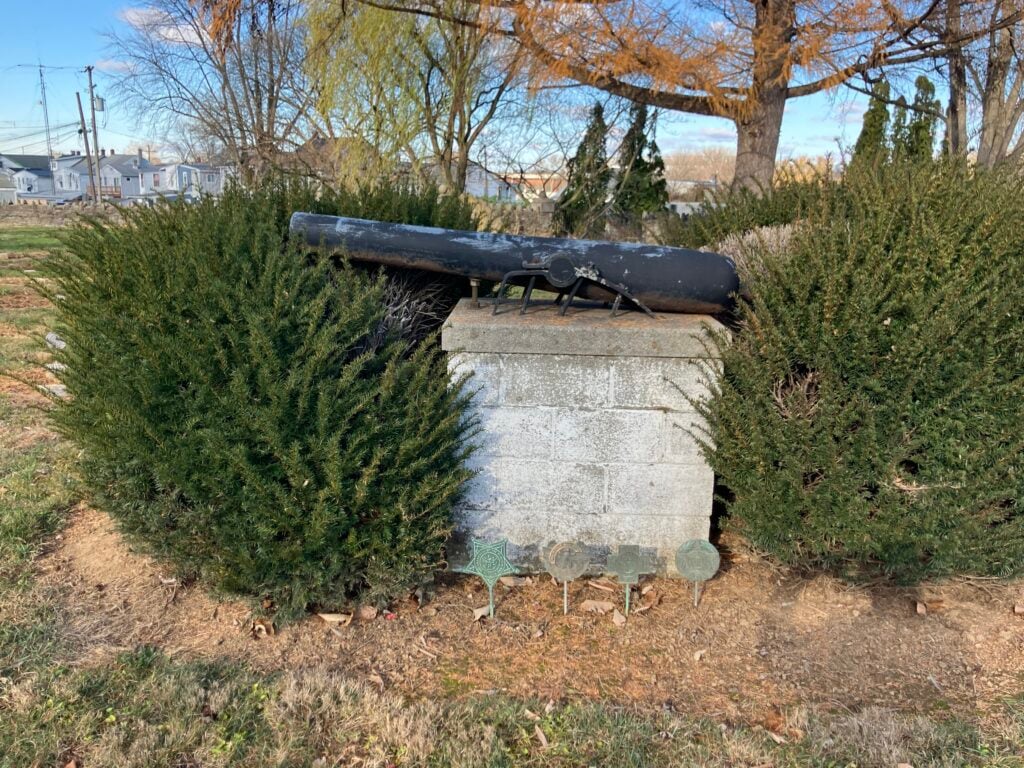 A Civil War cannon in Hebron Moravian Cemetery honors those veterans who served the nation during the bloodiest conflict on American soil in the 1860s. (James Mentzer)
Another well-known individual is David Tannenberg, a Moravian organ builder who emigrated to Pennsylvania and is often cited as the most important American organ-builder of his time. Many of his organs are still in use.
“Well, that’s why we wanted to have it preserved and it’s historic, so it can’t be — it can’t be destroyed. And we have a program in place, we’ve done it a couple of times, ‘If These Graves Could Talk,’” Klahr said. “It brings up the guys who were, the men who came, the families, so the French and Indian guys and all of them. Those people’s stories. And Hebron became a refuge for people, and actually Hessian prisoners were housed in the Hebron Church, which was used to house prisoners.”
Read More: The Paxton Boys, an early case of viral fake news witnessed from Lebanon’s Hebron Moravian Church
Dieffenbach said the cemetery does have what she called “legends.”
“We just wanted to keep it alive,” Dieffenbach said, adding that a bus tour may be organized for the America250 next year. “We do come every Easter. We have our Easter Sunrise service here. And we have our holiday service here.”
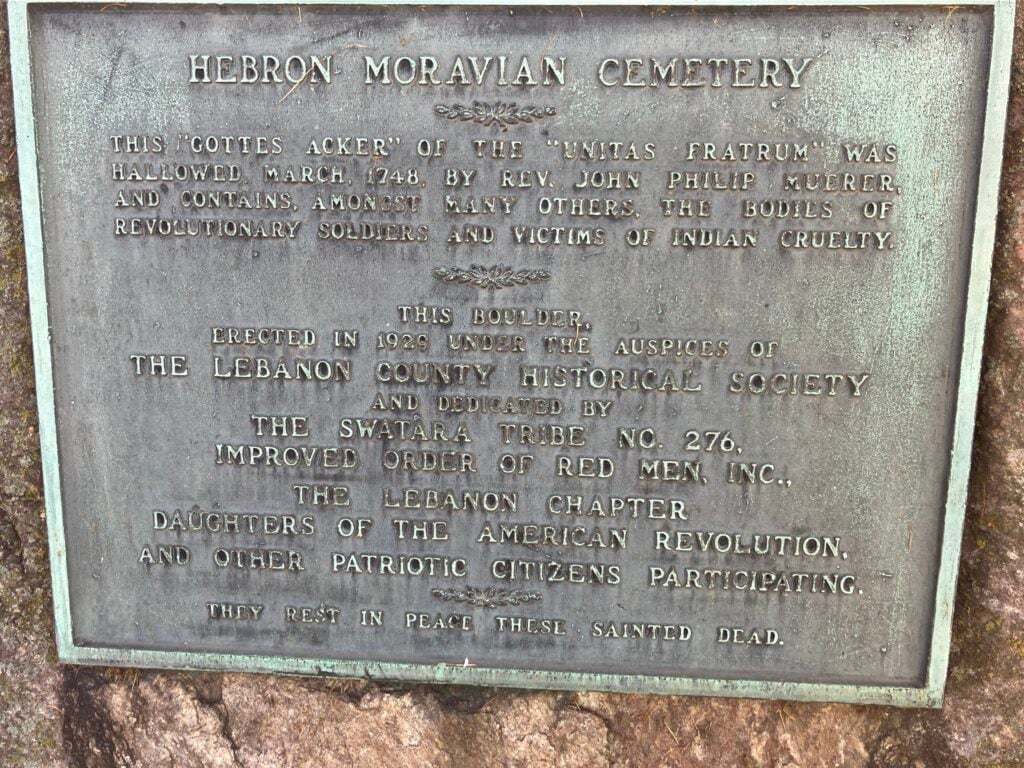
A marker on a boulder within the cemetery was dedicated by the Lebanon County Historical Society in 1929 by several different groups, as noted on the stone. (James Mentzer)
A public service will be held on Dec. 13 at 9 a.m. as part of the Wreaths Across America program, which honors those who served.
Beyond the upcoming ceremony, Dieffenbach will work on getting national historic designation for the cemetery.
“So to get national designation, you must first be accepted by your state board and they won’t accept you if you don’t have a chance to go forward with the national. I got bogged down with some … issues, and I never have proceeded on the national (designation). I have the application started,” she said.
Klahr, who is also involved with Cedar Hill Cemetery in Fredericksburg, and Dieffenbach expect to be buried here since both are members of the Moravian faith. Dieffenbach said some family members already have Hebron Moravian Cemetery as their final resting place.
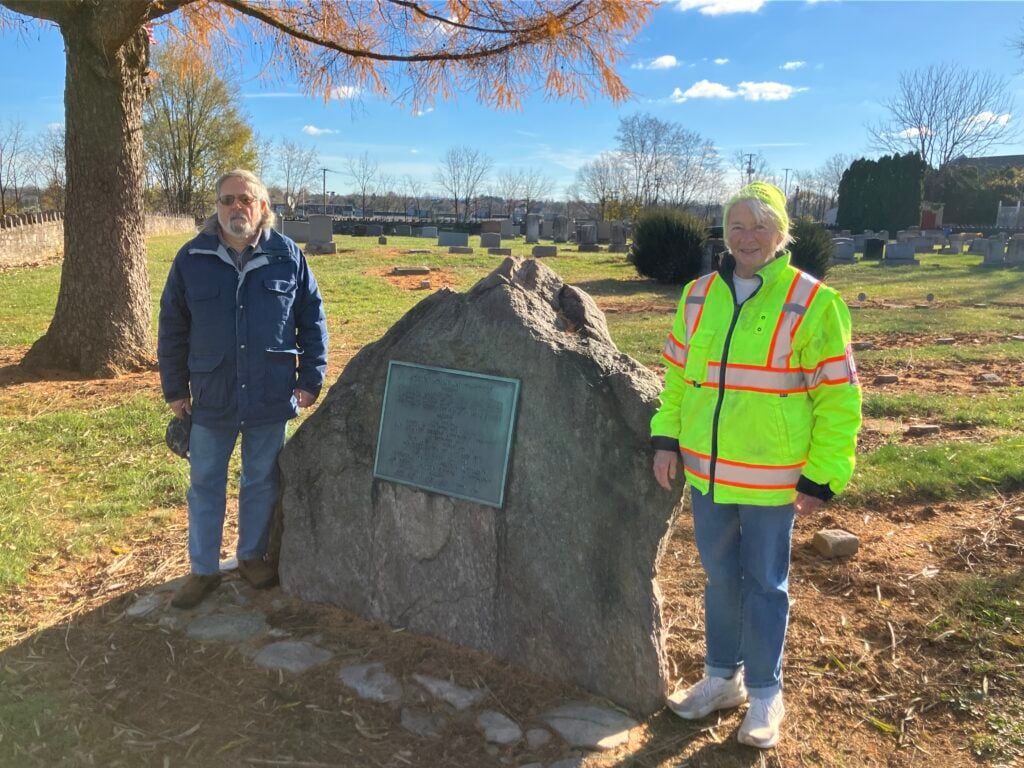
The stone marker that was dedicated in 1929, and located in the old section of the Hebron Moravian Cemetery in South Lebanon Township. (James Mentzer)
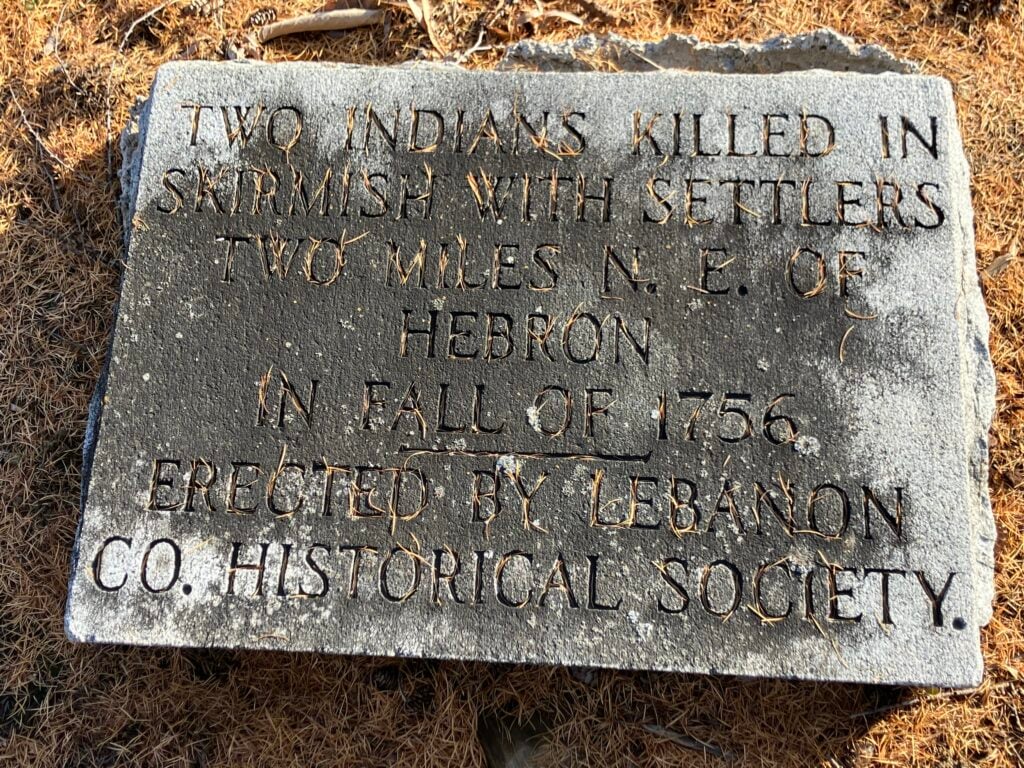 Marker in memory of two Native Americans who are buried in Hebron Moravian Cemetery. The church had a practice of interring individuals even if they were not of the Moravian faith. (James Mentzer)
Questions about this story? Suggestions for a future LebTown article? Reach our newsroom using this contact form and we’ll do our best to get back to you.
Keep local news strong.
Cancel anytime.
Still no paywall!
Fewer ads
Exclusive events and emails
All monthly benefits
Most popular option
Make a bigger impact
Already a member? Log in here to hide these messages
Lebanon County needs modern local journalism that works. LebTown delivers timely, accurate reporting without paywalls or corporate mandates. Support our independent newsroom with a monthly or annual membership, or make a one-time contribution to fuel more local coverage. Cancel anytime.