
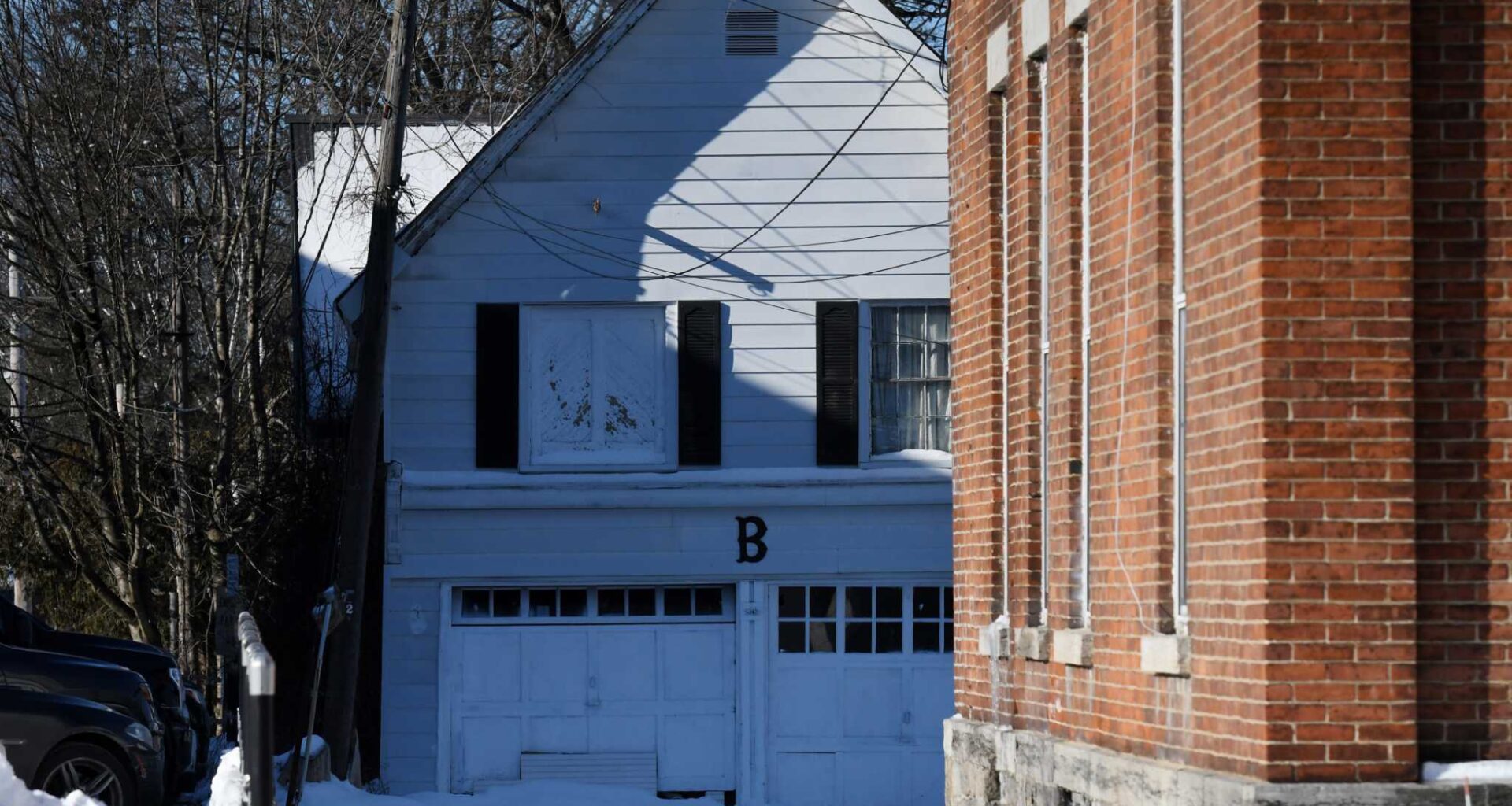
A state comptroller’s audit says New York and NYC health agencies must tighten funeral oversight after risks of misidentified bodies and invalid burial permits. Above: Garages behind the Ehle-Barnett Funeral Home in Johnstown, where Brian M. Barnett was charged with a number of criminal offenses including state health law violations in 2022.
Will Waldron/Times Union
ALBANY — A risk of misidentified corpses, shoddy efforts to check for signs of life, and poorly monitored embalming rooms are among the major gaps in New York’s oversight of the funeral industry, according to the state comptroller’s office.

The findings were detailed in a recently released audit which found that thousands of bodies were buried or cremated before required documentation was filed.
Article continues below this ad
The audit said that meant burial permits were potentially invalid or funeral arrangements might not have matched the wishes of the deceased or their families.
The audit, which covered April 2019 through November 2023, concluded that the state Department of Health and the New York City Department of Health and Mental Hygiene must improve oversight and coordination to address significant deficiencies in the practice of funeral directing.
Among the concerns was health officials’ ability to monitor funeral firms and funeral home director registrations. The comptroller found two instances in which a firm may have been practicing at unknown or unregistered locations. There were also cases where death certificates were filed by unregistered or unknown funeral directors or firms.
Make the Times Union a Preferred Source on Google to see more of our journalism when you search.
Add Preferred Source
This issue made headlines in 2022 after authorities discovered an unspecified number of decomposing human remains at a Johnstown funeral home. At least two bodies were discovered in the garage, where the remains were stored alongside trash and furniture.
Article continues below this ad
The owner had been working under a suspended license for operating an unregistered firm after having been previously sanctioned by public health officials for the same violation.
In a statement to the Times Union, Marissa Crary, a department spokeswoman, said the Bureau of Funeral Directing is committed to improving its oversight of funeral homes and directors.
“The department is reviewing the audit’s findings and has already taken steps to strengthen compliance, communication and follow-up processes,” Crary said.
Checking for signs of life
Some funeral directors weren’t using required tests to verify that someone died, the audit found.
Article continues below this ad
Funeral directors are supposed to confirm a death through two required tests, one of which involves placing a stethoscope or an ear over the heart to listen for signs of life.
The comptroller noted that four of the eight funeral directors interviewed said they instead relied on assessments by medical staff at the hospital or nursing home. One told auditors that they could “just tell” when someone was dead.
The auditors acknowledged that it’s rare for someone who has been declared dead to be still alive, but said it does happen.
In 2023, an 82-year-old woman was pronounced dead at a Long Island nursing home, only to start breathing again soon after she arrived at the funeral home. She was brought to the hospital and died the following day.
Article continues below this ad
Photos of preparation rooms included in a state comptroller’s audit of the funeral industry. The photo on the left was identified as a “horror scene” at the time of the firm’s registration.
Office of the New York State Comtroller
The comptroller said that case illustrated the importance of a multistep verification process meant to confirm that a person died.
The state Health Department’s response that’s included in the audit said that a medical professional makes the primary determination of death and that funeral directors are a second-line defense. However, they often lack clinical training and will soon receive state guidance on the matter.
Risk of misidentified corpses
Corpses are supposed to be clearly labeled to prevent tragic mix-ups, yet gaps in oversight and outdated guidance have allowed misidentifications to persist, the comptroller said.
Article continues below this ad
After issuing guidance in 2017 instructing hospitals and funeral directors to tighten procedures for identifying and releasing remains, the state Health Department did little to provide further guidance, even as more than half of all deaths from 2018 to 2023 occurred in residences or nursing facilities, according to the audit.
During that period, misidentifications continued, including two cases in 2021 and 2023 in which the wrong bodies were buried. The audit did not provide any details on those cases.
According to news reports, a family sued Amityville funeral home and its director in 2021, accusing the business of burying the wrong body.
Comptroller interviews with eight funeral directors revealed that three of them also did not consistently label the bodies of dead people in their care.
Article continues below this ad
Some said they avoid tagging remains during pickup to avoid traumatizing families; others believed their caseloads were small enough to prevent errors.
The Health Department, however, maintained that the responsibility for labeling the deceased rests with the entity releasing the remains.
The comptroller urged the Health Department to issue more frequent guidance to help prevent mistakes.
“As with instances in which people are pronounced deceased in error, instances in which bodies are misidentified are traumatic for the deceased’s loved ones and can be damaging to the reputation of the funeral firm and the industry,” auditors said.
Article continues below this ad
‘This is a horror scene’
The state Health Department has little assurance that funeral homes maintain safe, sanitary embalming rooms — spaces that, by regulation, must be clean, dedicated solely to preparation, easily sanitized, and equipped with proper waste disposal.
When budget cuts ended in-person inspections around 2006, the state Health Department replaced them with a one-time photo submission at initial registration. After that, no updates were required unless someone filed a complaint. As auditors noted, that meant the agency “may not ever know” whether a firm’s prep room still met standards, or ever did.
A review of 32 firms found that the state Health Department had a reduced or no assurance of compliance for 22 of them.
Article continues below this ad
One firm submitted a set of 2019 photos showing a room in disrepair, accompanied with a sticky note that read: “This is a horror scene. It will be completely renovated.” The state agency didn’t request updated images until this year.
In another case, nine of the 13 firms operating at the same location had for a decade relied on the same embalming room photo that was date-stamped from 2013.
Health officials told auditors that the newly established bureau of investigations will resume on-site compliance checks and that funeral firms will now be required to provide current prep-room photos during every biennial registration renewal.
Deaths registered after burial
State law requires that deaths be registered before any burial, cremation, organ donation or entombment. A death certificate needs to be filed with the local registrar within 72 hours. Only after that filing can a registrar issue a burial permit.
Article continues below this ad
However, despite that clear mandate, the comptroller’s office found widespread noncompliance. There were 2,545 cases in which death certificates were registered after the deceased had already been buried, cremated, donated organs or entombed.
The late registrations involved 872 funeral directors, including 483 who did it more than once and eight who filed 22 to 49 late certificates each. Erie County had the most at 539. Albany County saw 116.
Registering a death after disposition is more than a paperwork error, auditors noted. That’s because it raises the risk that no valid permit existed and that the disposition may not have matched the wishes of the deceased or their families.
Article continues below this ad
While agencies cited reasons for general delays, such as difficulties locating next of kin or disposition occurring abroad, it did not explain why registration would occur after the body was already disposed of, the comptroller’s office said.
Note: An earlier version of this story included an image of the W.J. Lyons, Jr. Funeral Home in Rensselaer, which was not a subject of the comptroller’s audit.