
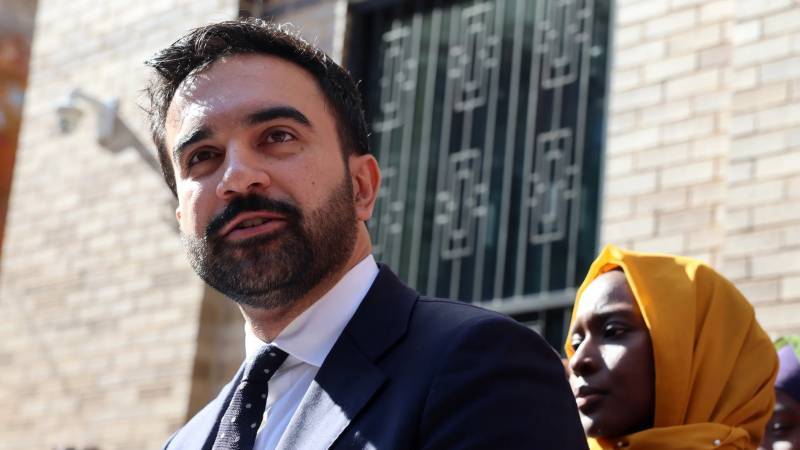
Five years ago, Zohran Kwame Mamdani walked into this house as just a motivated candidate. He represented a new voice for the younger generation and a leader who wasn’t born into politics, but who built his path step by step and door by door.
On Thursday, he was welcomed back — not as a rising candidate, but as the next Mayor of New York City.
“I am less than 30 days,” he said, voice steady, “from being inaugurated as the first South Asian, the first Muslim mayor in the history of New York City.”
The evening was warmly hosted by PSA National Co-founder Arsal Ijaz. “This isn’t just another political gathering,” he said. “For us, it’s personal.” He explained that the Pakistani American Political Action Committee was born in that very house, a place where his father, Dr Ijaz, first envisioned a community moving from silent outsiders to active shapers of politics.
Mamdani spoke candidly about how these identities provided him with the “experience of what it looks like to be on the outside looking in”. He described being asked to step aside at JFK and the anxious moments waiting for news during his father’s citizenship interview. These experiences, he said, showed him “the limitations of the promise” made in the city.
At the start of the campaign, many called his dream impossible, viewing it as a “fool’s errand”. Mamdani, however, invoked Nelson Mandela: “It always seems impossible until it is done.” Polling at just 1% at one point, his campaign won more votes against the odds than any candidate since John Lindsay in 1965.
There was a roll call of gratitude. He acknowledged Dr Ijaz, the aunties and uncles who opened doors in Queens, and the young volunteers who skipped weekends to stand on subway platforms handing out flyers. He traced a straight line from a long-ago city council race, knocking doors for Ali Najmi, eating biryani at his mother’s house, listening to the story of the uncle who “couldn’t wait” to vote after the election had already passed, to the decision this time that no uncle, no auntie, no first-time voter would miss their chance.
Now days away from becoming New York’s first South Asian and first Muslim mayor, he urged supporters to continue contributing to the transition. He emphasised that the period following the election is not merely a time for celebration, but a crucial phase of preparation that determines the success of his administration from its first day.
He ended, as he began, with a story. A poignant tale from a plane returning from Puerto Rico, where a South Asian doctor saved a woman’s life. When asked how to thank him, the doctor’s request was simple, stunning, and profound: “I need two tickets to Zohran Mamdani’s inauguration.”
If 2020 had been a test of whether Mamdani belonged in the process, 2025 had been a demonstration of him redrawing the political map. Pakistanis, Indians, Bangladeshis, Nepalis, Tibetans South Asians from across the five boroughs pulled into a campaign that insisted it was theirs too. And yet, for all the noise and the nerves, it never truly felt like Zohran wouldn’t get there in the end. For Zohran certainly did not doubt it.