

UTICA, N.Y. (WKTV) — New Yorkers are being urged to cut back on rock salt use to protect waterways and drinking water supplies.
The New York State Department of Environmental Conservation highlighted the environmental impact of rock salt, noting that just one teaspoon can pollute five gallons of water.
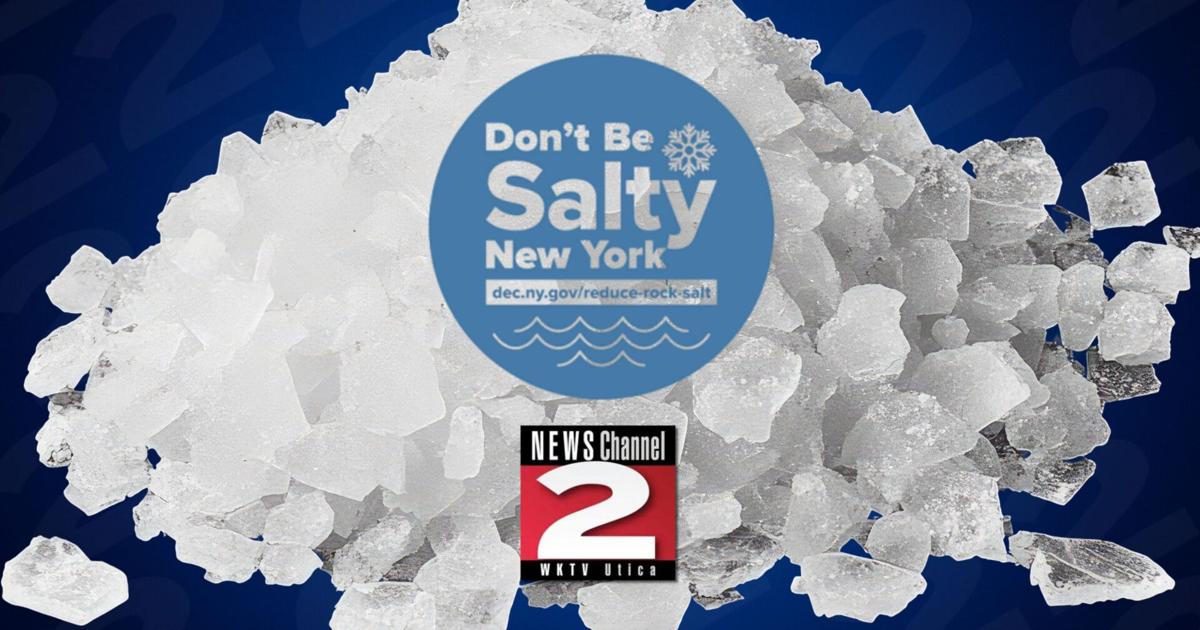
The “Don’t Be Salty, New York” campaign seeks to educate the public on reducing salt usage while maintaining safety.
According to NYSDEC, “Consistent with a recommendation in the 2023 Adirondack Road Salt Reduction Task Force report, DEC conducted a public survey in 2024 to better understand perceptions surrounding rock salt usage and make appropriate recommendations for reduction strategies to be applied throughout New York.”
In August 2025, the New York State Department of Transportation expanded its road salt management program for the 2025-26 season, reducing the average application rate of granular salt to 172 pounds per lane-mile during the 2024-25 season—down from the seven-year statewide average of 194 pounds per lane-mile.
“NYSDOT takes the issue of road salt management very seriously and for more than a decade has been a national leader in the effort to reduce the use of salt while still maintaining a safe and reliable transportation system. These efforts include but are not limited to enhanced training for snowplow operators, direct liquid applications in place of road salt, continuous evaluation of innovative equipment, and utilization of best management practices for reducing road salt,” according to NYSDEC.
The DEC encourages several practices to limit salt usage, such as:
Shoveling snow before applying salt;
Using a spreader for even distribution; and
Considering alternative products like brine solutions.
A brine solution can be made by “combining 3.5 cups of rock salt per gallon of hot tap water and stirring until all salt is dissolved. Let any gravel settle to the bottom. Pour the brine into a regular garden sprayer and spray in a zig-zag pattern over desired area. Save extra brine to use later,” the DEC added.
Rock salt becomes less effective at temperatures below 15°F.
“Sand can be used for traction on ice during a cold snap (and can be swept up in the spring for reusing) or switch to a deicer made for colder temperatures. If a snow or ice storm is predicted, consider pre-treating surfaces with rock salt to prevent ice from forming,” the DEC suggests.
The campaign also highlights the negative effects of excessive salt use, such as water pollution, harm to aquatic life and infrastructure damage.
“The presence of sodium in drinking water is problematic for individuals with low-salt or limited-salt dietary restrictions. People on a sodium-restricted diet can experience health risks when exposed to elevated levels of sodium in their drinking water,” according to the DEC.
For more information on salt reduction strategies, visit DEC’s Rock Salt Reduction webpage.