
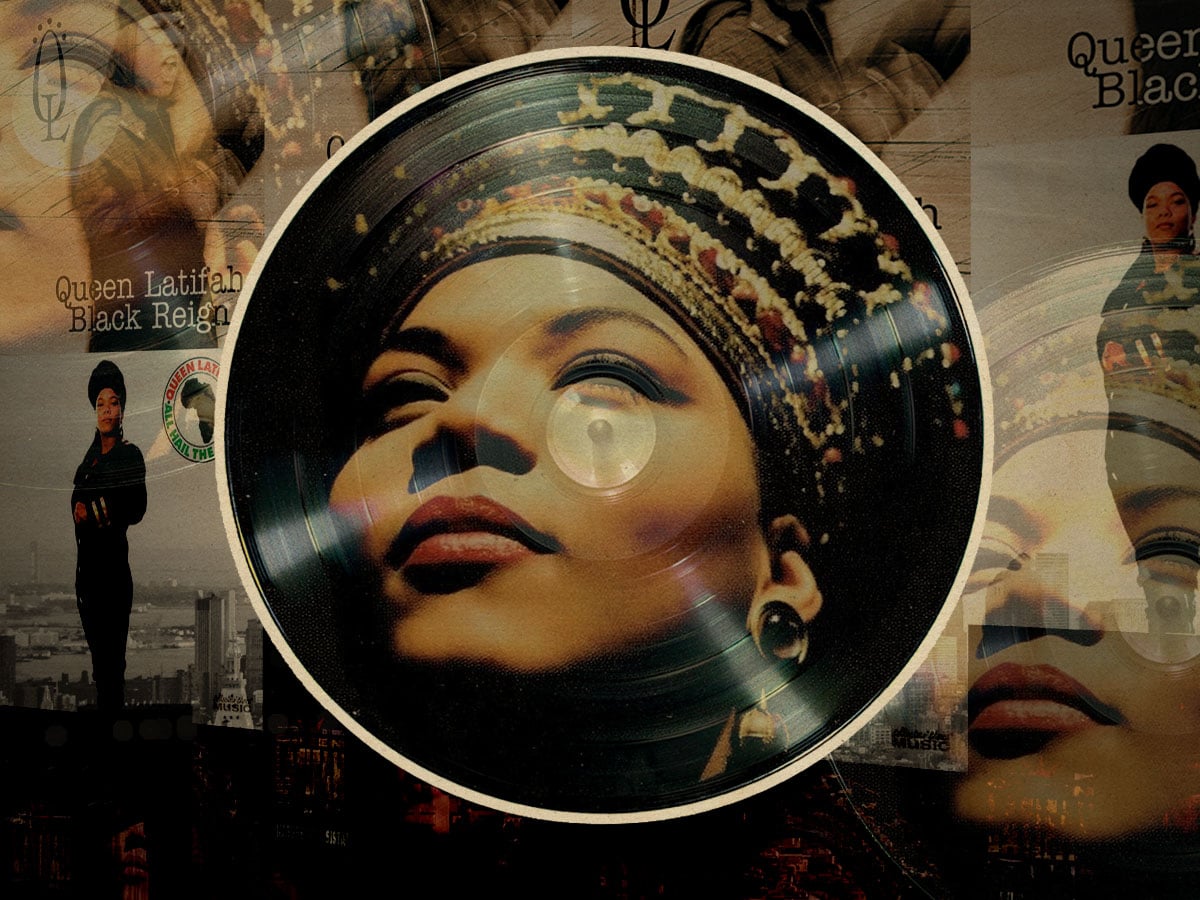
(Credits: Far Out / Tommy Boy Records)
Tue 9 December 2025 3:00, UK
In 1973, ‘The Big Apple’ was being taken over by the infectious sounds of disco, funk, and soul, with every dancefloor throughout Manhattan filled with flamboyantly dressed people two-stepping in time to crystal clear guitars and 4/4 drums.
To the untrained eye, life would have seemed pretty sweet, but there was a divide between different areas in New York, one perpetuated by race and wealth inequality.
In the Bronx, that disco sound wasn’t quite as prominent as people couldn’t relate to it; the glitzy dancefloors where it was so commonly played in Manhattan didn’t exist elsewhere. Not to mention, even if those dancefloors were available, the people likely wouldn’t fill them because there weren’t many DJs in the area. Turntables were expensive, and it was money that people didn’t have readily available to part with.
All you need is one creative person to spark a movement, though, and in the case of hip-hop, that person was DJ Kool Herc, and while the specific origin of hip-hop is tricky to definitively pin down, a major moment was during a party in August 1973 hosted by Herc and his sister, which is said to be the birthplace of the genre, inspired by his DJing style.
The way Herc DJ’d was unlike anything people had previously seen: he was playing the same funk and soul music that everyone in New York was, but only fragments of it. Herc would focus specifically on the break, let it run, and then move over to the next turntable and play the same thing, and this cycle created a breakbeat that people would dance to (hence the term breakdancing) and eventually rap over.
From that moment on, hip-hop advanced in the same way any other genre of music does, but at record speed. Before you knew it, you had MCs whose role within the genre kept changing, and you had groups, different styles, conscious rap, flow, gangsta rap, house, neo-soul, trap, all of these different subsections of rap music, which developed in a matter of decades. The sound went from an underground party to being the biggest genre in the world in a matter of years, and it remains as relevant today as ever.
Of course, every genre of music has its problems, and hip-hop is no different, with one of the biggest issues which has infiltrated the movement ever since its development in 1973 was the fact that it was anti-feminist. You never got many female DJs or MCs, and a lot of the music which was released within the genre spoke of women in a derogatory fashion. Some female MCs broke through the mould in a bid to act as an exception to the rule, but as they became famous rappers, the inherent sexism built into a lot of hip-hop remained evident.
 Queen Latifah – 1980s (Credits: Far Out / Groove Liberator)
You could see this inequality in the fact that female MCs, regardless of their style, were usually pitted against each other. Conscious rappers were compared to party rappers, and women whose styles didn’t overlap at all battled it out as if they were clear rivals. There wasn’t much of a sense of unity throughout the genre, and the cracks built into the sound’s foundation remained ever-present, that is, until Queen Latifah came along with her groundbreaking track ‘Ladies First’ in 1989, a song remains a pivotal moment in the history of hip-hop.
The track would come across as any other celebration of womanhood and femininity within music were it released today, something whose placement in the music industry remains necessary but isn’t quite as scarce, however, when it was initially released, ‘Ladies First’ was the first of its kind, a song that celebrated being a woman and asked them to rejoice rather than compete.
When you listen to this track, it’s upbeat, catchy, and sees Queen Latifah and Monie Love trade bars in a way that remains timeless. The words don’t go too deep into feminism as a concept, and instead just celebrate women, and as this was supposed to be a party, you just had to throw your hands in the air and sing along.
Queen Latifah opens: “The ladies will kick it the rhyme that is wicked / Those that don’t know how to be pros get evicted / A woman can bear you, break you, take you / Now it’s time to rhyme, can you relate to / A sister dope enough to make you holler and scream”.
Monie Love adds: “I break into a lyrical freestyle / Grab the mic, look at the crowd and see smiles / ‘Cause they see a woman standing up on her own two / Sloppy slouching is something I won’t do”.
Women rappers are less of a rarity these days, and while there are still issues surrounding sexism in hip-hop, attitudes towards female rappers have improved. Not to mention, women rappers have a lot more confidence releasing music and truly speaking their mind on what they wind up putting out there, and these improvements may well have not happened were it not for great music such as ‘Ladies First’.
Queen Latifah and Monie Love delivered a call for unity within a genre that wanted women against each other, and thus remains a classic of hip-hop. While it’s still a lot of fun to listen to, the message it carries within that music remains the most important thing, posing to us the question of where hip-hop would be without all the great female rappers that continue propping the genre up, and without a little bit of ‘Ladies First’.
Related Topics