
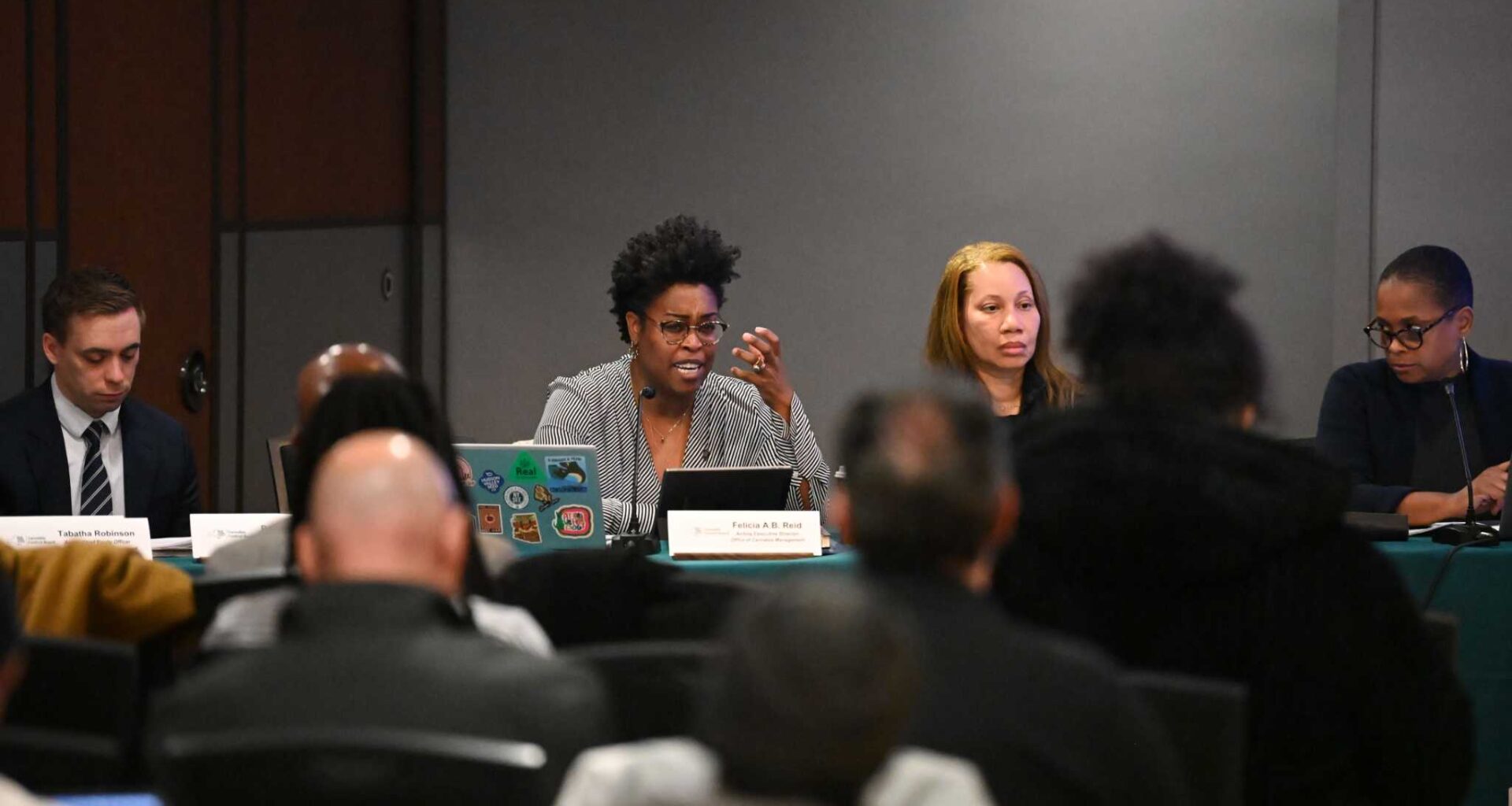
Felicia A.B. Reid, acting executive director of the New York Office of Cannabis Management, center, delivers an annual report last year in Albany. The New York Medical Cannabis Industry Association is seeking a court order compelling New York regulators to “fulfill their legal responsibility to thwart the influx of illicit cannabis product” that they say is undermining the industry.
Will Waldron/Times Union
ALBANY — The New York Medical Cannabis Industry Association filed a lawsuit Wednesday seeking a court order compelling state regulators to “fulfill their legal responsibility to thwart the influx of illicit cannabis product … and to identify and sanction the companies responsible for the illegal ‘inversion’ of out-of-state cannabis products into New York.”

The lawsuit was filed in state Supreme Court against the Office of Cannabis Management and Jessica Garcia, chairwoman of the state Cannabis Control Board.
Article continues below this ad
It alleges the board and Office of Cannabis Management have disregarded their statutory mandates, “and abdicated their responsibility to create a safe, regulated and insular intrastate adult-use cannabis market.”
The lawsuit contends the proliferation of illicit cannabis in New York is not only the result of unlicensed marijuana shops. It notes that illicit cannabis has also infiltrated the licensed cannabis market, and has “placed adult-use consumers and medical patients at risk, threatened the financial viability and reputation of the regulated adult-use market, bolstered the illicit cannabis market and robbed communities impacted by the War on Drugs of critical tax revenue.”
The botched rollout of New York’s retail cannabis industry has been plagued with regulatory and administrative missteps, poor decision-making, a lack of communication and transparency, and a bustling illicit marijuana network that has undermined the ability of those who invested in the marketplace to do well, according to court records, interviews with industry stakeholders and testimony at public hearings.
Make the Times Union a Preferred Source on Google to see more of our journalism when you search.
Add Preferred Source
The medical association’s lawsuit notes that “less than 30 percent of cannabis businesses are profitable.” It also alleges that “most cannabis businesses struggle to remain viable in the hope that the federal government’s re-categorization of cannabis from Schedule I to Schedule III will lower their tax burden and enable them to realize modest profits.”
Article continues below this ad
The lawsuit also contends the state has unnecessarily delayed implementation of a “seed-to-sale” tracking system that would sharply inhibit the ability of “out-of-state actors” to get their illicit products onto the shelves of licensed retail stores.
It’s not the Medical Cannabis Industry Association’s first legal battle with New York’s regulators.
Eleven months ago, the association filed a lawsuit challenging the constitutionality of what it alleged was a punitive $20 million fee that’s required for medical cannabis operators to enter the retail marketplace.
That lawsuit argued that regulations requiring registered medical marijuana companies to make four payments of $5 million as a condition of entering the retail market were so “onerous” that they essentially constituted a “regulatory taking” of their business — and at a time when the number of individuals with valid marijuana prescriptions in New York has been plummeting.
Article continues below this ad
The fallout, they said, has also deprived the state of tax revenue, kept medical operators out of the retail cannabis market and inhibited medical marijuana patients’ access to products.
Closures of medical marijuana businesses have limited the options for medical marijuana patients with prescriptions. Their numbers had already been sharply declining in the wake of the increase in both licensed retail shops and illicit sales; and with fewer medical patients, there has been a decrease in medical sales, another factor that’s hurt those companies. The decline has also impeded the ability of patients to obtain medical guidance for marijuana prescriptions.
New York’s cannabis regulators have lost numerous constitutional challenges over the past four years and weathered dozens of lawsuits challenging their regulations.
Medical companies were held out of the retail cannabis market for the first three years of the rollout and their ability to enter it — even at a high price — has been questioned by other industry stakeholders, including cultivators, who have argued that the state’s poor execution had already crippled smaller vendors in various aspects of the market. Indeed, many licensed retail store owners had to wait far longer than expected to open, while many cultivators and processors found themselves with mountains of product but not enough storefronts to sell it.
Article continues below this ad
Two years ago, as lawmakers considered moving up the timeline for medical companies to enter the retail market, the Cannabis Association of New York issued a memo criticizing the decision.
“Now is not the time for massive out-of-state corporate special interests to jump the line, and be given special treatment, especially while small and midscale (New York) operators are struggling,” CANY said in a memo in June 2023.
The medical marijuana industry has pushed back, noting that state regulators and others have demonstrated a consistent pattern of hostility toward registered organizations — medical cannabis operators — and cast them as “big cannabis” that would destroy the marketplace for small operators and “social equity” licensees that include those with past marijuana convictions. But the medical industry stakeholders contend that characterization is misplaced and fails to recognize the financial stability they have brought to the industry while upholding the medical program for years.
The retail marijuana market was especially harmed by the proliferation of illicit marijuana shops that exploded across the state. They have been fueled, in part, by the lawmakers’ decision to immediately legalize marijuana possession when the law was passed in April 2021 — long before the retail market would begin taking shape. Many law enforcement agencies had initially been reluctant to target those shops or street sales because of the decriminalization of the drug and criticism that marijuana arrests for decades had unfairly impacted minority communities.
Article continues below this ad
Even as enforcement efforts have been ramped up, and after the Office of Cannabis Management underwent a leadership overhaul at the direction of Gov. Kathy Hochul, the “inversion” of illicit marijuana into the regulated market remains a serious problem, according to industry stakeholders.
The Cannabis Control Board adopted new regulations intended to strengthen enforcement efforts against the thousands of unlicensed shops. Those rules empowered the Office of Cannabis Management to work with police agencies to seize illegal product, issue fines and close shops that were not in compliance.
Officials with the state Office of Cannabis Management have said they will not comment on litigation.
The petition filed by the medical association this week seeks a declaratory judgment and and order compelling New York’s cannabis regulatory bodies to: Promulgate rules and regulations to prevent the inversion and diversion of adult-use cannabis from New York into other states and vice-versa; rescind the licenses of cannabis companies found to have imported and/or exported cannabis across New York state lines; enforce rules and regulations that require cannabis licensees to tag, label, and/or record all raw material and/or finished product in an inventory tracking system; inaugurate the seed-to-sale tracking system no later than Dec. 31, and set a deadline no later than Jan. 12 for all adult-use licensees to integrate their electronic inventory system with the seed-to-sale tracking system.
Article continues below this ad
The lawsuit also seeks a court order requiring the state attorney general’s office to take legal action, including suspending the retail licenses of any licensees who have imported or sold cannabis or diverted it to other states.
“Companies that produce their cannabis goods out-of-state can circumvent New York’s transaction costs and wholesale tax duties and sell their cannabis products at a fraction of the price of New York’s legitimate operators, who manufacture their products in New York and obey New York’s two-tier market structure and testing rules,” states the medical association’s petition, which was filed by Matthew Schweber, an attorney with Feuerstein Kulick LLP, which specializes in cannabis laws and represents the state’s medical cannabis association.
Schweber wrote that the unbridled illicit cannabis market “deprives New York state of critical tax revenue, some of which is earmarked for communities disproportionately impacted by cannabis prohibition. Moreover, this outflow of capital from New York to illicit players in other states directly leads to the loss of employment opportunities in-state and, more dangerously, props up a multitude of ancillary criminal activity.”
Article continues below this ad