
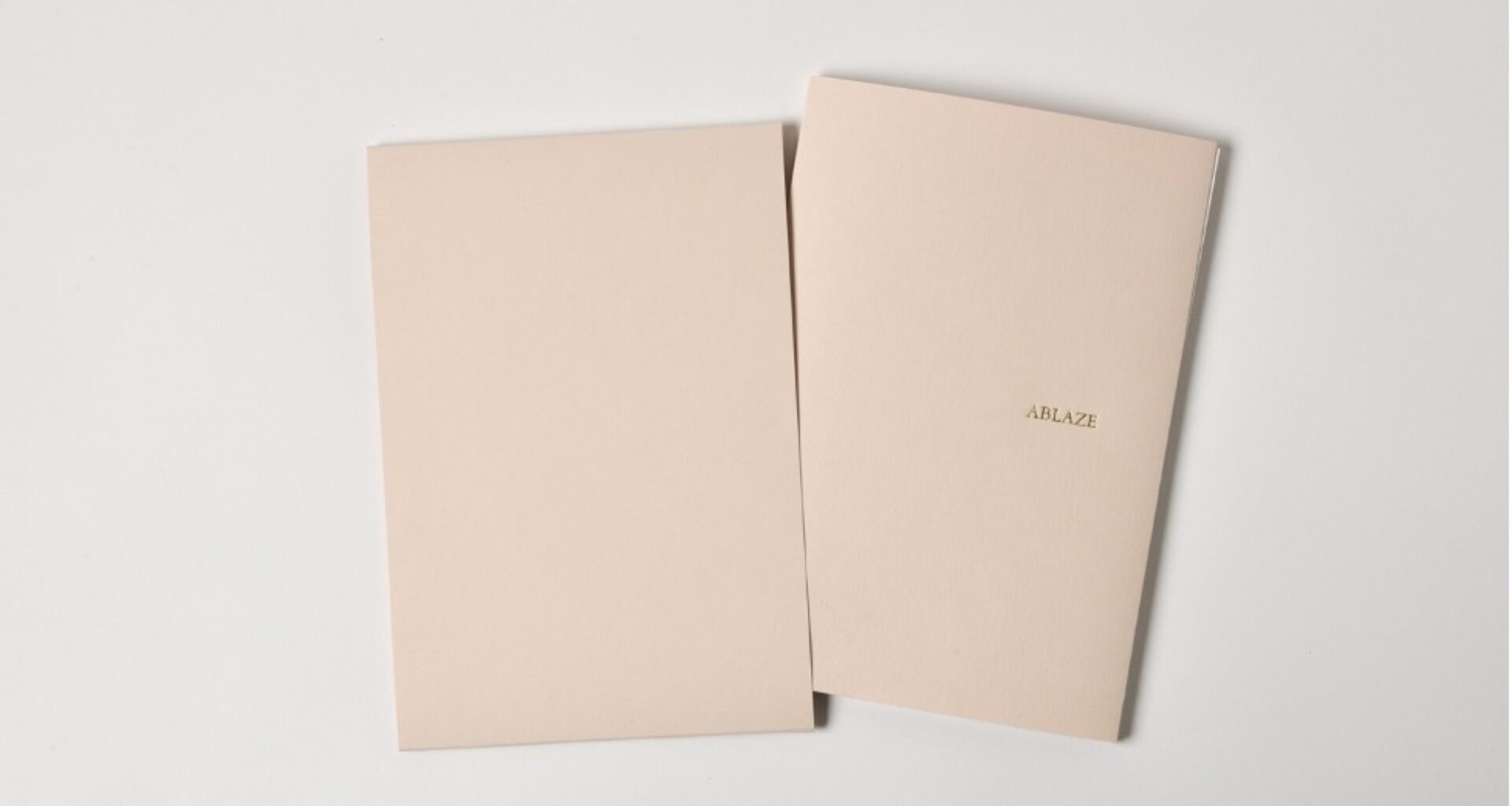
ABLAZE
Photographs by Ewa Monika Zebrowski
Poem by Anne Michaels
Datz Books, 2025
ABLAZE (did Rodin like chandeliers?) is a lovely collaboration between the artist Ewa Monika Zebrowski and the poet and novelist Anne Michaels. This is the fourth time the two Canadians have worked on a book together, and this may be the most beguiling of the bunch.
Zebrowski, a photographer and poet, has mounted forty solo exhibitions and produced twenty-five artists’ books. I came to know her work through a shared interest in Cy Twombly. Michaels, also a poet, might be best known for her 1996 novel Fugitive Pieces—a stunning lyrically fragmented story that happens to be one of my favorite novels of the decade. At first glance, Zebrowski and Michaels are an unlikely duo, but both have the capacity to imbue the ordinary with something just a little extra, something magical, some sort of aura, the everyday recast as the curious.
Zebrowski’s photographs take their inspiration from Auguste Rodin, specifically the light in his home and studio, the Hôtel Biron. Now a museum, the Hôtel Biron is a mélange of genres—not unlike this book about it. ABLAZE contains sixteen photographs and sixteen “colour veils,” which are non-photographic rectangles of color. These veils sometimes overlay the photographs and seem to symbolize or embody the colors of light itself. The combination of the veils and the photographs makes ABLAZE feel like a gallery.
Many of Zebrowski’s photographs are of chandeliers and reflections and refractions of light from and around them. Mirrors also function as a kind of protagonist, as do windows. They serve as key metaphors and motifs, capturing, throwing, enabling, revealing, and releasing light—as though the Biron air is itself ablaze. These images oscillate between gauzy moodiness and stark minimalist realism. A row of metal chairs against a marble staircase. A row of trees in an orchard. All presented without text or captions. The world as it is. But other times, as in a haunting photograph of the back of a sculpture, we get the sense that we are looking through a thin drapery. The image is in focus but not clear; indeed that paradox between clarity and obscurity permeates the book.
Michaels’s poem, also titled “ABLAZE,” is the thread stitching Zebrowski’s photographs to each other. Located in the center of the book on heavier paper stock, the poem functions as both the metaphorical and literal nucleus. It folds out, pamphlet-like, into three sections, as though creating three panels, walls, or frames: a triptych. When unveiled, it looks and feels like a broadside. The poem begins: “I keep my eyes closed / to see / what your hands see / I am / who your hands make.” The “I” here is curious. Is the speaker Michaels? Zebrowski? Some unnamed viewer? My suspicions are that the speaker is Rodin the human talking to Rodin the sculptor. Or Rodin talking to one of his sculptures. Or both.