
Alexa West
Jawbreaker Part 1 Part 2
99 Canal, co-presented by Pageant
November 15–16, 2025
New York
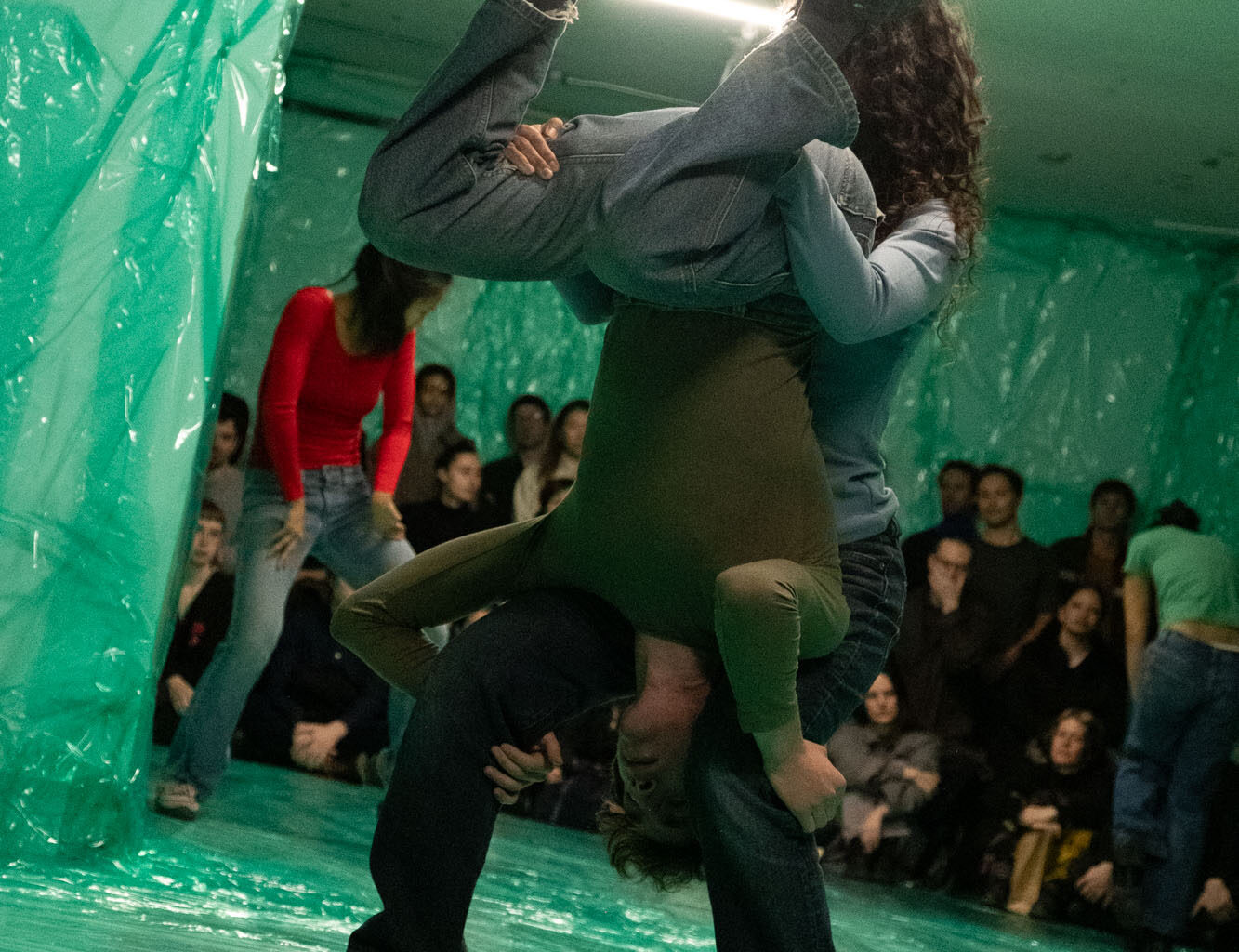
There are two ways to conquer a jawbreaker: lick to the center or buck up to its threat and bite. Either way it’s total fixation, a kind of frantic devotion to the candy and to a potentially destructive result (sugar-high or broken-face). This double bind forms the core of Alexa West’s Jawbreaker Part 1 Part 2, a performance that pushes its dancers into alternate states of slow and whiplash compulsion. Swaddled by Charlap Hyman & Herrero’s aqua stretch-wrapped room—a life-sized candy wrapper and West’s most monumental dance environment to date—Jawbreaker confronts obsession and the nature of control within choreographer-performer dynamics.
Five dancers—Cayleen Del Rosario, Benin Gardner, Amelia Heintzelman, Molly Ross, and Isa Spector—announce themselves with a catwalk. It’s somewhere between military bootcamp exercise and nineties runway stomp, and in their all-American jeans the quintet looks like a Calvin Klein ad gone rogue. Their hypnotic strut, set to a thumping score, calls to mind another Jawbreaker: the 1999 teen-queen cult classic in which three high school socialites accidentally kill their friend by choking her with a jawbreaker. The film’s iconic stage is the high school hallway, an apt parallel for West as her Jawbreaker follows certain cheerleader logics: rote and repetitive movements, individualism and required cooperation, feats of strained and bewildering athleticism, a human pyramid. It’s the inevitable fall—from grace, toward something more sublime—that West attends to. Mid-strut each dancer collapses, one after the other, and over the course of Part 1—through a cavalcade of single and paired contortions, piqué twirls, and tweaked-out Bob Fosse flourishes—they keep struggling toward images of grotesque perfection.
West’s singular ability to isolate manic focus is on full display in Jawbreaker, as is her challenge to the audience to see it all. A dancer on all fours, slowly scanning the room, demands the same attention as one convulsing at its center. The spatial fragmentation of 99 Canal amplifies this disorienting simultaneity. Jawbreaker first debuted at Pageant, an artist-run performance space that West cofounded in East Williamsburg, where dancers were bounded by the loft’s side walls and backdrop of windows. At 99 Canal, West incisively shifts Jawbreaker’s axis and peripheries, making smart use of the split rooms and the opening between them. The passageway cuts and orders sightlines, a generative denial that serves to crop, distort, and hide the dancers’ bodies. It also functions as a trick mirror, making twins of the divided audience watching and studying the dancers and each other from opposite rooms. The rawness of 99 Canal pipe and brick-filled venue lends this iteration a colder, more hard-edged flavor, amping up its anxious impulses while stripping away a softness available in the more intimate and enclosed Pageant. This may operate to the piece’s detriment, as part of West’s brilliance is her ability to cast fixation as a strangely tender form of devotion. But it’s also a radically new version, and Jawbreaker’s second half magnifies these games of strange symmetry and unruly doubles.