
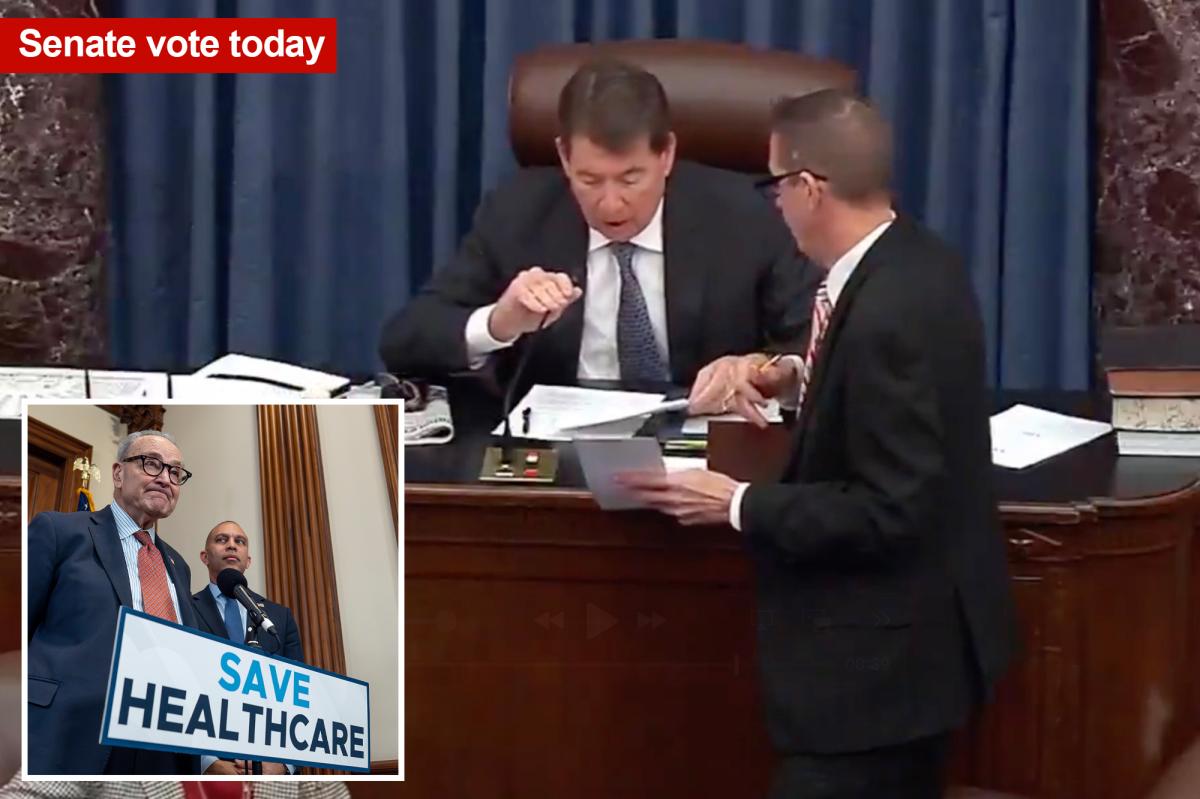
The Senate rejected a Democratic bid to extend expiring COVID-era Affordable Care Act subsidies for three years — dealing a final defeat to Senate Minority Leader Chuck Schumer (D-NY) after he and his party forced a six-week shutdown of the federal government.
Democrats, led by Schumer, had forced the 43-day suspension of operations earlier this fall in an attempt to get Republicans to agree to extend the subsidies, which were implemented as part of the 2022 Inflation Reduction Act — passed by Congress without a single GOP vote — and signed into law by President Biden.
“Let’s avert a disaster,” the Brooklyn native implored his colleagues ahead of the vote. “The American people are watching.”
Republicans, led by Senate Majority Leader John Thune (R-SD), had rejected an extension of the subsidies as out of the question without restrictions like income qualfications and safeguards against potential fraud.
“Apparently, they think that a three-year extension with no reforms to try and disguise the real impact of ObamaCare’s spiraling costs is actually a plan,” Thune said in his floor remarks. “I don’t know how you can call it a plan.”
Moments earlier, lawmakers voted to block advancement of a bill proposed by Sens. Bill Cassidy (R-La.) and Mike Crapo (R-Idaho) that would have scrapped the subsidies in favor of health savings accounts (HSAs) that will be funded for the next two years.
The Senate voted to block advancement of a bill proposed by Sens. Bill Cassidy (right) and Mike Crapo (left). AP
The Senate rejects the Republican-proposed Obamacare solution, 51-48, Thursday, Dec. 11, 2025.
Senate Minority Leader Chuck Schumer and House Minority Leader Hakeem Jeffries speak to reporters about health care affordability at the Capitol in Washington, Dec. 3, 2025. AP
In both instances, 51 senators voted to begin debate on the bill in question with 48 opposed.
Sen. Rand Paul (R-Ky.) joined all 47 Democrats to block the Cassidy-Crapo plan, while GOPers Susan Collins of Maine, Josh Hawley of Missouri, and Lisa Murkowski and Dan Sullivan of Alaska voted to advance the Schumer plan.
Start your day with all you need to know
Morning Report delivers the latest news, videos, photos and more.
Thanks for signing up!
Members of both parties did agree on one thing: There is not enough time left before lawmakers leave DC for the holidays to avert premium hikes for approximately 22 million Americans enrolled in Affordable Care Act exchanges, whose bills are due to double on average.
“It’s too complicated and too difficult to get done in the limited time that we have left,” Sen. Thom Tillis (R-NC) told reporters.
“Our bill is the last train to leave the station,” Schumer warned on the floor. “After this, we will not have time to try again.”
Since the shutdown ended Nov. 13 after eight Democrats and Dem-aligned independents voted to reopen the government, Republicans and Democrats have yet to engage in meaningful talks on a solution to the premium rises.
Sen. Angus King (I-Maine) has claimed initial talks broke down when Republicans demanded language adding new limits on abortion coverage that King called a “red line” for Democrats.
In lieu of the subsidies, the Cassidy-Crapo proposal would have offered adults earning up to 700% of the federal poverty level ($109,550 for single people) to access $1,000 per year in a tax-advantaged HSA if they’re younger than 50.
For those aged 50 to 64, the amount in the HSA would have risen to $1,500 per year.
President Trump told reporters on Air Force One Tuesday that “I like the concept,” but stopped short of giving his full endorsement.
“I love the idea of money going directly to the people, not to the insurance companies, going directly to the people. It can be in the health savings account; it can be a number of different ways.”
Schumer and Senate Democrats disagreed, with the Brooklyn native saying: “Under the Republican plan, the big idea is essentially to hand people about $80 a month and wish them good luck.”
The minority leader added in his floor remarks that the only viable plans to access the HSA money have deductibles of $7,000 or more.
“So, to get that $80 a month, you’re going to pay $7,000 off the top before you even get any health insurance,” he said. “How ridiculous. How stingy. And how mean and cruel to the American people.”
Explaining his “no” vote, Paul argued on X that while the GOP proposal “may be a slight improvement … it’s still a vote for ObamaCare — something conservatives would have firmly rejected not long ago.”