
Farms aren’t just farms anymore — they’re also event venues, community spaces, art studios, classrooms, taprooms and restaurants. As the latest wave of post-pandemic residents and visitors seek reprieve from cityscapes but still want things to do, agritourism in upstate New York is booming.
Interest in returning to the land is not new, but a new crop of agriculturally curious couples, families and entrepreneurs is diversifying the region’s cultural offerings in pursuit of a lifestyle rooted in physical labor and connection to nature and community. These new business owners are also grappling with centuries-old farming traditions and competing with families who have been plowing fields for generations, while legacy farmers must adjust to a tourism market where consumers increasingly want to interact with the farms that feed them.
Some two decades ago, farmers began thinking, “How do we pivot into the 21st century?” said Pieter Estersohn, author of “Back to the Land: A New Way of Life in the Country.”
Article continues below this ad
Many have looked to reorient their business models around farm-to-table culture, scenic surroundings, a historical connection to the 19th-century Hudson River School movement, and their easy access to New York City. They’re turning their farms into public-facing properties offering events, festivals, food and pop-ups for locals and tourists.
Families flock to Kesicke Farm in Rhinebeck for pick-your-own pumpkins.
Lauren Mulvey/For the Times Union
Kesicke Farm in Rhinebeck runs a corn maze in the fall.
Lauren Mulvey/For the Times Union
A food pop-up at Greig Farm in Red Hook.
Lauren Mulvey/For the Times Union
Not all in the family
Some generational farms found themselves with few options but to change hands, unable to continue work or meet shifting consumer demand.
Article continues below this ad
In 1980, when Dave Fraleigh and his wife, Karen, took the helm at Rose Hill Farm in Red Hook, they had every intention of keeping it in the family, where it had been since 1798. But after a few decades, none of their children saw farming in their future and health complications made farming more difficult for Dave. So, they decided to put Rose Hill up for sale.
A Harlem-based couple, Holly and Bruce Brittain, were the first interested buyers. They didn’t have backgrounds in agriculture, but had married in the area and were up for the challenge. When they met with Dave Fraleigh to talk details, they could tell he wasn’t initially keen on turning over his farm to strangers.
“I remember him saying, ‘Well, neither of you has ever driven a tractor — you have to find someone to partner with who can drive a tractor,’” Holly Brittain said.
Article continues below this ad
The Fraleighs had already begun hosting tourists, adjusting from a wholesale to a retail and pick-your-own model in the 1990s. At the time, Dave Fraleigh worked the farm with a small team of apple pickers. But after requests continued to roll in for visitors to pick their own apples, they changed up.
Fraleigh was hesitant to allow people into his orchard, worried it would disrupt his personal connection to the land. But soon, they found a rhythm that worked. They expanded their fruit offerings: cherries, peaches, nectarines. Karen began hosting Red Hook Elementary School students at the farm in the fall. Rose Hill became a sanctuary for the community and more financially sustainable for the Fraleighs.
Since purchasing the farm in 2015, the Brittains have preserved the Fraleighs’ legacy, but have built out its offerings — partly out of necessity.
“There’s a price of Hudson Valley real estate these days, or even when we purchased, that doesn’t align with the business model of just farming,” Holly Brittain said. “There’s a real necessity to figure out something else because the farming is not going to be able to sustain itself, a staff or a salary.”
Article continues below this ad
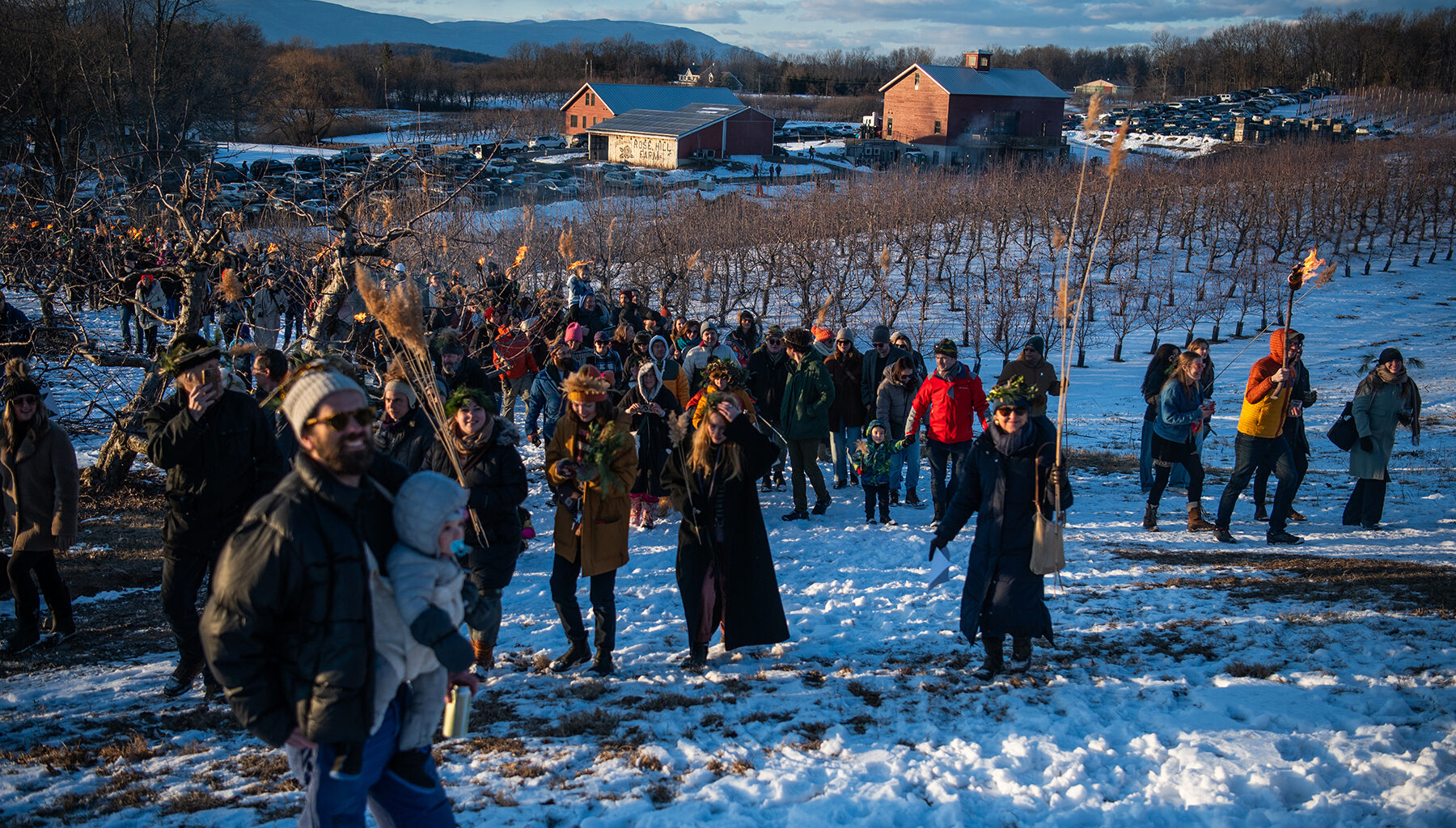
Today, Rose Hill has been revamped from an orchard to a regional destination. An on-site taproom is open weekly, offering in-house ciders, and food trucks regularly pop up outside. Holly Brittain said they try to host a different large-scale event every season, which has spanned from Hudson Valley Sustainable Fashion Week’s annual runway show every fall to the popular Wassail celebrations in January.
The events and pop-ups attract more fruit pickers, but Holly Brittain said the sales at the taproom are an “insurance policy” for the farm. During the winter, Rose Hill can get by on taproom sales. In the summer, the taproom purchases apples from the orchard for cider-making, making the on-site taproom one of Rose Hill’s most loyal patrons.
Wassailers at the annual Wassail Celebration at Rose Hill Farm on Jan. 26, one of several events the Red Hook farm now hosts.
Kelly Marsh/Special to the Times Union
Upstate chic
While some legacy farms adjust to the new normal, other players have brought farm ventures to the region with an agritourism model already in mind. For these businesses, the farm is a necessary part of a larger brand. A curated aesthetic attracts fashion-forward visitors alongside regular weekenders and locals.
Article continues below this ad
“It doesn’t have to be ‘ye olde’ like a Cracker Barrel, right?” Estersohn said.
Arrowood Farms founder Blake Arrowood markets his Accord farm as a multifaceted property. Arrowood brews beer and distills spirits distributed across the region, but also hosts live music, open-air movie nights, and the annual Woodsist Festival, which sees headliners like Waxahatchee and Sun Ra Arkestra.
Next door, Westwind Orchard offers a similar model. The farm exclusively supplies a trattoria offering elevated Italian classics like pappardelle al ragu. During the high season, the property sees visitors every week at its cidery; in the summer, a gelato cart, dance classes and private events take over.
In Altamont, Indian Ladder Farms, founded in 1916, draws throngs of locals and tourists alike with its pick-your-own operations as well as its brewery, cidery and pizza garden.
Article continues below this ad
In Tivoli, Lasting Joy Brewery sits back from the road, its sleek modern taproom with floor-to-ceiling glass windows, picnic tables and fire pits inviting visitors to spend a while. Owners and former city folk Alex and Emily Wenner know that the experience of a space is just as important as the product offered. The allure of their taproom is its scenic location, dropped in a cranny of woods next to a pond surrounded by blooming native plants.
Lasting Joy’s elegant taproom was designed by New York City design studio Auver. The design is part of the brewery’s brand. Lasting Joy hosts events as well and just launched a kitchen menu: Gather at LJB.
“To me, this place is a reflection of the Hudson Valley — a reflection of what we love about it, of this close-knit farming community, of the natural beauty, of this abundant, beautiful, connected place,” Emily Wenner said.
Branding is also crucial at Sky High Farm in Pine Plains, where founder Dan Colen has turned a fashion line into an engine for community involvement. Sky High is a nonprofit that donates 100% of its food to local pantries — more than 225,000 pounds of vegetables and meat over the past decade.
Article continues below this ad
They’re also one of the very few farms with an in-house fashion line. Sky High Farm Universe sells a range of shirts, hats, outerwear and accessories, including collaborations with other boutique designers. It’s not cheap: knit sweaters run upwards of $2,000.
The farm has also leveraged the connections that Colen, as a former downtown gallerist, has made. Last year, Sky High hosted a picnic fundraiser at Kaastbaan Cultural Park where The Roots headlined and Converse debuted a special-edition sneaker emblazoned with Sky High’s logo. This year, they hosted a biennial art exhibition titled “Trees Never End and Houses Never End,” exploring local ecology, history and industry in the Hudson River Valley and its connection to New York City.
These agritourism engines see themselves as part of a larger life cycle: farmland that otherwise might have faced development gets bought up by new Hudson Valley residents who turn the property into a business that in turn feeds, imbibes and entertains its community.
The first Sky High Farm Biennial transformed a disused Germantown warehouse into a labyrinthine gallery of work by over 50 artists.
Phillip Pantuso/Times Union
Lasting Joy’s design-forward taproom brings tourists from far and wide. The farm brewery grows many of its ingredients on site.
Lauren Mulvey/For the Times Union
Doing it the old way
Still, some farms maintain steady income from standard wholesale and retail models. At Chaseholm Farm, a three-generation farm now run by Sarah Chase, customers drive from hours away to purchase fresh milk at the farm store. Chaseholm’s cheese products are also popular at grocery stores throughout the mid-Hudson Valley and beyond.
Article continues below this ad
While they have hosted events, including tours, pastry pop-ups and karaoke nights, since 2013, Chase said these mostly serve to boost foot traffic to the farm store.
“Sometimes it’s hard to get off the farm, so we decided to invite people here instead,” she said.
At Hawthorne Valley Farm in Ghent, a long history precedes the present-day model, which converges Waldorf education with a farm market and a vast farm rooted in biodynamics and ecological research.
Hawthorne is a pioneer in the region’s organic and biodynamic farming industry. Throughout the year, the farm offers training programs to connect the region’s agricultural history with its future.
Article continues below this ad
Scenes from Hawthorne Valley Farm in Ghent.
Lauren Mulvey/For the Times Union
Though much of Hawthorne’s foot traffic comes through its market, CEO Martin Ping said Hawthorne has intentionally avoided making changes to appeal to tourists, opting instead to focus on education and research. Still, he acknowledges that incorporating tourist attractions is a necessity for some farms.
“It’s a tragedy, in a way, that the work of growing our food and stewarding the land isn’t valuable enough that we find a way in society to pay for that without having to add on all these other things,” he said.
Article continues below this ad
But despite all the changes in the industry, Ping remained optimistic about the durability of the profession and the people — whoever they are, wherever they come from — who work in it.
“Farmers are like Renaissance people,” he said. “They’re taking on one of the most challenging vocations in an incredibly shifting landscape: environmentally, ecologically, socially, culturally and economically. It’s all shifting.”