
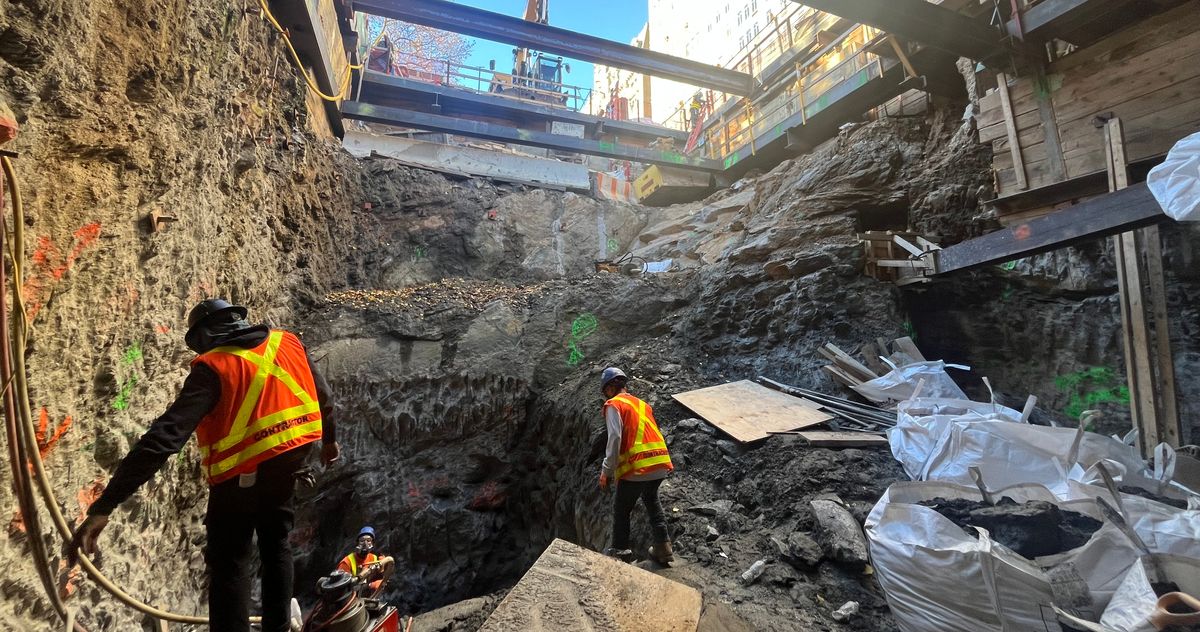
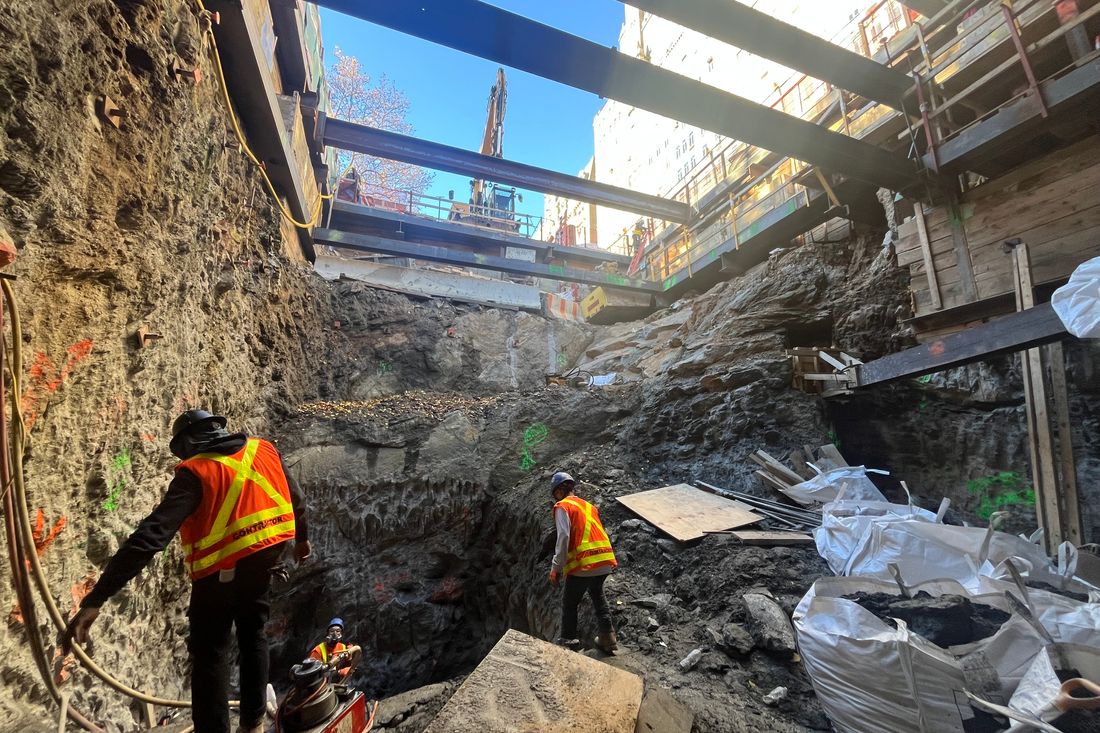
Adding an elevator to the 81st Street station outside the American Museum of Natural History required a dig 40 feet deep, 32 of which were through solid rock.
Photo: Christopher Bonanos
As we disembark from the G train at the Smith–9th Streets station, Matt Best issues a challenge: Think about how we’d get from here to the street without using the stairs. Best is the chief engineer of the construction-and-development division at the MTA, and he and Jamie Torres-Springer, who runs the division, are showing me how they plan to add an elevator to this station. Smith–9th is built on a trestle over the Gowanus Canal, and as we make our way down three levels, platform to crossover to mezzanine to turnstiles, they point out a roadblock at every turn: a girder that would make it nearly impossible to put in an elevator shaft here, a stairwell that blocks it there, a platform that, if extended, would go over some private property. Then we get to the exit, and it’s four extra steps down to the curb. “Probably on purpose, since we’re near the Gowanus Canal, to avoid flooding,” Best says. I’m a little dizzy from following the real-life Escher drawing, and I can’t see where you’d cut a hole to get from the tracks down to ground level. Basically, Best explains, you can’t. You’d need three separate elevator shafts plus a rebuilt entrance, creating a lousy experience for the passenger and a hugely expensive one for the MTA. “We’re not touching any of that,” he says, gesturing to those last four steps, and motions me across the street.
Reasons to Love New York 2025

There, at the other end of the station, they’re planning a pair of 90-foot-high elevator towers from scratch, one on each side of the trestle, that will go directly to the platform. Each will sit mostly on a patch of land that is now occupied by a scrapyard that is, as some document digging eventually revealed, already city-owned, rented out for so many years that the tenants don’t have a copy of their lease. The agency will also probably have to buy a few square feet of land there from Lowe’s, the big-box store nearby. Alongside each elevator, the MTA will also build a very tall stairwell. “We don’t anticipate a lot of our customers will use that to go up — it’s a haul,” Best says. “But a lot of people will go down.” Thus, this station will finally have two exits on each side rather than one, a good thing in any case. “Speaking with the community and compliance folks and best practices,” Best says, “we came up with a design that actually was less expensive, easier to build, and served our customers better.” The direct-to-platform build, one of the engineers tells me, will remove probably at least three expensive elevators from the project and eliminate a whole lot of overhead structure that would have to be built.
There are 472 stations in the New York subway, each of them charmingly, frustratingly unique. Decades ago, the MTA pledged to make the trains accessible, and in 1990 the Americans With Disabilities Act mandated that it happen. As of 2020, a quarter of the system’s stations had been brought into compliance, which is both impressive and appalling. Impressive because changing anything in this gnarled old system is more formidable than it ought to be; shameful because at that rate (averaging maybe three per year, though they were built in fits and starts), it’d take over a century to do them all. Not to mention that the elevators installed since 1990, beset by age, weather, vandalism, pee, and the general relentlessness of the New York City environment, seemed to break down as often as not. In 2002, a New York Times reporter accompanied a disability advocate on his daily travels, and it was a life-sapping travelogue of heading to a station, discovering a busted elevator, then rolling several blocks down to the next stop and finding the same thing. Fifteen years later, in 2017, stories in both the Times and Curbed found that things weren’t much better at all. In the late 2010s, I commuted daily past an elevator at 34th Street–Herald Square whose platform exit was an absolute marvel of ruination, glass bashed in and the entire structure coated in something brown and drippy that may have been sewage. It may have been running — I never dared touch the button to summon it — but it looked as though it had been pulled up from the Titanic.
A decade later, there is a different story to tell. Since 2020, 39 stations have gotten full-accessibility upgrades (elevators being a large part of that), and 36 more are under reconstruction right now. Another 84 are funded under the current capital plan, to be built or under construction in the next four years or so. By 2029, the number of accessible stations will, in a decade, have gone from 115 to 272. That’s more than half the system, with a binding agreement to do all the rest (aside from about a dozen stations that have been deemed hopeless) by 2055. In the interim, the MTA says, everyone will be one stop away from an accessible station by 2029, so in the worst-case scenario, you will have to travel about ten blocks to get to one. Not ideal, but a lot better.
What finally broke the logjam? Money, of course, had been a lot of the holdup, because there is never enough of it, and everything in the subway system demands it. When there is finite capital, someone has to pick and choose where it goes, and it’s easy enough to see why replacing failing steel trestles or train cars that break down constantly would be pushed to the front of the line. The agency began spending significantly more on accessibility around 2020, and then came congestion pricing, which has paid for vastly more of it. The toll funds a big chunk of the 2025–2029 capital plan, which in total includes about $68.4 billion in spending on (among other things) cars, buses, stations, signals, and expansion. About 10 percent of that will go for accessibility upgrades, a lot of that for subway elevators.
Then there is civic will, which both brings and follows the money. Before ascending to MTA chair in 2021, Janno Lieber helped create the construction and development division that Torres-Springer heads and gave it a mandate to get more done more quickly and less expensively. Governor Kathy Hochul, via email, tells me that the capital plan was a priority of hers when she took office that same year and that she saw improvements on this particular front as vital: “The MTA had already been making huge progress with subway accessibility, and I told them early on that I wanted them to go even faster.” The culture and demands of the city have shifted, too, with a growing sense that we have coasted on our infrastructure inheritance for far too long and a widespread belief that a place this rich and vast should not be blocked off to anyone who isn’t fully ambulatory. Mind you, that enlightenment didn’t come out of nowhere. An array of disability-rights groups have pushed the MTA hard for a very long time, and class-action suits surely spurred a lot of this new action. Quemuel Arroyo, the agency’s first chief disability officer, also arrived in 2021 and has pressured the agency from within to work faster. Turning that ocean liner has been gradual, and these projects have long lead times — but five years in, the result is becoming visible.
The money and the mission are there now, in other words. But that does not mean these projects are straightforward. The uniqueness of our subway stations, the hellish snarl of jurisdictions that govern the systems surrounding them, and the almost comical nature of what construction crews find when they open the streets up all contribute. “People say, ‘Oh, why is it so expensive to make it ADA-accessible?’” Torres-Springer says. “‘You just have to put it in an elevator.’” But the elevator, he says, “is typically less than 10 percent of the budget.”
Whereas Smith–9th Street calls for a two-tower solution, the underground 81st Street–Museum of Natural History station, with its stacked platforms, requires a completely different one. The subterranean station on Central Park West, served by the B and C lines, was built in 1932, and it has been renovated recently enough (circa 2000) that it’s in pretty good shape. Here, a new elevator has to hit both platform levels, and for that to happen, its shaft has to go down about 40 feet. The soil below the street here is eight feet deep. Below that, it’s primeval Manhattan schist, half a billion years old. In some other place and time, you’d use explosives and blast it out. You can’t do that across the street from the Beresford. (“Very active, engaged residents,” Torres-Springer says diplomatically.) After some experiments with chemical drilling, they ended up jackhammering it out instead, 1,100 cubic yards of it.
What was in those eight feet of soil is considerable, too. A big steam pipe was a few feet off from where the plans indicated it should be. A lot of electrical lines had to be moved, again unexpectedly. A cast-iron water main just outside the pit needed to be replaced lest it crack. “So much of our work, in the existing stations in Manhattan especially, is relocating utilities,” Torres-Springer says. Since so much of what’s buried does not reveal itself until the street is opened, they inevitably result in “change orders,” the dreaded amendments to the project that cost extra and slow things down. Every day spent moving that steam pipe out of the way is a day spent not drilling or pouring concrete or whatever else had been slotted in, and everything gets bumped and bumped again. (When I asked which digs have revealed the worst underground tangles, the group brings up the one that was completed a year ago at 68th Street–Hunter College.) Even some weird seasonal details factor in: At 81st, the staging area for the work crews had to be shrunk down and paved over in late November to allow the Macy’s Thanksgiving Day Parade to come through, then reassembled and reopened the following Monday.
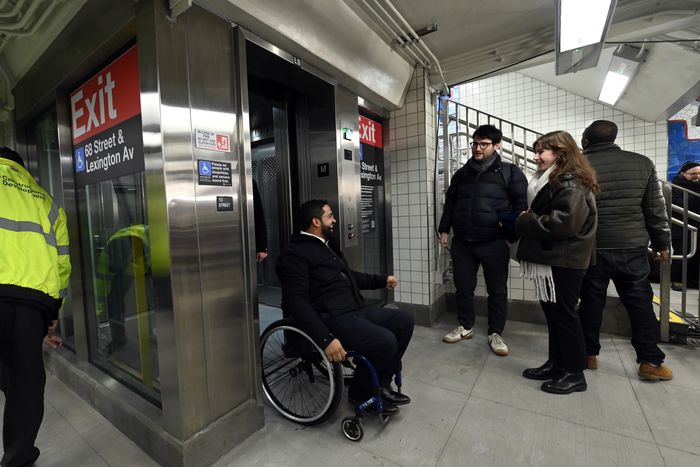
The 68th Street–Hunter College elevators, dedicated a year ago, were built through a particularly gnarly bit of Manhattan substructure.
Photo: Marc A. Hermann/MTA
There’s an unexpected advantage to the agency’s better-faster-cheaper push: Since so much work is going on now, the MTA can bundle the jobs, offering contractors a chance to bid on aspects of a bunch at once. “In the 2015-to-2019 plan, we got 16 stations made ADA accessible through 15 contracts,” Torres-Springer says. Since 2020, “we’ve got 57 stations that are in construction on 13 contracts.” Some of the benefits are related to economies of scale, including geographic ones. If 81st Street’s concrete pour gets delayed for a week because (let’s say) a whole bunch of electrical lines unexpectedly turn up and need to be relocated, a construction crew can be shifted to a similar project, like the one now happening at 96th Street, for a week instead of waiting around. There are what Torres-Springer calls “economies of outage,” too. “We’ve understood better and better that when you’re giving a contractor access to a portion of a line by taking it down on the weekend, you should get as much done on that segment of the line as you possibly can. So in our next program, we’re doing a station’s power substations, track, structural work — flooding the zone of that area that’s got an outage,” so they don’t have to do it again a year later.
Smith–9th requires that they build up; 81st Street requires that they go down. Broadway Junction, a sprawling multilevel station serving the A, C, L, J, and Z on the edge of Brownsville, requires both, and it’s a monster of a job, requiring a new elevated structure that will span Van Sinderen Avenue. There will be not one new elevator, or a pair, but seven. Part of the dig lies under a city park, and for that to be disrupted, the land had to be clawed back from the city in a jurisdictional process known as parkland alienation, which has to go through the State Legislature. That had to be done before hiring the contractor and thus before the entire scope of what lay underneath the land was known. “We had to make some decisions before his design was complete, and that’s a constraint he’s having to work into,” Torres-Springer says. Even something as peripheral to subway construction as the lighting in that park presented its own complication, because its electrical lines had to be moved. It’s run by two different agencies, some under the Department of Transportation, and the rest — “recreational lighting” is the term of art — by the Parks Department. Plus Con Ed, of course. If you touch any of it, you have to get everyone’s buy-in. There’s also a so-old-nobody-knows-how-old-it-is sewer line more or less underneath the station, as well as an LIRR tunnel. Neither of those should move, or can.
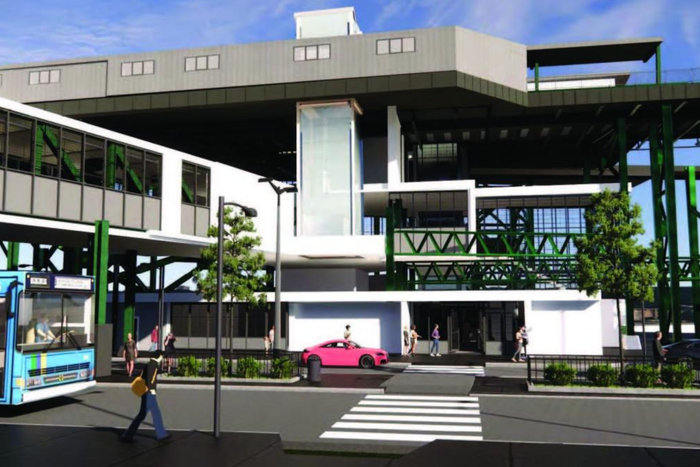
A rendering of the rebuilt Broadway Junction station in Brooklyn. The elevator tower at center and the bridgelike structure at left will be new, and a lot of the rest of the station will be reconstructed.
Photo: MTA
One seemingly subtle change in approach has actually done a lot to bring these projects into the realm of the doable: The MTA has embraced a broader idea of what’s permissible under the ADA. The law is clear but also nonspecific, calling for equality of access. In the past, Torres-Springer tells me, there was a belief at the MTA that this meant equality of experience: If you rolled into the station in a wheelchair, your elevator ride had to drop you at approximately the same place as someone who took the stairs. Now the thinking is that an equivalent path — not necessarily the same one — is acceptable; you just have to make the station properly usable for everyone. As minor as this shift in thinking sounds, it opened up a lot of options, since it means that, for example, you could graft a new structure onto a station — like a separate entrance for those with physical disabilities — instead of ripping out quite so many existing stairwells. You might not need to stop the elevator at the mezzanine-level passage used for crossovers if it goes directly from the street to the platforms. But what if a disabled passenger needs to switch from the inbound to the outbound side? Well, the technology is now there to solve that differently: The MTA can, in an instance like this, rig the OMNY pass to allow an extra free trip through the turnstiles. The MTA calculates that its direct-to-platform approach has saved it $250 million.
None of this will matter much if the elevators keep breaking down, and that, everyone admits, is a perpetual challenge after the effort of building is met. It’s easy to chalk up the frequent out-of-order problem to slipshod maintenance, although Torres-Springer pushes back on that, talking up the effort the agency does make. “We actually get a very high standard from New York City Transit elevator maintainers, but maintenance and cleaning is a big priority for us in a way that it hasn’t necessarily been in the past.” Inevitably, anything that’s constructed underground and essentially outdoors — from vandalism to salt runoff — requires a degree of toughness you’d never see in, say, an office building. There is one clever aspect of these contracts, at least, that encourages accountability: The builders of the elevators are responsible for keeping them running for at least the first 15 years after they’re installed. “They know that they’re on the hook for maintaining it. “
For whatever it’s worth, I stopped by that 34th Street nightmare on my way home the other day. It’s been completely rebuilt, and as I approached it, the car arrived, silently, at the platform level. It smelled okay.
Thank you for subscribing and supporting our journalism.
If you prefer to read in print, you can also find this article in the December 15, 2025, issue of
New York Magazine.
Want more stories like this one? Subscribe now
to support our journalism and get unlimited access to our coverage.
If you prefer to read in print, you can also find this article in the December 15, 2025, issue of
New York Magazine.