
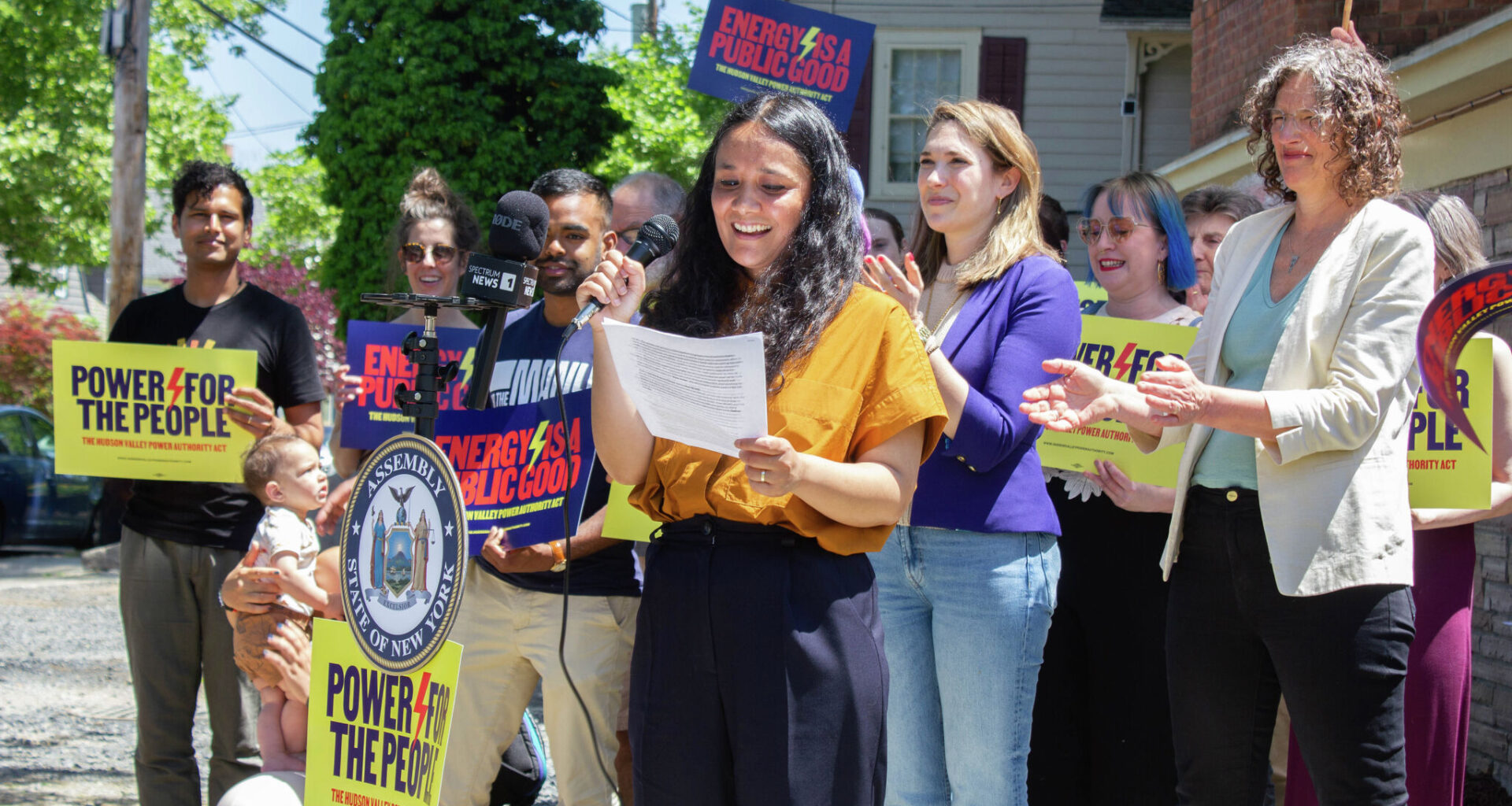
Assemblymember Sarahana Shretha (center), backed by state Sen, Michelle Hinchey (right) and Ulster County Executive Jen Metzger (far right) rally for a bill that would result in a state takeover of the utility company Central Hudson Gas and Electric.
Provided by Teddy Artschwager
An independent report analyzing a proposed state takeover of the utility company Central Hudson Gas and Electric finds that ratepayers would see lower bills in the first year.

The report studies the feasibility of a bill that would create the Hudson Valley Power Authority, which would take over Central Hudson’s operations and property. The bill is sponsored by Hudson Valley legislators Assemblywoman Sarahana Shrestha and state Sen. Michelle Hinchey, whose districts suffered after a disastrous rollout of a new billing system in 2021 led to tens of thousands of customers experiencing billing irregularities. The utility, which serves hundreds of thousands of customers in the Hudson Valley, has also repeatedly requested rate increases.
Article continues below this ad
The report, by New Gen Strategies and Solutions, a Texas-based consulting firm, and Duncan and Allen, a Washington D.C. law firm, states customers would see savings because the proposed power authority would have access to lower-interest loans, would not have to make profits for its shareholders, and would not pay federal or state income taxes.
Ratepayers would see their bills fall by about 1.9% in the first year of a takeover; by 3.6% in year five; and by about 13% in year 30.
However, this may not capture the full extent of savings, Shrestha said.
Make the Times Union a Preferred Source on Google to see more of our journalism when you search.
Add Preferred Source
Utility companies make money from how much they spend on capital investments, such as building new infrastructure, and are therefore incentivized to spend unnecessary sums on these projects to make money for their investors, she said. A publicly owned power authority would be a nonprofit and, therefore, make capital improvements at cost and have no incentive to overspend.
Article continues below this ad
The report also does not fully capture what kind of capital improvements would be made in the future, Shrestha said.
The proposed authority would also not be required to pay property taxes as a state entity. However, Shrestha said the authority would provide schools and local governments with payments in lieu of taxes, or PILOTs. Unlike PILOTs negotiated by private developers, which are incentivized to pay as little in local taxes as possible, the Hudson Valley Power Authority’s board would include members from local governments, who would be incentivized to give localities sufficient payments, she said.
The cost of taking over Central Hudson would be $3.5 billion, according to the report, which notes this is an estimate made from publicly available data and not an appraisal.
The report states a public takeover of Central would not be without its challenges, including a potentially contentious process of acquiring the company through eminent domain. The “single-most indispensable ingredient” in a takeover is “a high level of enduring public commitment.”
Article continues below this ad
“It should be anticipated that investor-owned utility opposition to the (takeover) will be tenacious and, in all likelihood, considerably better funded than the (takeover) effort itself,” according to the report.
Central Hudson is already hitting back at a takeover. An attempt to purchase the company “will only result in drawn-out and costly legal battles that would result in Hudson Valley residents footing a multimillion-dollar bill,” company spokesman Joe Jenkins said in a statement.
The statement includes a projection of the cost of a state takeover by the Protect Our Power Coalition, which includes several regional chambers of commerce and a union representing utility workers. It “could be as high as $12.2 billion,” which “could raise customers’ bills up to 36%,” according to the coalition.However, this figure also includes the cost of phasing out gas infrastructure, a separate issue from the proposed state takeover that is not included in the New Gen report’s estimate.
The coalition’s website includes a two-page fact sheet with this information.
Article continues below this ad
The bill creating the authority was introduced during the last two legislative sessions, but did not make it out of committee. The latest assembly version had 10 co-sponsors, including New York City Mayor-elect Zohran Mamdani.
Note: An earlier version of this story incorrectly stated the way utilities make their profits and incorrectly stated what was taken into consideration in the Protect Our Power Coalition’s cost estimate.