
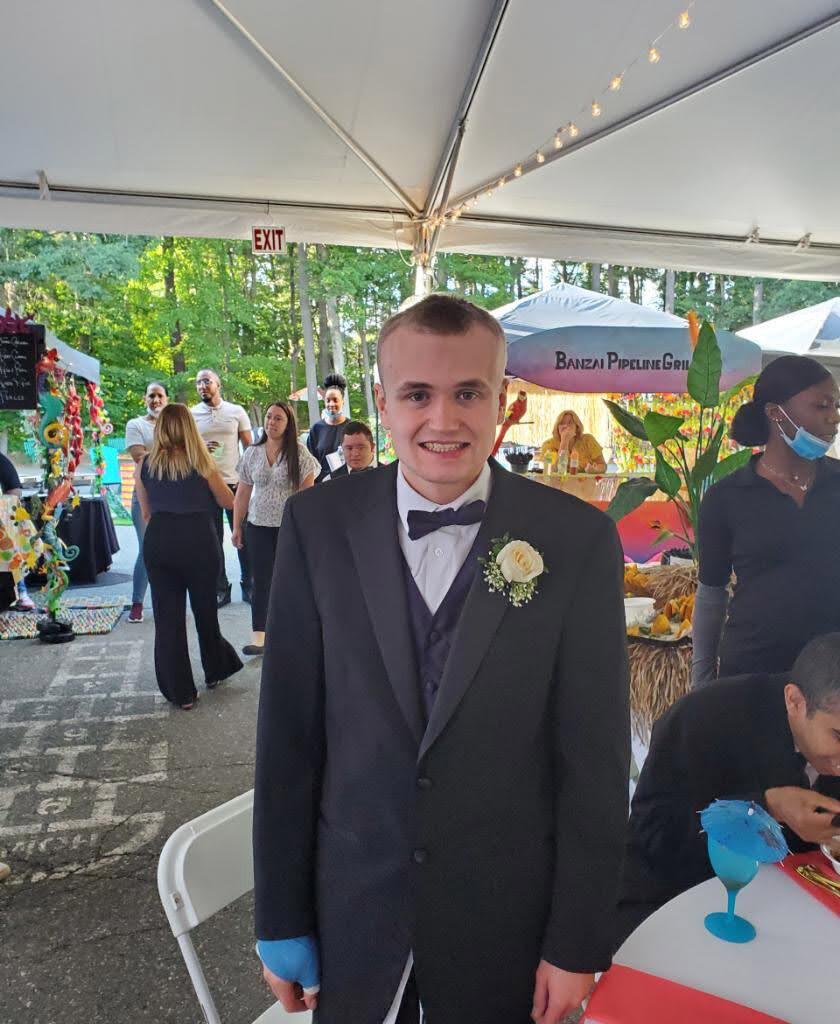
Craig Dribusch, 25, has battled severe behavioral issues since he was an infant. His parents are suing New York to force the state to return their son to a treatment center in Massachusetts where they say he had been thriving.
Photo provided by Dribusch family
The parents of Craig Dribusch say he has sustained multiple physical injuries and that his behavioral issues have deteriorated after New York officials removed him from a treatment center in Massachusetts.
Photo provided by Dribusch family
ALBANY — A Bethlehem couple is suing the state Office for People with Developmental Disabilities, alleging their adult son who has autism has been trapped in a vortex of hospitalizations and arrests after New York discontinued authorizing his residency at a Massachusetts facility that specializes in treating individuals with severe behavioral disorders.

The federal lawsuit was filed recently in U.S. District Court in Albany by Christian and Elizabeth Dribusch on behalf of their 25-year-old son, Craig, who has been diagnosed since early childhood with “severe developmental disorders, including autism spectrum disorder.”
Article continues below this ad
From 2017 to 2023, Craig Dribusch had been a resident at the Judge Rotenberg Educational Center outside Boston, a facility that has faced scrutiny for its use of electric stimulation devices (ESDs), which aim to deter injurious behavior by delivering electric shocks to patients. The U.S. food and Drug Administration banned the therapy in 2020 but the Rotenberg center successfully appealed the ban in court.
New York’s continuing placement of residents with special needs in that facility has been the subject of intense debate among lawmakers and many parents who say their children have benefited from the unique programs at the residential facility in Canton, Mass. Those parents also have said their children are afflicted with neurological disorders that trigger aggressive and self-harming behavior that resulted in New York facilities declining to care for them.
Christian and Elizabeth Dribusch are among the parents who say the facility had been extremely beneficial for their son and equipped to handle his violent outbursts that can include self-harm events. But three years ago, after he turned 21, his placement in the state-subsidized treatment program at the Judge Rotenberg Educational Center ended when New York officials determined he could be treated at a residential facility in Niskayuna.
Make the Times Union a Preferred Source on Google to see more of our journalism when you search.
Add Preferred Source
The state Office for People with Developmental Disabilities made that decision despite concerns raised by his parents and officials at the Massachusetts facility, who recommended he remain there along with dozens of other New York adults who receive treatment at the facility. In middle and high school, failed treatment programs for Craig Dribusch had included various psychotropic medications and placement in out-of-school facilities that also did not work out.
Article continues below this ad
His behavioral challenges included “hitting, biting, head-banging, and self-biting,” according to the federal complaint.
“Craig’s behavioral episodes can become violent and dangerous and have resulted in various injuries to himself and others, including caregivers attempting to restrain him,” the lawsuit continues. “Various preventative strategies were attempted, but often failed due to spontaneous, rapidly intensifying outbursts. Craig’s behaviors also began to include threats to engage in violent or terroristic activities. Inability to manage Craig’s behavioral problems led the school district to attempt suspensions and ultimately to remove him from classroom settings in favor of one-to-one tutoring.”
After Dribusch arrived at the Judge Rotenberg Educational Center in 2017, according to his parents’ lawsuit, his behavior improved noticeably as his treatment and medications were modified. In the five years he was there, they said he did not have any hospitalizations or brushes with law enforcement. He also earned a Regents diploma, received an academic achievement award and attended the center’s prom.
But when New York officials decided that he could receive adequate treatment at a facility in Niskayuna, the couple said their son’s behavioral challenges began to spiral. The decision to place him in in-state treatment also came after AIM Services and the Center for Disability Services, as well as a third agency, had screened Dribusch and “declined to offer services due to his behavioral profile … reinforcing the parents’ concern that OPWDD’s provider network lacked the capability to serve him safely.”
Article continues below this ad
The lawsuit also alleges that during one of many phone calls with state officials, Christian and Elizabeth Dribusch had expressed concern that the agency’s staff would be unable to manage their son’s episodes and may resort to calling police. They said state officials “dismissed these concerns as overwrought and insisted that OPWDD had no intention of allowing anything like that to happen.”
But once he was placed at the Niskayuna location, “Craig’s condition deteriorated, with recurrent episodes of physical aggression, self-injury, and threats of self-harm resulting in repeated emergency-room visits at Ellis Hospital.”
“Due to their inability to handle Craig, OPWDD staff began resorting to calling the police when he had a behavioral episode,” the lawsuit alleges. “Police would usually just transport Craig to a hospital where he would be evaluated and then returned to his OPWDD residence.” Between August and December 2023 he was arrested twice on charges ranging from harassment to forcible touching.
“These charges were pressed by OPWDD staff, the very people who were supposed to be helping to manage his aggressive episodes,” the lawsuit states.
Article continues below this ad
‘Ruptured eardrum’
In May 2024, Craig Dribusch was allegedly physically abused by staff and, according to the lawsuit, a New York Justice Center investigation “substantiated some allegations, including that Craig was kicked and hit in the head, chest, and back, after which he required urgent and emergency care for a sprained right thumb and a ruptured eardrum.”
His condition has continued to deteriorate over the past two years, including more injuries, brushes with police and emergency room visits following incidents that have included “suicidal and homicidal ideation, ingestion of hazardous substances, violent behavioral episodes including biting, and repeated head injuries requiring CT imaging,” the lawsuit states.
One of those incidents took place in September, when Craig Dribusch bolted from his state-run residence in Niskayuna with no clothes on after a door-lock malfunction. He sustained a head injury and emergency dispatch records indicated he had been in the middle of a five-lane highway “and he was subsequently arrested and charged with felony assault… for biting a police officer and harassment in the second degree,” the lawsuit states.
Article continues below this ad
In a statement provided to the Times Union, Christian and Elizabeth Dribusch said they “reluctantly” filed the federal lawsuit that seeks to force the state of New York to return their son to the Massachusetts facility.
“We have relied on OPWDD for three years now to do the right thing,” they said. “But the abuse and mistreatment of our son Craig, and forcing him to live in fear and shuttling back and forth between hospitals and criminal courts because staff don’t know how to provide for him, has driven us to this point, where if OPWDD will not do the right thing, we are asking a court to make them do it.”
Officials with the Office for People With Developmental Disabilities declined to comment on the lawsuit. They are also prohibited from discussing individual cases handled by their office.
State officials separately contend they do not have the authority to send students or adults to out-of-state facilities such as the Judge Rotenberg Educational Center in Massachusetts. They said those placements are arranged by New York school districts if the person is under 21. Still, the lawsuit says that “dozens” of adults who are at the facility and receive New York funding are being treated there.
Article continues below this ad
“They cannot use their self-created funding policy to justify denying a disabled person his civil rights, subjecting him to abuse, mistreatment, and serious physical, emotional and legal injury when they were the ones who put him in this dangerous position by requiring his return from JRC, and where there is an appropriate placement for him that they have made available in hundreds of other situations,” said Jeffrey J. Sherrin, an attorney for the family.
In 2021, the Judge Rotenberg Educational Center had 63 adults in its program who were from New York, including 58 whose treatment was funded by the Office OPWDD. Seven of those individuals had been there for more than 20 years, and 32 had been there for between five and 20 years. The center also was providing services to 82 school-aged students from New York, whose treatment is paid for by their New York school districts or social services.
The couple’s lawsuit was filed several years after some New York lawmakers tried unsuccessfully to pass legislation that would have banned New York’s use of the Massachusetts center due to a treatment program known as “aversion therapy.”
Electric shock therapy and other aversive conditioning, which involves using pain or discomfort to alter a person’s behavior, was banned in New York in 2005. The methods came under intense scrutiny as a result of their prior use at Willowbrook State School, a state-run institution on Staten Island. Revelations of unsanitary and dangerous conditions there prompted New York to deinstitutionalize its treatment programs for individuals with neurological conditions.
Article continues below this ad
The Massachusetts facility routinely takes in residents who are rejected by treatment facilities and educational programs in other states. Supporters of the center note that it changed its policies and instituted safeguards, and that the use of electro-shock therapy at the facility is extremely rare and subject to court authorization and an evaluation of the client by an independent mental health expert.
According to the center, aversive conditioning treatment is used in only the most severe cases when the person is at risk of harming themselves. The facility is regularly inspected by two New York agencies: the Office for People with Developmental Disabilities and the Justice Center for the Protection of People with Special Needs.
In 2021, the state abandoned its efforts to discontinue funding for some New York residents receiving educational and treatment programming in other states. OPWDD had ordered a handful of families to choose between moving their disabled adult children to a remote treatment center in the Adirondacks or face the loss of state funding for their child’s care at out-of-state treatment centers. The office reversed course days after a Times Union story was published highlighting the situation.
Article continues below this ad