
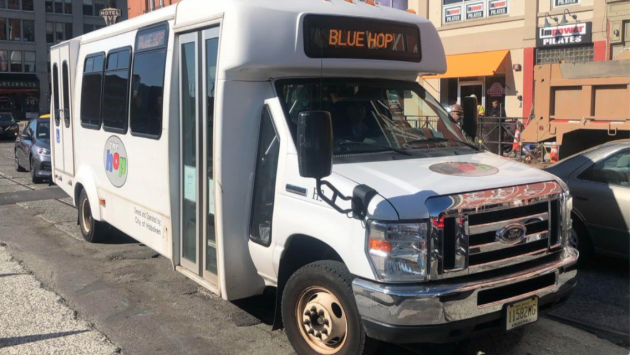
In an editorial, Jersey City Heights resident Kevin Davis lays out his claim that Clayton Lane’s dual roles raises questions about Hoboken’s Hop study.
 Photo courtesy of the CIty of Hoboken.
Hoboken is being asked to approve a $55,000 consulting contract for a policy-shaping study of the Hop bus system.
The proposal lists Clayton Lane as principal-in-charge, while public materials also identify him as a founding board member of Bike Hoboken, a local transportation advocacy organization active on the same issues this study is meant to inform.
That overlap raises a basic question: can a study meant to guide city policy be truly independent when the person overseeing it also holds a leadership role in advocacy aimed at influencing that policy?
This isn’t about bikes versus cars, or opposition to the Hop, it’s about governance, and whether City Hall is paying for analysis or paying for validation.
At some point, you’re either advising City Hall or lobbying City Hall. Doing both at once doesn’t produce insight, it produces a mirror.
Advising government and advocating to government are both legitimate activities. But they are different roles. Holding both at the same time on the same issue blurs a line that shouldn’t be blurred — especially when public money is involved.
Independence matters for a zero-based review
For a policy study to be credible, officials need to approach it from a truly zero-based view, evaluating options from scratch rather than starting from assumptions shaped by prior advocacy.
That standard is hard to meet when the principal-in-charge of a city-funded study is also identified in public records as holding leadership roles in local transportation advocacy. If the person running the study already has a position, the study isn’t research, it’s rehearsal.
This is a structural issue, not a personal one. It has a simple fix: separate advocacy leadership from study oversight, or restructure the procurement so independence isn’t up for debate.
This concern isn’t hypothetical
Bike Hoboken has publicly advocated for higher residential parking permit rates (330% at the time) in a letter that Clayton Lane signed.
When the same individual who signed that letter is later proposed to oversee a city-funded study that could influence Hop service levels and funding priorities, it becomes difficult to credibly claim the study began from a clean slate.
The Hop is supposed to be a bus, not a Trojan horse.
Hoboken has seen this pattern before
Residents are also right to be cautious given recent history.
The Kimley-Horn parking study’s preliminary recommendations included raising residential parking permit prices and using those funds to support other forms of transportation.
More recently, the Automotus contract was pitched as a limited review of automated loading zones. It ultimately became a three-month parking enforcement camera pilot, rolled out during a lame-duck administration with little City Council oversight.
First it’s “just a study.” Then it’s recommendations. Then it’s policy. By the time residents notice, the vote already happened.
After Kimley-Horn and Automotus, residents don’t hear “study”, they hear “to be continued.”
Whether intentional or not, these episodes should erode public trust in how Hoboken transportation studies are scoped, expanded, and implemented. That history makes independence and process discipline more important now, not less.
Optics matter, even when everything is legal
Public campaign finance records show that leaders of Bike Hoboken-affiliated organizations have made donations to Mayor-elect Emily Jabbour’s campaign and that Automotus’s CEO contributed to her campaign on the same day she learned of the parking ticket camera program.
No one is alleging impropriety. But repeated overlap between advocacy, campaigns, and city contracts narrows the benefit of the doubt.
Questions still unanswered
Beyond independence, two basic questions remain.
First: does this work need to be outsourced at all? Hoboken already operates the Hop, collects ridership data, and employs professional staff. Before spending $55,000 on a discretionary consultant, residents deserve to hear what can be done in-house.
Second: why wasn’t this study competitively bid? Open bidding isn’t a technicality. It’s how taxpayers get better value and better ideas.
Legal doesn’t always mean wise. Good government isn’t about seeing how close you can get to the line, it’s about avoiding situations that predictably undermine trust.
There is no downside to slowing this down. A study produced with clear independence and a competitive process will carry far more weight when difficult decisions are made later.
The Hop matters. That’s exactly why the process for studying it should be beyond reproach.
Kevin Davis
Jersey City resident