
NEW YORK CITY — The woman on the court’s TV monitor was scared.

“Why didn’t you come in person,” asked Judge Evalyn Douchy, who also appeared on a video link.
“I’m just afraid with whatever is going on in immigration court,” the woman said.
Article continues below this ad
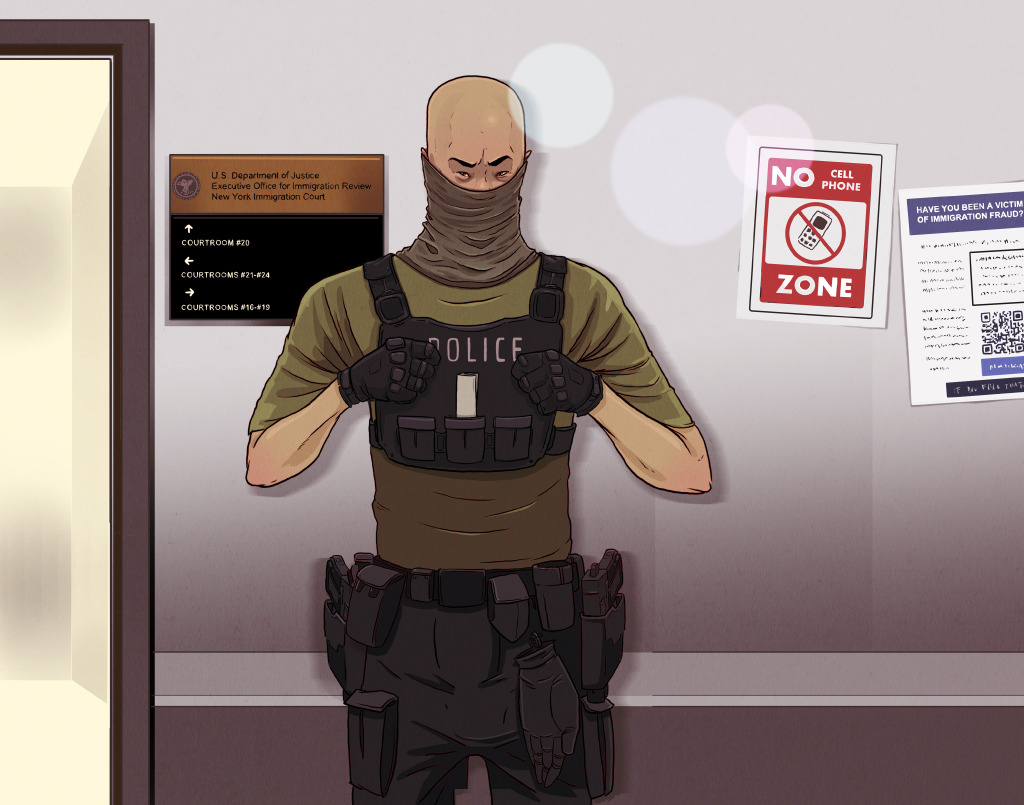
A few steps outside the small courtroom on the 14th floor of the towering federal building in lower Manhattan, four immigration officers stood waiting to see if they would arrest anyone that day. They were dressed not in traditional law enforcement uniforms but in cargo pants, jeans, T-shirts, baseball caps. Some wore black tactical vests emblazoned with “POLICE.” Some had on sunglasses. All carried sidearms and had neck gaiters pulled over their faces.
There were no arrests in the immigration court at 26 Federal Plaza that day in early October. But the week prior, video circulated online of agents pushing a mother to the floor and shoving journalists, sending one to the hospital; one of the agents was suspended for three days. For months, federal immigration agents had been waiting outside the courtrooms to arrest immigrants as they came and went from routine hearings.
“I’m very sympathetic to that, that you’re afraid,” Douchy told the woman before proceeding with her hearing. “But in the future, if the court denies an order, you need to come in.”
Article continues below this ad
Just under 120 miles separate the federal immigration courts in Hartford and lower Manhattan, but they show very different sides of a system that decides whether millions of immigrants who are in the United States without legal authorization can stay here or have to go.
A reporter and illustrator with CT Insider spent a week observing hearings at Connecticut’s only immigration court. Over the course of that week, they never saw agents with U.S. Immigration or Customs Enforcement on the same floor as the immigration court, even though ICE’s Hartford office is located just one floor below in the downtown Hartford federal building.
During just one day at the New York City court, however, they saw at least a dozen officers with ICE and other federal agencies waiting in the hallways and lingering outside courtrooms. Families with young children often walked a gauntlet of masked, armed agents — and the news photographers who followed them — to get to and from their immigration hearings.
In the middle are immigrants who have their cases transferred to Federal Plaza after they move from Connecticut to New York. They go from a court where ICE is all but absent and arrests are rare to one where agents walk the halls on a daily basis and arrests are much more common.
Article continues below this ad
In a statement to CT Insider, the U.S. Department of Homeland Security said Federal Plaza “has been the target of multiple threats including assaults on law enforcement by sanctuary politicians and activists, a bomb threat and a threatening letter with a white suspicious powder.”
“Again, we are urging the media and politicians to stop fanning the flames of division and stop demonization of law enforcement,” DHS said.
From Hartford to New York City
The man on the TV monitor in Judge Ted Doolittle’s courtroom in Hartford in August had left Connecticut after a falling out with his partner, the mother of his children. Now, he was living at a shelter in Brooklyn.
Article continues below this ad
“Vivo solo,” he said in Spanish. “I live alone.”
After severing the man’s case from that of his partner, Doolittle asked if he wanted his case transferred from Hartford to a closer immigration court.
“Yes, that would be better,” the man responded, speaking through an interpreter. An attorney for the government, who was also present in court via a video link, didn’t object. And with that, it was done.
The immigration court at Federal Plaza in Manhattan would contact the man with his next court date, Doolittle said.
Article continues below this ad
“Thank you so much,” the man said, placing his hand over his heart, before Doolittle disconnected him from the court’s video link.
The courtroom was one of four off a small lobby that comprised the Hartford Immigration Court. For a government office that hosts serious proceedings, there are welcoming elements — especially for the children who often visit court with their parents. Picturebooks are stacked in front of a window for filing paperwork. A rubber ducky left by a child sits atop the lobby’s fire alarm. Some courtrooms include coloring books and crayons.
CT Insider never saw ICE agents in Hartford Immigration Court over the course of a week observing hearings there in August or during other visits before and since. Doolittle said he only knew of two arrests by ICE at the court while he was an immigration judge there from fall 2023 to this September.
“I didn’t see it,” he said. “Obviously, I can’t speak for what was happening on any other floors (of the federal building in downtown Hartford).”
Article continues below this ad
A couple waits for their hearing in the lobby of Connecticut’s only immigration court, located inside the Abraham A. Ribicoff Federal Building, in downtown Hartford.
Illustration by Matt Stevens
The U.S. Department of Justice, which oversees immigration courts, let Doolittle go in September, the month after that hearing with the man whose case was transferred to New York City, along with about 20 other immigration judges.
There was one high-profile arrest by ICE in Hartford Immigration Court in May — former Yale student Saifullah J. Khan, who told CT Insider earlier this year that agents used a stun gun on him after he ran from the elevators, where they first approached him, back to the doorway of Doolittle’s courtroom.
After he left the court in September, Doolittle gave CT Insider his own account of Khan’s arrest. It was late in the day, Doolittle said. As he heard the commotion at the closed door of his courtroom, he went out into the lobby through a back exit to see what was happening, still dressed in his judge’s robe.
Article continues below this ad
“It was very, very disturbing,” Doolittle said. “It’s the most crazy, upsetting thing I’ve ever been around.”
As the agents took Khan away, Doolittle recalled telling them they should be ashamed of themselves for the way they arrested him in the court. That reaction underscored how rare it was for ICE to arrest someone in Hartford Immigration Court, and how out of keeping it was with the court’s character.
“This is the lobby where the staff, at their own expense, stock it with drawing books and crayons,” he said. “It’s not a safe place to be having a takedown. So I was mad.”
In a new statement to CT Insider, DHS said the officers who arrested Khan “took appropriate action and followed their training to use the minimum amount of force necessary to resolve the situation in a manner that ensures the success of the operation and prioritizes the safety of the public and our officers.”
Article continues below this ad
Yale expelled Khan in 2019 after two allegations of sexual assault — one by a fellow student and one by a man in Washington, D.C. A Connecticut court acquitted Khan of the student’s allegations in 2018, and Khan’s attorney at the time, Norm Pattis, said he had a letter from a D.C. police detective saying that case was closed; no charges have been filed in that case. Khan denied wrongdoing.
In arguing for Khan’s detention an attorney for ICE’s parent agency, the U.S. Department of Homeland Security (DHS), told a judge Khan was a “danger to the community,” the subject of an order of protection in Washington state and that the government could not confirm he was acquitted of the Connecticut assault charges, according to the Hartford Courant.
ICE released Khan from custody on a Massachusetts immigration judge’s orders in May.
Returning to the man whose case Doolittle transferred from Hartford to Federal Plaza back in August, CT Insider couldn’t determine when he had his first hearing in Manhattan or how he has fared since. Immigration courts fall under the U.S. Department of Justice, not the Judicial Branch, so court records aren’t open to the public as they would be in most civil and criminal cases.
Article continues below this ad
There’s also no hard data on how many cases have been transferred from Hartford to Federal Plaza in Manhattan — though CT Insider saw several such transfers in one week.
CT Insider is not naming individuals who appeared in court because their identities could not be verified. Although names were posted in court lobbies, they often appeared before judges in a different order, and court officials declined to confirm who appeared when. Court staff usually referred to cases among themselves by the last three digits of their Alien Registration Number, or A-Number — a unique identifier assigned to them by U.S. Immigration and Citizenship Services. When names were spoken in court it was not always clear. Respondents approached by CT Insider declined to comment.
Amid all the opaqueness of immigration court one thing is clear: The man was going to a court where arrests by ICE and other federal agents are anything but rare.
Inside the Manhattan court
By 10 a.m. on a Wednesday in early October, photographers and videographers with City of New York press passes slung around their necks were walking the hallways at 26 Federal Plaza in lower Manhattan trying to suss out where the action would be, if there was any that day.
Article continues below this ad
For a while, the journalists bounced between federal agents who stood together in small groups spread out between the 12th and 14th floors, where the New York – Federal Plaza Immigration Court has its offices. The trick, one veteran photographer said, was to pick a spot and stay there — move around too much and you might miss something.
Unlike Hartford, Federal Plaza is a warren of various waiting rooms and courtrooms — some large, some tiny — spread across the 12th and 14th floors.
Only members of the media were allowed to linger in the hallways. Security told a volunteer who was there to observe the court on behalf of an immigrant rights group to leave the hallway.
Regulations set down by the Executive Office for Immigration Review — a division of the U.S. Department of Justice that oversees the courts — state that hearings “shall be open to the public” outside of narrow exceptions. Agency policies also allow sketch artists with proper advance notice.
Article continues below this ad
However, security guards told the CT Insider reporter and illustrator that they would have to request access to hearings from the judges presiding over them — even for preliminary group hearings that were open by default in Hartford.
EOIR did not respond to requests for comment for this story.
Outside Douchy’s courtroom, her assistant said the CT Insider reporter could come in to observe the master calendar hearing, as such group hearings are called. However, the illustrator couldn’t. Court security guards also asked the illustrator to leave one of several waiting rooms in the court complex. Later, outside a separate courtroom, an assistant for Immigration Judge Frederic G. Leeds let both the reporter and the illustrator in to observe a hearing.
Later, a dozen or so photographers had settled on the 12th floor, lining one of the hallways and spilling into the elevator lobby. On either side of the press were two small groups of officers from various federal agencies — at least one wore a baseball cap that bore the logo of the U.S. Treasury Police — who’d been detailed to ICE.
Article continues below this ad
Like the agents outside the courtroom on the 14th floor, none of the agents here wore uniforms. Instead, they wore jeans or cargo pants, T-shirts or polos and casual jackets. Most had on baseball caps. All but one hid their faces, and the one who didn’t was wearing sunglasses. Several wore badges clipped to their belts or hanging from ball-chain necklaces.
Mostly, the photographers talked to the other photographers and the agents talked to the other agents as both groups waited for something to happen. Meanwhile, business carried on around them.
A family leaving a court hearing walked through the rows of federal agents and photographers to get to the elevators — the toddler holding onto their mom’s arm as she pushed a stroller with a baby in it.
A man showed a security guard a paper and asked him a question in Spanish, appearing as if he was asking for directions. As they spoke, a masked federal agent came up behind the man to look at the paper over his shoulder. Moments later, a different masked federal agent did the same.
Article continues below this ad
CT Insider did not witness any arrests on the day in early October at Federal Plaza. But for weeks, those hallways had been the scenes of regular arrests by federal agents — immigrants taken into custody as they came or went from routine immigration hearings.
At least some of those arrests, captured on camera, appeared to be dramatic and, at times, violent. One video showed agents grappling with New York City comptroller and then-mayoral candidate Brad Lander, after he refused to let go of a man they were arresting until the agents showed him a judicial warrant. (ICE often makes arrests under administrative warrants, which do not require a determination of probable cause by a judge.)
Another video from late September showed several agents pulling Ruben Abelardo Ortiz-Lopez away from his wife and daughter as they tried to arrest him. “Suelta la niña,” one agent can be heard saying in Spanish — “Let go of the girl.” Agents then pulled the man down a hallway and into a stairwell, where they covered the window with papers as journalists tried to document the arrest.
Moments later, in videos that went viral, an ICE agent pushed the man’s wife, Monica Moreta-Galarza, against a wall then wrestled her to the floor after she begged officers not to detain her husband, according to ProPublica and The New York Times. A DHS spokesperson called the officer’s behavior “unacceptable,” and he was briefly relieved of his duties. However, he was back in Federal Plaza three days later, ProPublica reported.
Article continues below this ad
The U.S. Department of Homeland Security, which oversees ICE, later said Ortiz-Lopez was a violent criminal, telling the BBC, “If you come to our country illegally and break our laws, we will arrest you and you will never return.” Ortiz-Lopez was released from immigration detention last month after lawyers filed a petition in federal district court.
In a filing in U.S. district court challenging Ortiz-Lopez’s detention, his attorneys said he was arrested in June 2024 but the charges were dismissed “shortly thereafter.” The attorneys did not respond to a request for comment.
Another dramatic video that went viral in late September showed federal agents shoving photojournalists as they walked toward a public elevator where an arrest was occurring to document it. L. Vural Elibol, a journalist with the Turkish news agency Anadolu Ajansi, had to be carried out on a stretcher afterward.
In a statement to CT Insider, DHS said officers involved in that incident “repeatedly told the crowd of agitators and journalists to get back, move and get out of the elevator.”
Article continues below this ad
“Rioters and sanctuary politicians who encourage individuals to interfere with arrests are actively creating hostile environments that put officers, detainees and the public in harm’s way,” DHS said.
The pace of arrests at Federal Plaza appeared to have slowed by the time CT Insider visited, days into a federal government shutdown.
One photographer who was a regular at the immigration court, Madison Swart, said she’d only seen one arrest in the past week.
When officials did step in to remove someone from court, it was the observer from the immigrant rights nonprofit who’d been warned to stay out of the hallway.
Article continues below this ad
The observer — a retired man with salt-and-pepper hair wearing a shirt and tie — had been leaning half in and half out of a waiting room while chatting with reporters in the hallway.
That was when a court security guard — one of several contractors dressed in gray-and-black uniforms who are separate from ICE and the other federal agents who waited in the hallways — told the observer to leave.
“Grab your stuff,” the guard said. “Because I already told you like five times (to stay out of the hallway).”
The observer retreated back into the waiting room, and the guard left before coming back with three of his colleagues. As they stood in the doorway talking to the observer, photographers crowded around to get a shot.
Article continues below this ad
If the observer didn’t leave, one guard said, they would call the police. After a brief back-and-forth, the guards escorted the observer out of the waiting room, onto an elevator and presumably out of the building.
The immigrant rights nonprofit the man was there on behalf of did not return requests for comment.
As all this happened, the federal immigration agents stayed at their posts on either side of the group of journalists. Not long after the observer left, however, a supervisor came to tell them they were done for the day. It was shortly after 11 a.m.
Back up on the 14th floor, the ICE agents were gone, too. Inside Courtroom 10, Leeds was sitting at the bench in his judge’s robe presiding over a master calendar hearing. A mother sat at the defense table with her small child. About eight people were in the gallery, including court observers.
Article continues below this ad
Leeds ticked through cases quickly, going through all the same questions judges ask at master calendar hearings in Connecticut: Has your address changed? Are you looking for an attorney? Why haven’t you filed an asylum application yet?
This project was made possible in part with a grant from the Poynter Institute.