
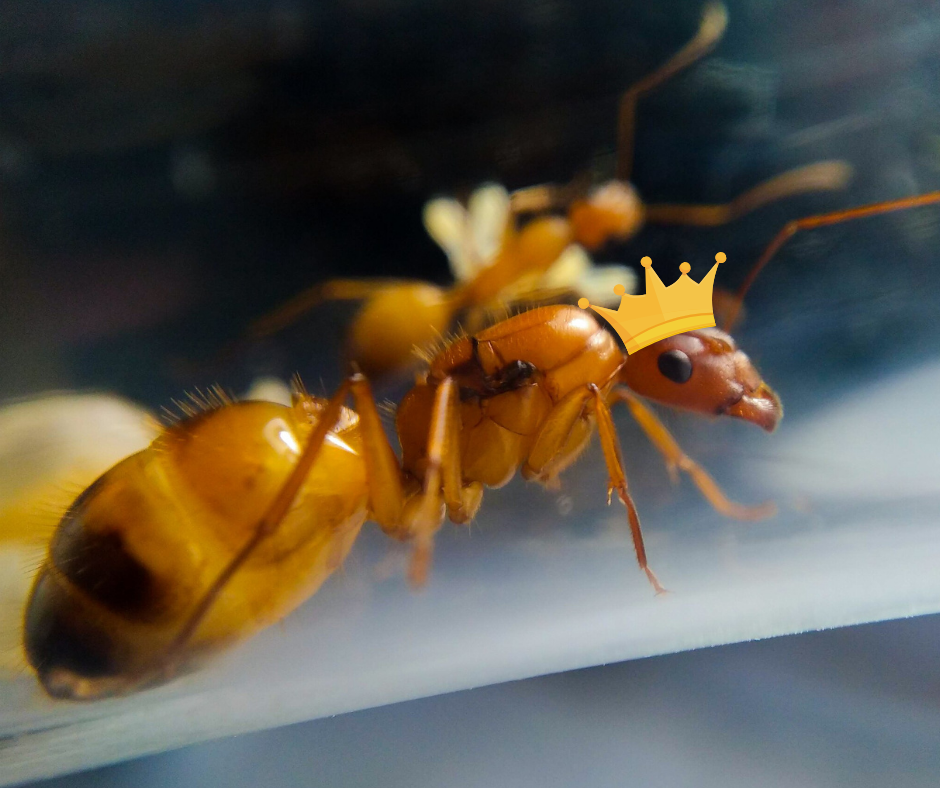
In most ant colonies, there are three types, or castes, of ants—workers, drones and queens. Researchers have discovered that you can have two ant eggs with the exact same genes, and one can grow up to be a large queen that lives a long life laying eggs, while another becomes a smaller worker that only lives a few months. How is this possible? It turns out that not just nature, but also nurture, determines the future for larvae. Neuroscientist and evolutionary biologist Dr. Daniel Kronauer joins Science Friday Host Flora Lichtman to explain what scientists know.
Key Ideas
An ant’s life cycle starts as a tiny egg. It hatches into a larva which is like a small worm without eyes or legs. It grows quickly and depends on adult worker ants to feed it. These workers decide how much and what kind of food the larva gets. Once the larva is big enough it goes through a metamorphosis and becomes a pupa, and then finally an adult ant.
Larvae that get more food grow bigger. Being bigger is a main reason the “queen development program” starts in some ants. All living things have a genotype, which is the genetic information they inherit through their DNA, and phenotype, which is the observable traits they show (like size or color). Two ants can have the exact same genotype, but their phenotypes can be very different because of things in their environment, like how much food they got when they were larvae.
However, recent research from Dr. Daniel Kronauer shows the process may be even more complicated. Some genes can affect how big the ant grows, while other genes affect how the ant’s body responds to that size. This is an example of phenotypic plasticity—when organisms with the same DNA develop different traits based on their environment.
Dr. Kronauer studied clonal raider ants. This species is unique because true queens, so all the ants are clones (exact genetic copies) of their worker mother. When he changed how much food the larvae received, their chances of becoming queen-like also changed. He also compared different groups of these clonal raider ants and found that some were more likely to become queens no matter how much they were fed or how big they grew. So he realized there were multiple ways an ant could become a queen.
His research may demonstrate that both nature (genes) and nurture (environment) work together to shape how organisms develop.
Think Big
After you’ve watched the video about Dr. Kronauer’s research, think about the following questions:
What new finding from his study does Dr. Kronauer claim complicates the simple “bigger = queen” idea?
What evidence from the ants shows that genes alone do not determine whether an individual becomes a queen or a worker?
How may a difference in feeding by worker ants lead to different adult outcomes for genetically identical eggs?