
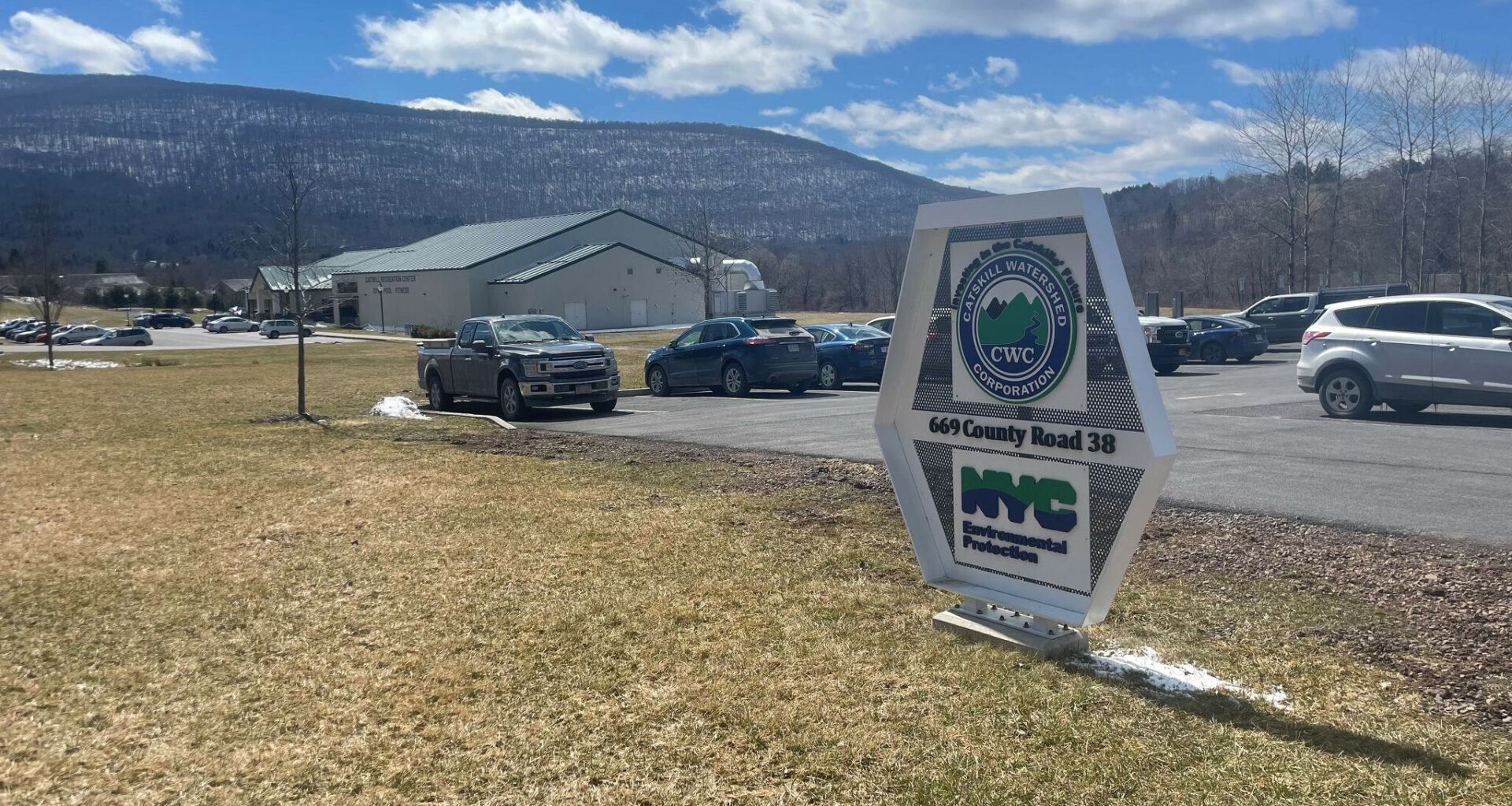
The Catskill Watershed Coalition building in Arkville in the Catskill Mountains, the site of years of negotiations between stakeholders in the region over New York City lands in the mountain formation. Environmental groups were excluded from the final round of negotiations, and are dismayed over the final agreement.
Roger Hannigan Gilson / Times Union
ARKVILLE — On Nov. 25, members of the New York City Department of Environmental Protection and Delaware County leaders gathered in the western Catskills after four years of negotiations to sign a landmark agreement laying out how the city purchased land in the Catskills.

Since 1997, the DEP has purchased more than 220 square miles of land in the Catskills under a plan with the state that allowed the city to continue drawing water from its reservoirs in the region without installing a filtration system, which would cost billions of dollars. The agreement requires the city to purchase land in the watershed to buffer the reservoirs from runoff, which could introduce pollutants into a system that supplies water to 90% of New York City and approximately 1 million people in the Hudson Valley.
Article continues below this ad
Catskills town leaders often chafed under the agreement, saying it limited economic growth and usurped local political control. But after years of negotiations for a new agreement, Delaware County got most of what it wanted, including the ending of the city’s major land-buying program in most of the Catskills. County leaders ratified the new agreement in November, and the Coalition of Watershed Towns, composed of local town leaders, signed it on Dec. 15.
However, not all the parties that were part of the negotiations are happy. But their approval wasn’t needed for the agreement to go through.
Three environmental groups — Riverkeeper, the National Resource Defense Council, and the Catskill Center — were excluded from the final round of talks, which began in October.
Make the Times Union a Preferred Source on Google to see more of our journalism when you search.
Add Preferred Source
“Public health and environmental interests weren’t fully present at the table, and that has frayed the 30-year upstate-downstate watershed partnership,” NRDC senior attorney Eric Goldstein said, adding the agreement “downplays the importance of fragile ecosystems” in the Catskills and the health of the reservoir system.
Article continues below this ad
The environmental groups took issue with modifications to a land-buying program, and some spoke of their anxiety about the agreement allowing some mining and energy development in the wild mountain formation.
At issue is the Streamside Acquisition Program, which focuses on small, targeted purchases along creeks running into the reservoirs. It allows for much smaller land purchases than the previous arrangement, which allowed the city to buy large chunks of land throughout the Catskills and was officially ended with the new agreement.
Though the Streamside Acquisition Program was expanded from the northeastern Catskills to the entire watershed, it was “weakened to the point of insignificance” in the new agreement, Goldstein said. Riverkeeper Legal Program Director Mike Long said the program had “been gutted.”
]Before the new agreement, the Catskill Center used science-based methods to identify parcels before soliciting landowners on behalf of the DEP. But the new agreement introduces working groups that must vote on a purchase before a landowner is even solicited, groups that include local town leaders — who have opposed many land purchases — and county-based conservation districts, among others.
Article continues below this ad
The Catskill Center is included in these working groups, according to the agreement — as a nonvoting member.
“We would be there to facilitate the process, as opposed to engage in the process,” Catskill Center Executive Director Jeff Senterman said.
The program will use both purchases and licenses to protect land, according to DEP spokesman John Milgrim. The DEP would pay residents to preserve their land in some way under the licenses, something Catskills leaders proposed in an April 2023 plan.
Jeff Baker, the attorney for the Coalition of Watershed Towns, reached out after the online publication of this article, claiming the environmental groups had been on board with many of the items they now took issue with before negotiations were broken off. He said the only “substantive change” made to the Streamside Acquisition Program after the break in negotiations was to make clear that the Catskill Center “could participate and could propose a project, but does not have approval/veto authority.”
Article continues below this ad
Granting the Catskill Center this power was a nonstarter, as it would give the organization “authority equal to an elected governmental entity,” Baker wrote.
The environmental groups also took issue with the way the DEP’s land will be used.
Current and future conservation easements were modified as part of the new agreement. Now permitted is “the extraction of sand, stone, soil, and gravel,” according to the agreement. It appears to only allow small areas of mining, with the materials used onsite for “maintenance and construction of access roads, and parking areas,” or offsite for “purposes of water quality protection in any area of the watershed,” and any mining would need to get normal state approvals. But Goldstein wondered “if that’s an appropriate use” of the land in the region.
The agreement also allows utility infrastructure, “including water, sewer, electrical, telecommunication and broadband lines and telecommunications tower structures.” Mike Dulong, the legal director at Riverkeeper, said the organization had long approved of cell towers in the region, which still has large areas with no service, as well as the ability to run utility lines. But the agreement also allows renewable energy infrastructure. Dulong said this could mean solar fields and battery energy storage systems, which often cover many acres and can cause fires, as well as wind energy in the future.
Article continues below this ad
Baker wrote that any opposition to the conservation easements was new.
“All the parties agreed to the changes in the conservation easement that permitted limited activities on the affected lands, including the mining and renewable energy language,” according to Baker. “There was no change in that language leading up to the final agreement.”
Goldstein said the agreement was Delaware County’s “dream draft.” The county had been the loudest opposition to land purchases and opted out of participating in the Streamside Acquisition Program altogether in the new agreement. The DEP will also pay all of Delaware County’s and the Coalition of Watershed Towns’ attorney fees incurred negotiating — and often, outright opposing — land-buying programs over the last three years. The cost would be footed by DEP ratepayers, which Goldstein called a “little bit of a sweetheart deal.”
Article continues below this ad
The agreement — informally called “the bridge agreement” — seeks to continue the DEP’s programs in the Catskills until a longer-term pact due at the end of 2027. The DEP has convened a panel of scientists to study how climate change could impact the reservoir system to inform this agreement. The agency is also planning to assemble a “NYC Watershed Protection Environmental Advisory Workgroup,” according to Milgrim. Coalition of Watershed Towns Chair Ric Coombs said last month the group could create its own expert panel.
Senterman said he hoped with a new New York City mayor in 2026, “there’s a realization of the value of truly collaborating with everyone and bringing back that spirit that we had before this past summer, when DEP just walked away from the negotiations.”