
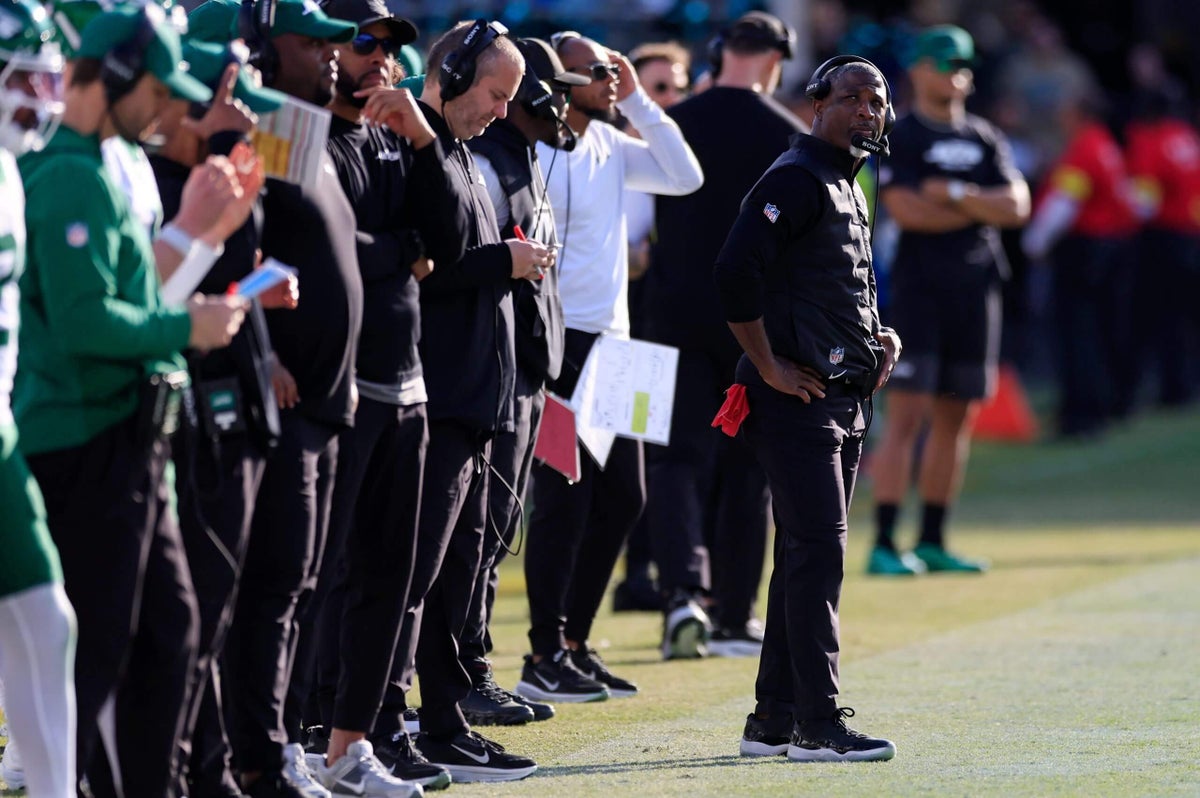
The New York Jets have traded away stars, fired their defensive coordinator, signed players to extensions and shut the season down for others. They have, loudly, turned the page to 2026. And so shall we.
The Jets have three games left, starting with Sunday’s road affair with the Saints in New Orleans. Odds are, they won’t win any of them. As it has been for weeks, these games are more about evaluation — for coaches and players — than winning.
So, in turning the page to 2026, let’s look at Aaron Glenn’s path to 2026 through the end of this season and through free agency and the NFL Draft.
Early extensions
For a long time, the Jets rarely signed players to early extensions. It quickly became clear that won’t be general manager Darren Mougey’s M.O. In the offseason, the Jets extended Garrett Wilson and Sauce Gardner (even if Mougey traded one of them a few months later).
Last week, the Jets re-signed center Josh Myers to an affordable two-year, $11 million extension, which really amounts to a one-year, $4.3 million deal in its structure. Myers leans closer to average than Pro Bowl-caliber, but he can hold down the fort at center and has been a leader on a team that needs them. This also locks the Jets into some continuity on the offensive line that they haven’t had year-to-year in a long time. Four of five starters are now locked up for 2026.
On Wednesday, the Jets re-upped backup tight end Jeremy Ruckert to a two-year deal worth up to $11 million. Ruckert’s stats don’t jump off the page (20 catches, 163 yards, one touchdown) but he’s made strides as a pass-catcher and blocker. and his contract structure will likely be similar to Myers’ in that it’s more of a one-year deal with an option for the second year. This deal does not preclude the Jets from adding another tight end behind starter Mason Taylor; they likely will.
Mougey might not be done either. Some obvious remaining candidates for early extensions include kicker Nick Folk, returner Kene Nwangwu and defensive tackle Harrison Phillips, whose salary in 2026 is non-guaranteed. Right guard Joe Tippmann, a 2023 draftee, will also be eligible for an extension once the season ends. His contract is up after 2026.
The DC Decision — and other staff changes
Chris Harris is replacing Steve Wilks as defensive coordinator in the interim, so he’ll have a leg up, of sorts, on the other potential candidates in that he’ll get a three-game audition in the role. It’s a challenging spot to be in — inserted mid-stream to lead a defense lacking for talent — but it’s not going to be easy in 2026 either. Harris won’t be able to make any wholesale changes but maybe he’ll add a level of aggression and/or creativity that was lacking under Wilks. Glenn said Wednesday that Harris has already introduced some wrinkles into the scheme for this week’s game against the Saints.
Nobody expects the Jets to dominate their remaining opponents (Saints, Patriots, Bills), but improvement would go a long way. Glenn might throw Harris a parade if the defense can intercept its first pass of the season.
“I want to see consistent improvement,” Glenn said. “I want to see a structure that’s consistent, I want to see play that’s consistent, and I want to see the culture of this football team come together.”
Unless Harris does something truly spectacular, I expect Glenn to conduct a full search this offseason. He should go after the big names if they become available — Raheem Morris, Jonathan Gannon, Jim Schwartz, even Todd Bowles — but it seems unlikely that level of coordinator would want this job, working under a head coach with a defensive background with a roster that isn’t appealing on paper. The Jets lack game-changers or playmakers on their defense.
Play-calling experience should not be a prerequisite for the next defensive coordinator. That logic is what landed on Wilks last offseason. It’s more important to simply find the best coach, and Glenn being a former defensive playcaller would help ease the transition of someone who hasn’t done it before.
The most intriguing candidate might be Broncos defensive passing game coordinator Jim Leonhard, a former Jets safety who was once the defensive coordinator at Wisconsin. If Vance Joseph gets a head coaching job, though, Leonhard might replace him in Denver.
Bears passing game coordinator Al Harris would be a worthy target too. The Bears lead the NFL in interceptions this year and Harris is highly regarded. Eagles passing game coordinator Christian Parker is viewed as a rising star in coaching circles. Seahawks passing game coordinator Karl Scott has helped turn Seattle into one of the NFL’s best defenses. Dolphins defensive coordinator Anthony Weaver could be available if Mike McDaniel is fired.
I’d also expect the Jets aren’t done making coaching changes. Some position groups, especially on defense, have failed to make strides. Linebackers Quincy Williams and Jamien Sherwood, in particular, have regressed.
Impending free agents
Most free-agency lists have Breece Hall ranked near the top; Glenn has made it clear in his actions and his words that he wants Hall back. Whether that’s via an extension (in the neighborhood of $10-12 million per year) or the franchise tag (worth $14.1 million), I expect Hall to be back in 2026. The Jets are projected to have significant cap space.
I think they’ll be choosing one of John Simpson or Alijah Vera-Tucker to return as left guard. Simpson is safer and someone who has completely bought into Glenn’s program. Vera-Tucker has more talent but can’t stay healthy. I’d re-sign Vera-Tucker and add depth in free agency or the draft, but Simpson feels more likely (something in the range of a two-year deal worth $20 million or so).
I don’t expect Quincy Williams to return and I’ll be interested to see if the Jets want to keep Tyrod Taylor as a backup.
Quarterback
And that gets us to the most important part of the offseason: quarterback. It’s nearly impossible to predict right now until we know how the draft order lands. As of now, Fernando Mendoza might be the only prospect worth drafting at the top unless Oregon’s Dante Moore declares. If Moore doesn’t declare, the Jets will be at the whim of the draft order: If a QB-needy team like the Raiders, Browns or Cardinals find their way to the No. 1 pick, the Jets won’t get a shot at Mendoza. If the Giants or Titans land at No. 1, the Jets have the ability to trade up to the top spot — though they won’t be the only team in pursuit. Either way, Jets fans should be rooting for the Raiders to beat the Giants in Week 17.
If it’s not Mendoza and Moore doesn’t declare, the options look far less enticing. There’s Alabama’s Ty Simpson (if he declares), but he’s considered a raw prospect. The Athletic’s Dane Brugler said on my Flight Plan podcast that there aren’t really any Jaxson Dart-level prospects to pursue in the late first round this year either.
If the Jets decide to kick the quarterback bucket to 2027 — a risky proposition — they’ll pursue someone in free agency or on the trade market. None of those options are especially exciting: Jimmy Garoppolo, Marcus Mariota, Gardner Minshew, Russell Wilson and Joe Flacco are the veteran stopgap options of note. Malik Willis has some intrigue but is a flawed player. If Kyler Murray is traded or released, he’s not a great fit but probably would be under consideration. Same for Geno Smith.
Kirk Cousins might become the most realistic target if the Falcons part with him. It seems Tua Tagovailoa will be available, but I can’t imagine that would go over well around here.
Other potential trade targets include Mac Jones (49ers), Tanner McKee (Eagles), Davis Mills (Texans), Jacoby Brissett (Cardinals) and Spencer Rattler (Saints).
The point: It gets bleak if the Jets can’t land Mendoza or Moore, unless some unknown star forces his way to Florham Park (unlikely).
I’ll dive into all the options, realistic and unrealistic, in the coming weeks.
Quentin Lake could be among the free agents the Jets target this offseason. (Bill Streicher / Imagn Images)
Free agency pursuits
The Jets, arguably, have needs at quarterback (and backup quarterback), wide receiver, defensive end, defensive tackle, linebacker and safety. They’d need a left guard or running back if they don’t re-sign Hall or Simpson/Vera-Tucker. At cornerback, Jarvis Brownlee and Azareye’h Thomas flashed potential but suffered season-ending injuries, and neither is a sure thing.
Mougey will have a projected $92 million in cap space at his disposal, though it’s not generally good practice to go on free-agency spending sprees unless — like the Patriots last offseason — you already have a quarterback. Mougey doesn’t give the impression that he believes in building through free agency. And yet, the Jets have a lot of needs to fill; I’d expect they devote most of their free-agent dollars to the defensive side of the ball.
If Lions linebacker Alex Anzalone hits free agency, there’s a chance he’ll re-join Glenn with the Jets. The two are extremely close and the Jets need linebackers and leaders on defense. Broncos defensive lineman John Franklin-Myers might be in for a big payday, and he has told people he never wanted to leave the Jets, and that he would have restructured his deal rather than get traded to Denver — it ended up being one of the worst moves of the Joe Douglas era. Franklin-Myers has had a nice season (5.5 sacks, 13 QB hits) and his leadership and versatility would be particularly valuable here.
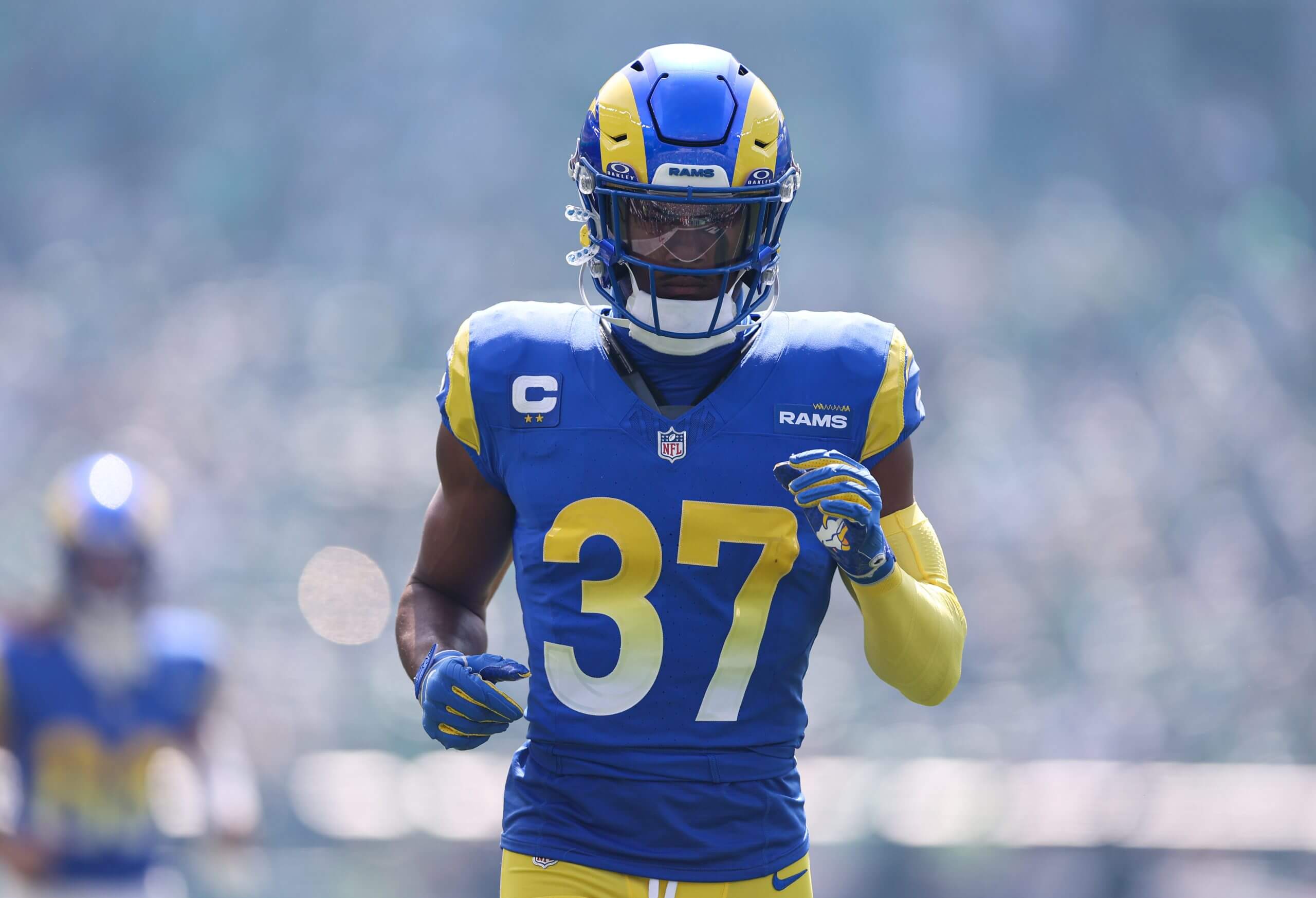
Keep an eye on Rams safety Quentin Lake as a potential upgrade in the secondary. The Jets badly need playmakers. Geno Stone (13 interceptions the last three years) or Reed Blankenship (eight interceptions in three years) would make sense too.
The Jets need some pass-rush juice off the edge too. New England’s K’Lavon Chaisson (6.5 sacks, 15 QB hits), Detroit’s Al-Quadin Muhammad (9 sacks, 18 QB hits), the Chargers’ Odafe Oweh (7 sacks, 15 QB hits) and Seattle’s Boye Mafe (6 sacks in 2024) would be intriguing targets.
Fans will also want the Jets to sign a wide receiver, but historically highly paid free agent wide receivers leaving for new teams don’t work out so well. It did in 2025 for Davante Adams and Stefon Diggs, but not for Cooper Kupp (three years, $45 million). The highest-paid free-agent receivers in 2024 were Calvin Ridley, Darnell Mooney, Gabriel Davis and Mike Williams (with the Jets). So should the Jets pay more than $20 million per year for Alec Pierce? Probably not. George Pickens probably won’t leave Dallas. But Romeo Doubs, Rashid Shaheed or Jauan Jennings would be worthy options at the right price.
The Jets won’t pursue players at the top of the market for all of these positions. My prediction would be that the biggest money they give out to a free agent will be at safety or defensive line.
NFL Draft
Barring trades in the first round, the Jets will have two first-round picks and two second-round picks to load up on premier talent. Let’s say they don’t get their hands on Mendoza or Moore — linebacker Arvell Reese would be a highly intriguing piece to bring into the fold on defense. Brugler wrote this recently about Reese: “Whether lined up as a spy off the ball or on the edge, Reese’s impact is profound and something every NFL team would love to add to its front seven.”
Priorities for the draft should be: quarterback, pass-catchers, pass rushers and defensive playmakers.
Will McDonald decision
The Jets have to make a decision on McDonald’s fifth-year option for 2027 by May. It’s projected at $14.9 million. It’s a more complicated decision than it might have seemed at this time last year. McDonald has taken a step back in 2025. He has seven sacks but all of them came in three games. He ranks 39th among edge rushers in pressures, per Pro Football Focus, and is graded 190th of 196 players at his position in run defense.
It might make more sense to decline the option and use that as a form of motivation in 2026.