
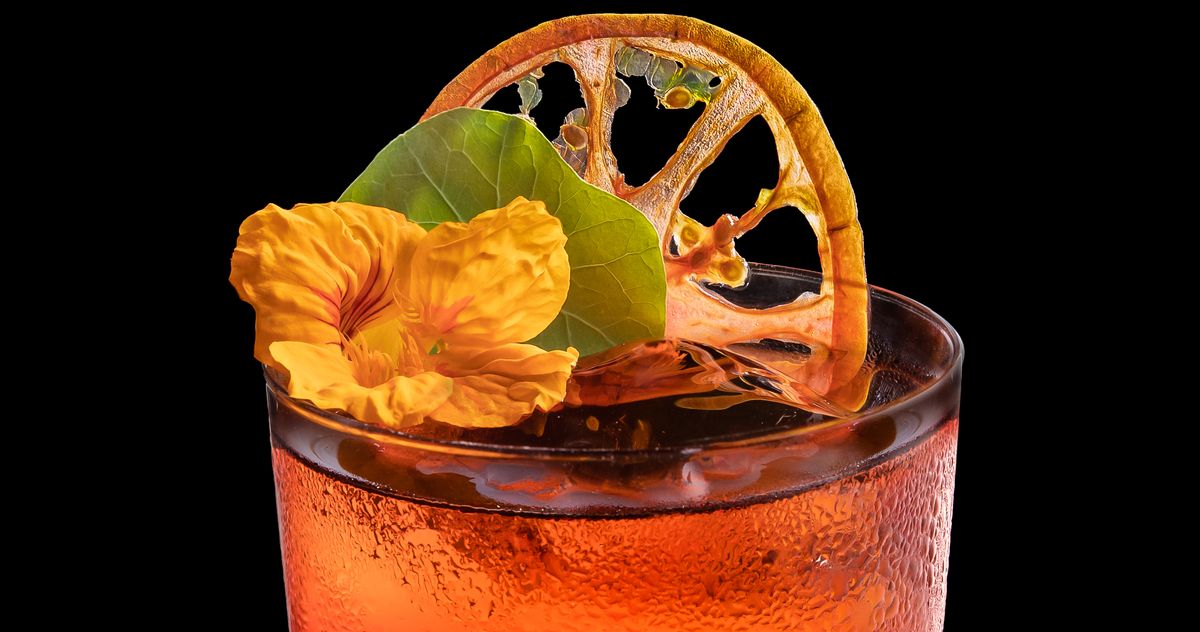
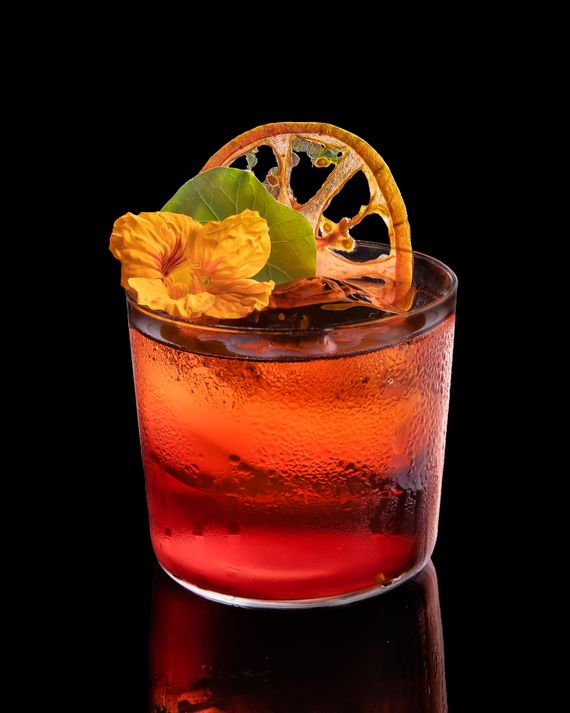
An Heirloom Garden cocktail from BarChef.
Photo: Courtesy of Leanne Solarik
For anyone looking to access Seed Library, the New York outpost of Ryan Chetiyawardana’s London bar, start with the bright-orange door on the side of the Hotel Park Ave. That leads to a narrow hallway, which is followed by a flight of stairs, a dark vestibule, and, eventually, a glowing underground cocktail den.
Despite the subterranean digs, a speakeasy this is not. (The outside door is well-marked, and, again, it is bright orange.) In fact, Chetiyawardana has done away with most of the trappings of speakeasy culture that once proliferated in New York, only to pop up in cities all across the world. For the past few decades, the global cocktail conversation flowed mostly in one direction: New York spoke and the world listened, as our bars — often with the bartenders involved as active participants and partners — opened elsewhere. But 2025 was the year the trade routes flipped. Four international bars put down roots in the city, bringing their interpretations of international cocktail culture to New York’s drinkers. The trend began in the West Village, when the team behind Tokyo’s SG Club opened Sip & Guzzle, a bilevel bar on Cornelia Street. Then came Schmuck, on First Avenue, a high-concept spinoff of Barcelona’s Two Schmucks. Next, Toronto’s BarChef brought its “experiential and multisensory cocktail experience” to 35th Street. And finally, last month, London’s Seed Library, the fifth bar in Chetiyawardana’s portfolio and his first permanent foothold in New York.
He says that every expansion starts with the same question: “Can we be an additive part of this landscape?” In New York, he continues, “Seed Library can actually be something that maybe sits in the middle of a couple of different threads.” For Chetiyawardana, those threads are both technical and environmental. Seed Library’s reference points include the listening bars of Tokyo, the youthful energy of Shoreditch, and a reverence for ingredients someone might otherwise find in, say, Copenhagen. “We wanted to be able to bring a different perspective but for it to feel like it’s for the city,” Chetiyawardana says.
What does New York feel like? “It’s a quiet confidence,” says Sam Ross, a co-founder of Attaboy and one of the most hands-on participants in defining this city’s cocktail culture. Chetiyawardana has taken that sensibility and shaken it up with a local-ingredient focus typical of his London bars. In New York, that naturally led him to apples, which provide a minerality used to balance a rye Calvados highball.
Schmuck’s menu, too, has the hallmarks of an outsider’s perspective, including another ode to the apple (in this case, an “apple colada” with Blanche de Normandie brandy). Schmuck takes equal inspiration from its more immediate neighbors. In October, the rotating menu featured a highball made with “a variety of ingredients from Russo’s grocery store up on 11th.” It tasted, more than anything, like a ham-and-Swiss on rye.
Early to the trend — twice — was Experimental, a group whose Parisian-imported Experimental Cocktail Club opened in New York in 2012, closed in 2016, and reopened last year. With this second attempt, the group has sought to import a sense of Paris’s after-hours debauchery and a willingness to break the rules occasionally in service of a wild night. “We have that expression in French culture, un joyeux bordel — you know, a ‘happy mess,’” says Xavier Padovani, one of the partners behind Experimental. “We want to do the best drinks we can, but we want to put the volume up, put the light down, and if people can have fun when they’re having good drinks, that’s the one thing we try to represent as best as we can.”
Experimental occupies an interesting perspective, having explicitly borrowed from New York cocktail culture in 2007 when it opened its first bar, located in Paris, in 2007. The bar was one of the first establishments in France to take the mixology revival seriously. At all these spots, the aim is to blend just enough newness into the mix to show local customers something that feels fresh.
“Familiar but surprising” is, to Chetiyawardana, the goal of any outside bar trying to make inroads here. “That’s our job. That’s the bit of the skill — the translation and the connection.”
Thank you for subscribing and supporting our journalism.
If you prefer to read in print, you can also find this article in the December 29, 2025, issue of
New York Magazine.
Want more stories like this one? Subscribe now
to support our journalism and get unlimited access to our coverage.
If you prefer to read in print, you can also find this article in the December 29, 2025, issue of
New York Magazine.
EAT LIKE THE EXPERTS.
Sign up for the Grub Street newsletter.
Vox Media, LLC Terms and Privacy Notice