
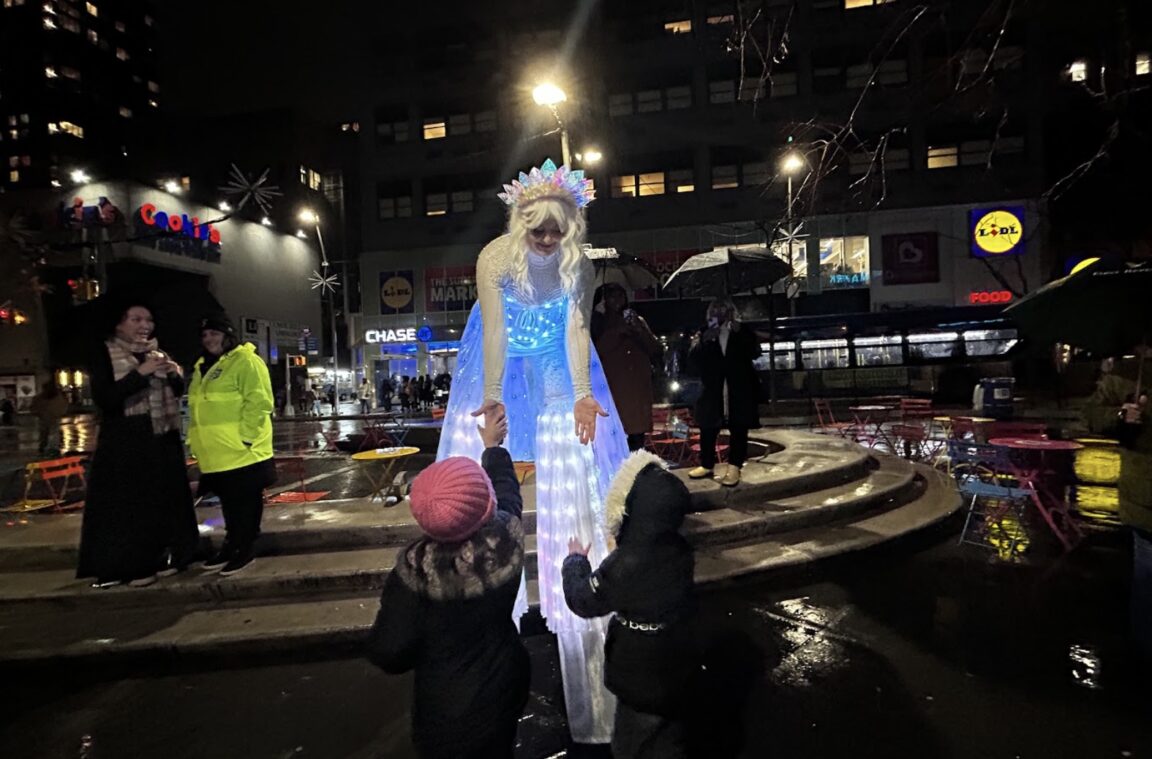
It’s the most wonderful time of the year. Millions of New Yorkers and tourists go to the Rockefeller Tree Lighting and New Year’s Eve Ball Drop, but various neighborhoods and shopping districts all over the city also draw big crowds, big bucks and big holiday cheer.
But how does it get done? It’s more of a grassroots effort than you might think.
“People don’t notice the labor, they just notice the effects,” said Tamara Greenfield, vice president of operations at the Downtown Brooklyn Partnership. “A lot of organizations and community groups are out there in the background doing a lot of work to help make the city more festive and illuminated during the holidays.”
Park conservatories, neighborhood councils, merchant groups and, most significantly, business improvement districts, work behind the scenes to create the city’s iconic holiday atmosphere.
A business improvement district is a geographic area where business and property owners pay a fee, called an assessment, to fund the maintenance, beautification and promotion of a particular commercial area. The districts straddle the public and private sectors.
“Even though BIDs receive a significant portion of their funding from commercial entities, all of the work they do is focused on improving public spaces,” said Tim Tompkins, New York University professor and former president of the Times Square Alliance. “They serve the broadest population, which is ordinary residents and people who are walking through a street or sidewalk.”
The creation of business improvement districts arose from the city’s fiscal crisis and economic decline in the 1970s. Failed urban renewal strategies, redlining and divestment created a landscape of urban decay.
During Thanksgiving week this year, community partners lit the tree at Albee Square on Fulton Mall, where the first business improvement district in New York City was created in 1976.
At the time, the Fulton Mall Improvement Association collected about $235,000 a year in property-owner fees. Today, that figure is roughly $2.95 million.
The Downtown Brooklyn Partnership manages three business improvement districts that bring in a combined assessment of almost $10 million.
That funding power allows the Downtown Brooklyn Partnership to spend upwards of $150,000 on holiday decorations, Greenfield said.
While other business improvement districts typically rent the same static holiday lights for a lesser cost year after year, the Downtown Brooklyn Partnership brought new responsive LED, sound-activated skylines and banners this year for Fulton Mall, Court Street and Abolitionist Place from Limbic Media, a Canadian company.
Smaller business improvement districts don’t let a lack of spending power stop them from putting on a good show.
The Flatbush-Nostrand Junction BID has an assessment of $350,000.
“We’re not like the Downtown Brooklyn Partnership or Bryant Park Partnership, you know?” said Mbonu. “They’re surrounded by a bunch of class A-type buildings. So our assessment will never be like theirs.”
Class A buildings are the highest-quality commercial buildings available on the market. They are typically newly constructed or highly renovated spaces, such as office towers and luxury mixed-use buildings. This results in business improvement districts receiving higher assessments.
Every year, the Flatbush-Nostrand Junction BID commissions a new artist to create a theme for a 100% upcycled holiday tree.
“We try to work with what we have,” said Mbonu. “We use art and design as a template to address a lot of the challenges we have here at the BID. And it works because it helps us to include artists that live in the community.”
Last year’s theme for the holiday tree spotlighted New York City’s homelessness crisis, featuring a couch from a Brooklyn family who lost their apartment. This year’s theme will center on the winter solstice and the Kwanzaa principle of unity.
But not every commercial shopping center has a business improvement district to foster unity and maintain winter programming.
After a merchant group on Vanderbilt Avenue ceased operations during the pandemic, a volunteer-run civic group, the Prospect Heights Neighborhood Development Council, stepped in.
“It’s challenging to keep a merchant association active if it doesn’t have a guaranteed funding stream like a BID,” said Gib Veconi, secretary of the Prospect Heights Development Council.
The council crowdfunded about $6,000 this year to fund holiday skylines on Vanderbilt Avenue.
“Donations come from residents and businesses on Vanderbilt Avenue. It’s somewhat unusual,” said Veconi. “But year after year, people come back to fund it. And I think that they do that because they can see the lights go up and think, ‘Yeah, I helped to do that. I was a part of that.’”
Community groups hire contractors to install the lights. City 1 Maintenance handles the storage, installation, and upkeep of the tree and holiday lighting fixtures for the Downtown Brooklyn Partnership. It’s a year-round affair.
“The holiday lighting, ironically enough, starts in the spring,” said Joseph Lozito, President of City 1 Maintenance. “It takes six to seven months of good planning.”
Workers start the installation process around 9 p.m. when traffic slows down and complete it in the wee hours of the morning before rush hour.
“We don’t want to become the topic of discussion by holding up traffic,” said Lozito. “We want the topic of discussion to be the product that’s up in the air.”
The best part is seeing the community’s response to all their hard work during the lighting ceremony.
“My guys take pride in what they do,” Lozito said. “Just hearing the crowd’s reactions — ‘Wow,’ or ‘Oh my God, this is beautiful’ — means a lot to them. They love putting up the lights and the stars. A lot of times, they film it and send it back home to relatives in Honduras or Ecuador. It gives them a sense of accomplishment.”