
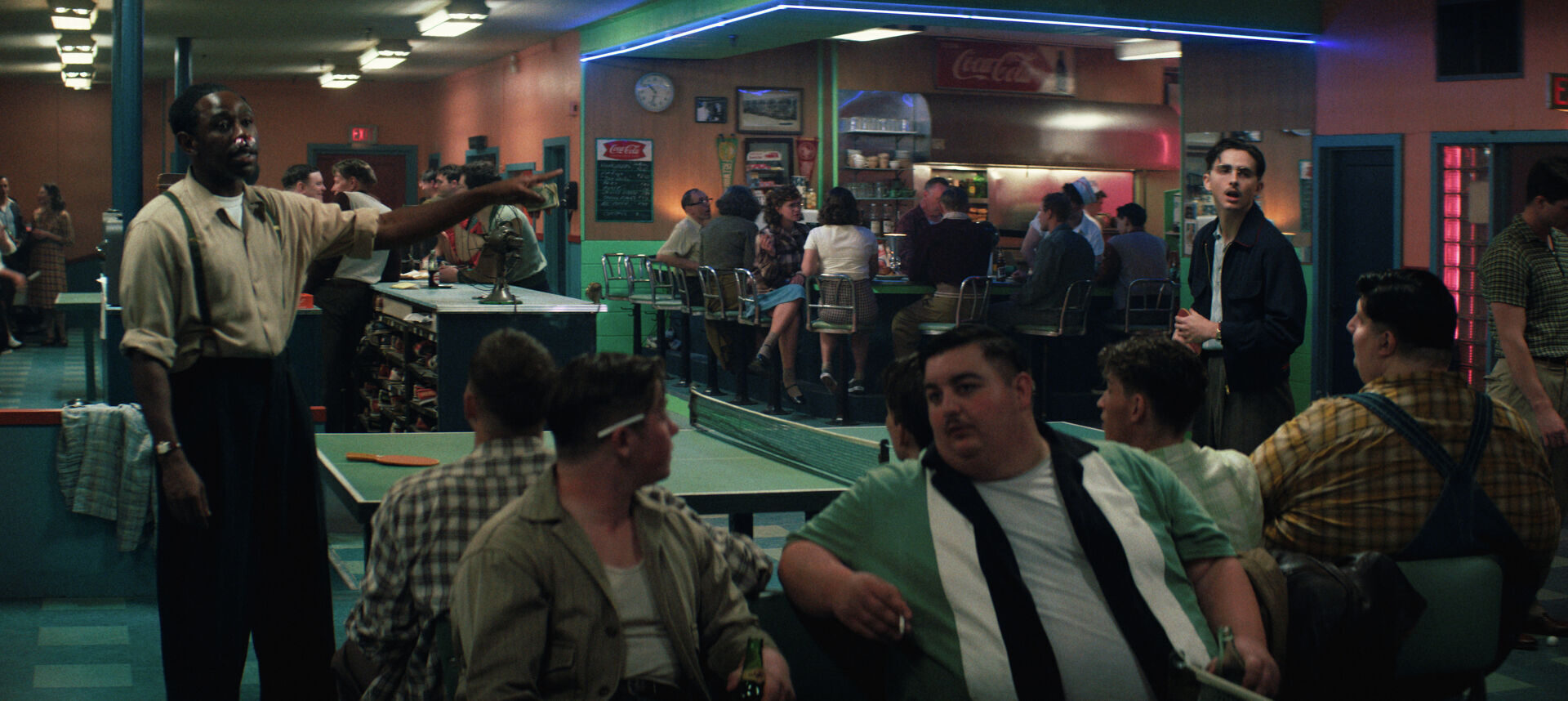
Tyler Okonma (left) and Timothée Chalamet (right) play table tennis at a bowling alley.
Courtesy of A24
Ross Brodar has become the go-to locations manager for New York-based projects after his work on “Anora” and “Mr. & Mrs. Smith.”

Raised in Great Neck, Long Island, and based in Brooklyn for years, Brodar knows exactly where to find locations that establish the desired mood and setting for a storyline. Whether it’s a Manhattan strip club, multimillion-dollar mansion hidden on a Brooklyn street, or a classic New York brownstone that’s actually accessible, Brodar’s past as a filmmaker, actor and artist makes him perfectly equipped to not just aid filming, but enhance the finished film.
Article continues below this ad
But “Marty Supreme” might have been Brodar’s most challenging production. Set in the early 1950s, the sports-comedy-drama tells the story of Marty Mauser (Timothée Chalamet), a prodigious table tennis player who sets himself the lofty ambition of becoming the best in the world. But his hectic life in New York City, which includes his pregnant girlfriend (who is already married), dangerous gangsters and his lack of money, gets in the way of his talent.
Directed and co-written by Josh Safdie, “Marty Supreme” unfolds at breakneck speed. Like many of the filmmaker’s other movies, such as “Uncut Gems” and “Good Time,” the narratives pile on top of each other to create a palpable intensity. Any anachronisms would immediately take the viewer out of the film, so it was essential that Brodar made sure each location was either from the 1950s or at least was changed to fit the period.
Brodar met Safdie while working on a different project involving Adam Sandler for Netflix when the 2023 writers and actors strikes brought it to a halt.
Make the Times Union a Preferred Source on Google to see more of our journalism when you search.
Add Preferred Source
“When they pivoted to ‘Marty Supreme,’ they brought me on because I’d already been working with him and producers Eli Bush and Anthony Katagas,” Brodar said. “They knew I knew New York so well. We just discussed creating the world that the story exists in, how to create that period and give it a gritty New York vibe.”
Article continues below this ad
Shooting on the Lower East Side was essential for the film, Brodar said, as that’s the area where Marty Reisman — the man Mauser is loosely based on — was raised.
“We were on Orchard Street a lot. We dressed up a lot there and on Eldridge Street. We really made that our home for a while. I was figuring out deals with everybody, how I could dress shops to make them look like the ‘50s and working with the mayor’s office. We also did a lot of stuff on the Upper West Side, New Jersey and then a bunch of things upstate in the Hudson Valley.”
Ultimately, “Marty Supreme” ended up shooting two extensive sequences in the Hudson Valley. One scene, where Marty and his friend Wally (Tyler Okonma) play table tennis in a bowling alley, was filmed in an actual bowling alley in Hancock, Delaware County.
“The building just had the right bones and architecture,” said Brodar, though the crew still had to do a lot of rearranging to make it right for the film. This included putting new carpeting in. “We took down some walls, put some new walls up. Then it was about making sure we lit it right and everyone was in the right clothing.”
Article continues below this ad
While Brodar never really has a specific area in mind when he’s scouting for locations, he knows that the Hudson Valley is usually a gold mine for post-World War II buildings and architecture.
“You’ll find so many spots in the Hudson Valley that have remained untouched,” he said. “There are amazing gems up there, which then give you that look of the period.”
After finding a location, he then has to negotiate with its owners, decide if it’s within the film’s budget, and ensure the production can get to the area in a timely and cost-effective manner.
Brodar went through this process for a second Hudson Valley location on “Marty Supreme” — Florida, Orange County. When Marty and Wally leave the bowling alley, they’re followed by a group of locals, who attack them and their cab while they’re pumping gas.
Article continues below this ad
Brodar knew they needed a big area to film this sequence. He ultimately found a “stretch of farmland that was split by a dirt road” for legendary production designer Jack Fisk, who has worked on the likes of “There Will Be Blood,” “Mulholland Drive” and “The Revenant.” Fisk and his team spent weeks building and set-decorating a period-appropriate gas station on the land, which they then filmed on for around five nights.
Brodar credits Florida and its inhabitants for supporting the film while they were in the area. “When you’re filming in places like this, you really have to get involved with the community,” he said.
Brodar achieves this by talking with locals, walking them through what filming will entail, and ensuring that everyone feels comfortable knowing they will protect their land. He then speaks with local businesses and the fire department so that when cameras finally start rolling, production can go as smoothly as possible.
When it came to filming, Brodar calls Safdie a “great collaborator and leader” and says that Chalamet was “laser-focused” throughout.
Article continues below this ad
“Chalamet comes on to the set, doesn’t talk to anybody but Josh, and waits for his moment,” Brodar said about the actor, whose performance is garnering Oscar buzz. “He does what he’s got to do. He was there to rock out that job.”
The result isn’t just one of the best-reviewed films of the year, but a trip back in time to a “fascinating world that barely anybody knew existed,” Brodar said.
“Who would have known that these table tennis players were so skilled and driven during that time period?”
Article continues below this ad