

The northeast corner of the borough is sleepy and under the radar. Residents would prefer to keep it that way.
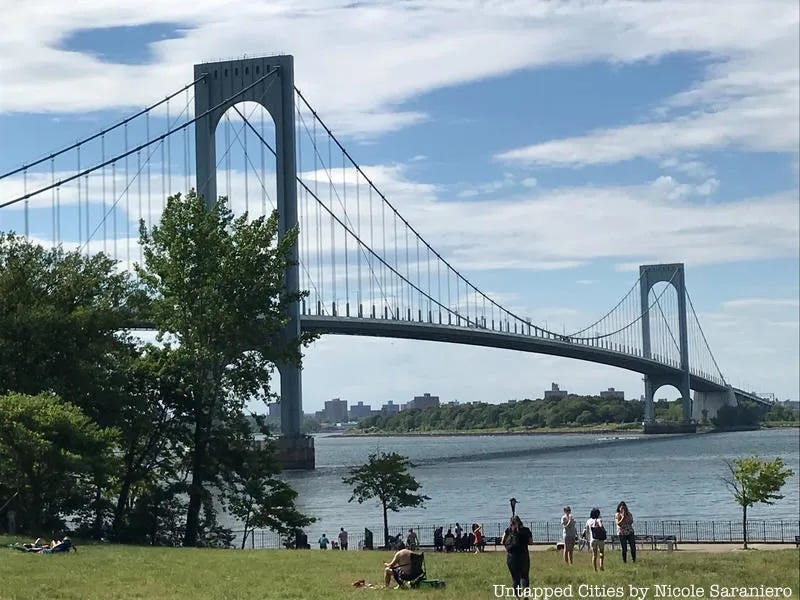
Press enter or click to view image in full sizeThe Bronx — Whitestone Bridge, viewed from Francis Lewis Park in Whitestone
If there ever was a movie that captures northeast Queens, it’s Goodfellas (1990), according to Jason Antos, a lifelong resident of Whitestone. Antos, who in September was appointed as the official Borough Historian of Queens, is also the executive director of the Queens Historical Society, based in Flushing. He wrote a book on his hometown, titled Whitestone, in 2006.
As a child, Antos and his friends were coming home from school. When they arrived at his building, they saw the crime scene where James D. Bishop, who had led New York City’s painters’ union, was shot dead in his car. The murder was most likely on orders from the Lucchese Crime Family. “The entire street was flooded with police,” recalls Antos, “There must’ve been 100 officers.” Antos and his friends tried to get a closer look inside the sedan, but were scolded by a burly cop to scram.
Yet, what Goodfellas did on a subtler level was show how people of different ethnic backgrounds spoke to one another. It was not pretty. “If you remove the criminal element, the killing element, the interpersonal relationship in that film are [sic] something that happened in the borough all the time,” remarked Antos.
Antos brings up the “cosmetic party” scene, when Karen (played by Lorraine Bracco), who is the wife of the main character Henry (played by Ray Liotta), has to sit through a night of the wives of mafia members saying hateful things about Jewish people. Karen herself is Jewish from the Five Towns, and the other wives do not seem to care or realize it.
Jimmy Quinn, now retired, has also lived on the northeastern edge of Queens his whole life. He worked two to three jobs — one being the captain in the fire department — to support his family of six children. As he sat in his district’s City Council office in Whitestone, he recalls growing up on 166th Street in Flushing. Before it became the most expansive Chinatown in New York City, Quinn remembers Downtown Flushing as less bustling. It was mostly department stores and the occasional movie theater. Quinn now resides in Bayside, one of the suburbs of Flushing.
Whitestone is another suburb of Flushing, which is more akin to Long Island neighboring their east than the rest of their fellow Queens neighborhoods to the west. Detached, single-family homes dot the landscape. Cars are the primary form of transportation. As the cost of living remains high in New York City, one would think that there would be an exodus to the surrounding suburbs. Yet Quinn sees it differently.
“The costs are very expensive sometimes. But, you know, my daughter’s moving back to Queens from Long Island. She has four kids. She wants to live a couple blocks from us. Not cheap, but you know, both of them work.”
Antos on the other hand saw many residents venture outside of the metropolitan border after 9/11. “Everybody kind of got scattered to the winds,” says Antos. The majority were of Italian, Irish, Greek and Jewish heritage, and they became new suburbanites on Long Island or Westchester County.
New York City’s demographics are constantly changing. Since the late 1980s and 90s, Quinn witnessed a surge in East Asian immigration to Flushing and its suburbs. In Whitestone alone, the population of people of Chinese descent more than doubled by 124% over a 10 year period.
Press enter or click to view image in full size
When Antos’ mother moved to Whitestone in 1960, the ethnic makeup was Irish, German and Jewish. In the 1970s and 80s, Greeks and Italians moved into the neighborhood. The Greek population rose further in the 90s as well, according to Antos.
During Antos’ formative years, Whitestone was majority Irish. “Everyone was an O’Connor or an O’Brien.” There was also a sizable Italian and Jewish community.
According to Antos, most of the Jewish population resided in the housing co-ops of Beechhurst, a subdivision of Whitestone. If they were employed in city government, they were usually public school teachers. Other ethnicities were also correlated with different jobs in the civil service.
Get Aidan Levin’s stories in your inbox
Join Medium for free to get updates from this writer.
“This is back in the day where if you had a certain type of job it was synonymous with a culture that was attached to it,” Antos noted, “if you were Irish and a civil servant you were most likely a police officer. If you were Italian or German and you were a civil servant you were most likely a firefighter. If you were Jewish and you worked for the city in New York it was like 9 out of 10 times you were a school teacher.”
For Jimmy Quinn, the core of Whitestone remains intact as a “hardworking, middle class neighborhood.” “It’s a big cop and fireman neighborhood,” he added.
If many police officers live in Whitestone, one might assume that the neighborhood would tend to vote conservative, which it does. It is also comparatively older than the rest of the city with a median age of 46. Additionally, 70% of homes in Whitestone are owner-occupied family households, despite being in a city where renting is more popular.
Whitestone seems to have leaned to the right since the 1950s. In Antos’ introduction to his book Whitestone, he writes that William Levitt, the same Levitt that created the segregated Levittown, New York, built an apartment complex that spanned 40 acres. “Very few black families lived in Whitestone,” says Antos over email. “There was no open segregation in regards to housing but there was always the unspoken rule that if the neighborhood was dominantly white then it would be hard to secure housing.”
Whitestone has shifted further right with the rise of Trump. Republican City Councilwoman Vickie Paladino has been representing constituents in District 19 since her election in 2021. She is an outspoken advocate for the policies of the Trump Administration. Paladino serves the communities of Whitestone, College Point, Bayside, Bay Terrace, Douglaston and Little Neck.
Before Paladino, Whitestone was not as conservatively entrenched. “Whitestone is one of those neighborhoods where I think it was always conservative but they don’t vote down the party line,” Antos realized. The neighborhood may be predisposed to vote Republican, but they are not partisan.
The City of Yes zoning reform is not favored by residents involved in city politics in northeast Queens, who want to maintain the secluded feel of the area. “Whitestone all the way up to Queens Village, Bellerose, New Hyde Park, a lot of other communities in the easternmost part of Queens, are the private house area,” says Richard Hellenbrecht, a vice president of the Queens Civic Congress. “We love our backyards. We love sitting outside in the summertime. We love talking over the fence to the next-door neighbors.”
This NIMBY (not in my backyard) attitude is reflected by Council Member Paladino as well, who sided with the Queens Civic Congress to file a lawsuit against the City of Yes. The case was thrown out last month in Staten Island. “We are now appealing that case because of the lack of a uniform environmental impact assessment of all of those programs put together,” Hellenbrecht stated, “Each program was studied but not in light of the consequences of the other programs.”
The other worry related to housing for the Queens Civic Congress is that northeast Queens will turn into Long Island City, which in recent years has seen an explosion of high-rise apartments. These skyscrapers have drastically changed the landscape of Long Island City, making it feel like less of a connected locality. “We’re fighting like hell,” responded Hellenbrecht in regards to keeping northeast Queens unlike its borough’s western border.
“We recognize that there is a definite need for more affordable housing in the city,” Hellenbrecht acknowledged, “but there is also a need for more residential areas, which is what we’re fighting for.” Hellenbrecht argues that more housing would overwhelm northeast Queens’ infrastructure, which is specifically zoned for a sparse, residential atmosphere.
He also believes that the City of Yes will take power away from local community boards, of which he is a part of. “I’m vice chair of community board 13, and one of our strongest powers is to provide input to projects through the ULURP [Uniform Land Use Review Procedure] program,” explains Hellenbrecht.
ULURP is the public accountability process for New York City residents to exercise their say on what gets built in their community. Yet, “the City of Yes literally allows other entities to completely ignore the input that we all give, as well as the City Council Members,” according to Hellenbrecht.
While Whitestone and the rest of northeast Queens continue to have immigrant families settle in the area, places such as Astoria and Long Island City are starting to see more young, college-educated professionals call western Queens home. However, Jason Antos still thinks that the immigrant core of Queens is integral to the borough. “I think that Queens will always be diverse and there will always be the immigrant element here. It has to be.”
In terms of gentrification on a city-wide scale, Antos believes that life-long New Yorkers still have not been able to catch up to how fast the city has changed.
“People who have lived here for 40 plus years, when gentrification started happening a lot of people didn’t understand it, they didn’t know what to make of it, it was very new. Not too many people are used to going into one of the worst neighborhoods in Brooklyn, or the most industrial areas of western Queens, in Long Island City and in Brooklyn and seeing, you know, very, very successful young people in their early 20s.”
Still, Jimmy Quinn, a life-long New Yorker thinks that neighborhoods with no immigrant roots have changed for the better. When asked if he worried about his native borough of Queens becoming gentrified, Quinn had a quick and succinct answer.
“It doesn’t bother me,” he said, “I ran into burning buildings for a living. Do you think I worry about who lives next door to me?”