
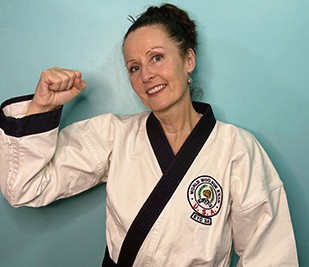

Michelle Redaj immigrated to Queens from the west of Ireland, where her passion for martial arts began. As a teenager, she trained in Mu Gen Do, laying the foundation for her lifelong interest in martial arts. In 2014, she began training in Soo Bahk Do at the 69th Lane Studio, initially to bond with her then, six-year-old daughter. As Michelle’s passion for the art grew, she ascended the ranks to Chodan (black belt) and became an assistant instructor under the guidance of her Sa Bom Nim, Master Trevino. She successfully ran the Little Dragons program, fostering a love for martial arts in younger students including her son who was then four.
However, like many small businesses, 69th Lane Studio faced significant challenges during the COVID-19 pandemic, losing its physical space. Despite attempts to maintain classes through Zoom and outdoor venues, participation dwindled. Undeterred, Michelle continued her training with Sa Bom Nim Trevino, achieving her second-degree black belt. She completed a two-year program to become a certified instructor with the Soo Bahk Do Moo Do Kwan Federation, and began teaching a small program in shared spaces in local dance studios across Queens.
As her daughter, then 13, prepared to apply to high schools in Manhattan, Michelle recognized the importance of teaching her about non-physical self-defense, particularly regarding situational awareness while commuting via subway. To better equip her daughter, Michelle pursued additional training and certification as a self-defense instructor. She believed that this knowledge should be accessible to everyone. Michelle developed workshops focusing on situational awareness, effective communication, and basic self-defense techniques, including striking and escaping from holds.
Starting last January, Michelle offered these workshops in church basements and collaborated with local PTAs, bringing it to local schools, Girl Scout groups, and her local community center Maspeth Town Hall.
Some self-defense workshop participants expressed interest in continuing their self-defense training, prompting Michelle to create a curriculum for self-defense fitness classes, which she now offers weekly at Maspeth Town Hall.
She now also runs, along with her instructor, the Soo Bahk Do program martial arts at the Maspeth Townhall, where students range from age four to over seventy. Her daughter, now a senior, assists in the workshops, while her son, now also a black belt, is a junior instructor in the Martial arts program.
With workshops booked in local high schools, and a weekly self-defense fitness class and a thriving martial arts program, Michelle is excited about the potential growth of her programs and remains committed to making self-defense accessible to all.
 NB: Other than the amazing diversity, what do/did you love most about living in Queens (or Queens in general)? How has Queens changed over the years?
MR: I love the accessibility of living in Queens. It’s wonderful to have all of my necessities near me, and to also be easily immersed in arts, culture, and history. I feel very lucky to be able to raise my own kids in this environment as well— where they are exposed to all of these things. As an immigrant myself, the accessibility and diversity of Queens has made me feel welcomed from the start, and Queens over the years has only continued to grow in population, diversity, and exposure to arts and culture.
NB: How does Queens inspire you? What are some of your favorite places to be inspired in Queens?
MR: Aside from what I mentioned in the previous question, I’ve found myself also being inspired when in public parks, particularly Juniper Valley. During the pandemic, I often trained there with my fellow martial artists because we couldn’t train inside. I felt a greater ability to connect mind, body and nature after that experience.
Additionally, I am inspired by museums like the Hall of Science, and MOMI not only because of its educational nature, but because I often spend time with my kids there, and have many fond memories of those spaces.
NB: What advice do you have for readers who are hoping to develop their martial arts, movement, or healing practices? Is martial arts a practice that anyone can learn? What is something you wish you knew before you became a martial arts instructor?
MR: My advice for readers is to have courage, as that is the first step to starting any martial arts training. Additionally, consistency is key, especially because in self-defense, repetition is important for overriding our natural freeze response and being able to take initiative and flight or fight if necessary. Absolutely anybody can learn martial arts. It is practice for all ages. Martial arts is a mindset and a spiritual journey as much as it is a physical practice.
NB: How important is personal connection and communication (networking?) in your industry?
MR: Personal connection and communication is incredibly important when it comes to martial arts and self-defense. It often requires a lot of social media marketing skills, because it is an oversaturated industry. Unfortunately, the passion for it and love of teaching isn’t always enough to get people in the door, which is why social media is a crucial tool for giving an inside look into the skills and relationships a class like mine would help one develop.
Additionally, aside from the promotional aspect, we focus a lot on building relationships with ourselves and others. In my classes specifically, there is an emphasis on values like respect and kindness that contribute to an overall educational, encouraging, and motivational environment.
NB: What is the best piece of advice you’ve ever received? What is something you wish you knew a decade or two or three or four ago?
MR: As cliche as it may seem, the best piece of advice I’ve received and held onto is that when one door closes another opens. I think it’s important to continue working hard, while keeping a positive mindset. If I had to wish anything, I wish I had discovered my passion for Soo Bahk Do and teaching a few decades earlier
NB: Who are some of your favorite martial arts instructors, yoga teachers, teachers, artists, writers, performers, entrepreneurs, and healers with a Queens connection?
MR: I have many favorites when it comes to martial arts instructors, yoga teachers, performers, and healers with a Queens connection. Firstly, I would be remiss if I didn’t mention my own instructor Sa Bom Nim Trevino, who introduced me to Soo Bahk Do. Through years of his excellent teaching, he has helped foster my love, passion, respect and understanding of the art as I know it today. His wife, Selma Trevino, introduced me to yoga and pilates, which are practices that go hand in hand with my martial arts training. My favorite zumba teacher here is Melodie, and I take her classes at Maspeth Town Hall, which are always incredibly lively and full of positive energy, which are energies I value deeply. My favorite performer(s) are Sarah Keane & the Decade Runners, a band of three seventeen-year-olds who explore music from a variety of decades (as the name suggests), namely rock (which, I love some 80s rock). Finally, for healers I appreciate my acupuncturist Jacqueline from Nature Points acupuncture in Maspeth, as she has helped me recover and relax my body.
NB: What are your favorite martial arts studios, yoga studios, restaurants, coffee shops, theaters, galleries, communities, and venues in Queens?
MR: When it comes to my favorite martial arts studios, yoga studios, restaurants, coffee shops, theaters, galleries, communities, and venues in Queens there’s too many to name all of them. However, I love Maspeth Town Hall Community Center, where I teach martial arts, and women’s self-defense as well as attending zumba. I also like going to Jongro BBQ in flushing, as I am a big fan of Korean barbeque.
NB: What do you wish more people knew about martial arts, discipline, and movement? What do you wish more people knew about being a martial arts instructor?
MR: In a world where gratification is instant, teaching skills like focus, consistency, and discipline becomes increasingly difficult. However, I have had great success so far, and seen the positive impacts on my students. My son (12) for example, trained for seven years consistently to gain his Cho dan(blackbelt) and took the skills it took to do that and has started applying them in other aspects of his life. People often don’t understand how much of martial arts is mindset, and I wish people did. Martial arts helps build communication, ability to adapt, leadership skills, confidence, and as I mentioned discipline, focus, and consistency.
Aside from the mindset portion of it, I also teach movement that combines dynamic technique with powerful stances and artistic form.
NB: What is something you wish I had asked? Please let me know what that question is, and answer it. Thank you.
MR: What makes Soo Bahk Do martial art different? Soo Bahk Do is different because it’s a traditional art that combines striking, kicking, and self-defense with mental and spiritual alignment—developing focus, character, discipline, and respect. It also incorporates aspects of Korean culture and history.
NB: Do you have any events or projects coming up that you’d like to promote? Can you tell us more about them?
MR: Maspeth Town Hall: Martial Arts, Monday and Thursday 4–6-year-olds 4:45pm-5:25pm; 7-12-year-olds 5:30pm-6:25pm; 13+ and Adults 7:00pm-8:00pm. Women’s Self Defense fitness classes: Tuesday 6:40pm-7:40pm; $10 a class (with a membership, which is $25 for a year). Winter Workshop does not have official date yet.
NB: If you could choose only one martial arts move or healing modality to represent Queens, what would it be and why?
MR: Anything with a “Kihap” because it’s concentrated energy, much like the energy of Queens.
NB: What is a typical day like for you?
MR: During the day, I work with special needs children which is difficult but fulfilling work. Then I teach martial arts to children on Monday and Thursday. On Tuesdays, I teach women’s self-defense fitness class. I created my own curriculum, using my experience, self-defense certification, and martial arts training. The fitness class combines basic self-defense moves with stretching and cardio. On off days, I lesson-plan and continue to train. On weekends I also do self-defense workshops in high schools, local churches, for girl scout troops, and community centers. The workshops focus on the non-physical side of self-defense. You will become more situationally aware, learn to use to voice to deescalate, discern intent and set boundaries.
NB: Can you tell us more about how you remain “committed to making self-defense accessible to all”?
MR: I remain committed to making self-defense accessible to all by making it affordable, and adaptable. Both things that are important given our economy and diversity. By teaching in community centers, I am able to keep costs low, while retaining quality instruction. Additionally, all of my physical instruction can be adapted to accommodate one’s abilities.
NB: What’s a wild story (PG-13) you have about NYC before the times of cell phones or social media? If you weren’t in NYC then, what’s a story you have of NYC past (or the past)?
MR: Back in the early 2000’s, I was bartending in Queens, often taking closing shifts. This was long before Uber, so I called a taxi service. I had just gotten a “smart phone” and was enamored with the new technology. I wasn’t paying attention and when I looked up, the driver had taken me off my usual route to a secluded part of Queens. I freaked out, and I started to yell and threaten the driver, telling him that I had a taser, and various other weapons (none of which I actually possessed). Through my own voice I heard the driver tell me there was a detour on Metropolitan Avenue. Safe to say, I tipped a lot, and that taxi company didn’t pick me up again— but I learned that I had fight in me, and that I wouldn’t freeze. Which, once I got past the embarrassment, was actually reassuring.
NB: Can you tell us more about why your workshops focus “on situational awareness, effective communication and basic self-defense techniques, including striking and escaping from holds”?
MR: I focus on situational awareness, because to be “situationally aware” means being aware of your environment, and being able to detect and avoid potential threats—as the non-physical side of self-defense is the most important. As for effective communication, my workshops help you discern intent, find your voice, and be assertive. You don’t want it to escalate physically, and my workshops focus on prevention as much as they focus on action. Action is where striking and escaping from holds comes in—if a situation escalates the priority is for you to be able to get away as quickly as possible with as little damage as possible. Knowing how to properly strike (and having that muscle memory) and the technique of escaping holds is crucial.
NB: What are the best ways to stay safe when commuting and traveling on subways?
MR: Navigating the subways safely is something I go into more detail during my workshops, however the basic gist is that you have situational awareness, don’t make yourself a target (which I touch on how not to be a target in this situation and in general in my workshop), and use technology to your benefit—not to distract you. With Queens being accessible to everywhere, and children having the independence to commute via subway, these are lessons that are invaluable for safety at a young age.
—Nicollette Barsamian
The Local-Express interview series was originated on July 3, 2013 by Nicollette Barsamian.